
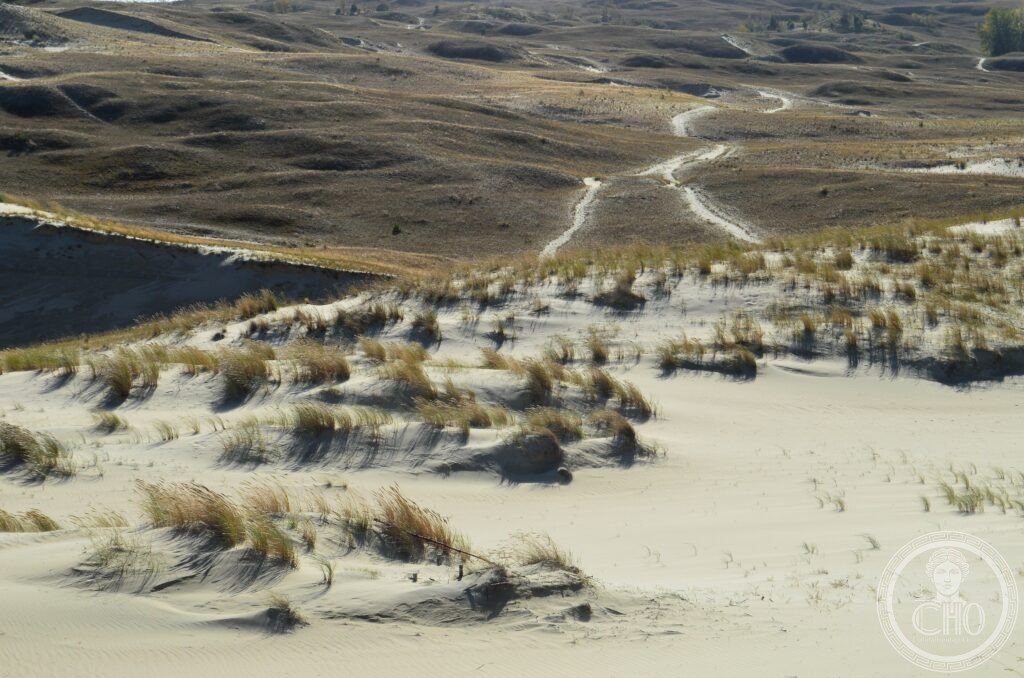
A 98-kilometre ribbon of sand separates the Baltic Sea from a vast lagoon, its dunes still shifting after centuries of deforestation once buried whole fishing villages. Shared between Lithuania and Russia’s Kaliningrad Oblast, the spit combines a rare natural landscape with a history of near-total ecological collapse and recovery.
At a glance
The Curonian Spit is a narrow sand spit running some 98 kilometres along the Baltic coast, varying from a few hundred metres to a few kilometres in width. It separates the open Baltic Sea to the west from the shallow, brackish Curonian Lagoon to the east, a habitat important for fish such as eel and perch and for waterfowl. Its highest point, the Parnidis Dune, rises 52 metres above sea level on the Lithuanian section and carries a sundial monument at its summit.
The dunes here are still active, migrating eastward under the push of prevailing westerly winds. In the eighteenth and nineteenth centuries this movement buried entire settlements, including the original village of Nidden, now Nida, which had to be relocated more than once to escape the advancing sand.
Key facts
- Length and width: around 98 kilometres long, ranging from roughly 400 metres to 4 kilometres wide.
- Territory: divided between Neringa, Lithuania, and Russia’s Kaliningrad Oblast.
- Highest point: the Parnidis Dune, 52 metres above sea level, on the Lithuanian section.
- Status: inscribed as a UNESCO World Heritage Site in 2000, shared jointly by Lithuania and Russia.
- Forest cover: around 70 percent of the spit is now pine forest, almost entirely the result of nineteenth-century planting rather than natural woodland.
History
The spit was originally home to the Curonians and Prussians, Baltic peoples distinct from the Latvians and Lithuanians who later assimilated under the Teutonic Knights, who took control from the fourteenth century. Under subsequent Prussian and German administration, from the port of Memel, now Klaipėda, the fishing villages were ethnically mixed, home to German settlers and Lithuanian-speaking Lietuvninks. The Baltic coast has long been the world’s largest source of amber, and the spit was a significant gathering area for the fossilised resin, traded southward to the Mediterranean since antiquity.
Intensive logging for timber, especially from the seventeenth century, stripped the spit of the forest that had stabilised its dunes for millennia. By the late eighteenth century the great majority of the spit had become barren, migrating sand, swallowing villages and threatening to choke the lagoon. The Prussian government responded in the nineteenth century with a major reforestation programme, associated with the forester Georg David Kuwert, introducing mountain pine and maritime pine to anchor the dunes. The forest visitors see today is almost entirely the product of that restoration.
In the twentieth century the writer Thomas Mann, the German Nobel laureate, built a summer house at Nida in 1930 and returned there in 1931 and 1932, writing part of The Magic Mountain during his stays. The house is now the Thomas Mann Museum.
What you see
Nida, at the southern end of the Lithuanian section, is the main visitor base, a former fishing village turned resort town. Its wooden houses carry traditional carved weathervanes in the shape of fish and boats, each pattern originally identifying a particular fishing family, a folk art still practised by local craftspeople. The town has galleries, an amber market and the Thomas Mann Museum, and a walking route leads from the centre up to the Parnidis Dune, where the view takes in the lagoon to the east and forest and beach to the west.
On the dune’s lagoon-facing slope the sand cliff is visibly active, its steep face advancing into the water as the dune migrates. On the Russian side of the spit, the Rybachy Bird Ringing Station is one of Europe’s most important ornithological research stations, sitting at a bottleneck of the East Atlantic Flyway through which large numbers of migrating songbirds pass each spring and autumn.
Practical information
- Access: the Lithuanian and Russian sections of the spit are administered separately; crossing between them requires the appropriate visa or permit for Kaliningrad.
- National park permit: private vehicles entering the Lithuanian section of the spit require a national park entry permit, payable through the park’s official channels.
- Getting around: a dedicated cycling path runs the length of the Lithuanian section between the ferry landing at Smiltynė and Nida, and cycling is generally considered the best way to experience the spit; bicycles can be hired locally.
- Season: Nida is busiest during the summer months; for opening arrangements at the museum, park and ferry, check the relevant official websites before travelling.
Getting there
Klaipėda is the usual gateway to the Lithuanian section of the spit, served by Palanga International Airport nearby and, for those arriving by sea, by ferry from Kiel in Germany. From Klaipėda, a short ferry crossing from the Old Ferry Dock at Smiltynė reaches the northern tip of the spit, from where the road and cycle path run south towards Nida.
Nearby
- Klaipėda Old Town — a few kilometres from the Smiltynė ferry landing, the former Memel’s red-brick and half-timbered old town, with a sculpture courtyard of contemporary Lithuanian work and the ruins of a thirteenth-century Teutonic Knights castle, now an archaeological museum.
- Kaliningrad, Russia — the former Königsberg lies east of the spit and requires a visa or pre-arranged permit; it was the birthplace of Immanuel Kant, whose tomb stands against the restored Gothic Königsberg Cathedral, and is home to the Museum of the World Ocean and a moored former submarine open to visitors.
Sources
- Wikipedia, Curonian Spit
- Wikipedia, Nida, Lithuania
- Wikipedia, Thomas Mann
- UNESCO, Curonian Spit
Find it on the map
See this place and what’s around it →📷 Become a Cultural Heritage Online photographer
Share your photos of places: they stay published under your name as the author. The more they're seen, the more you get noticed — and soon a contest will reward the most appreciated photos.
Log in or sign up free to add a photo