
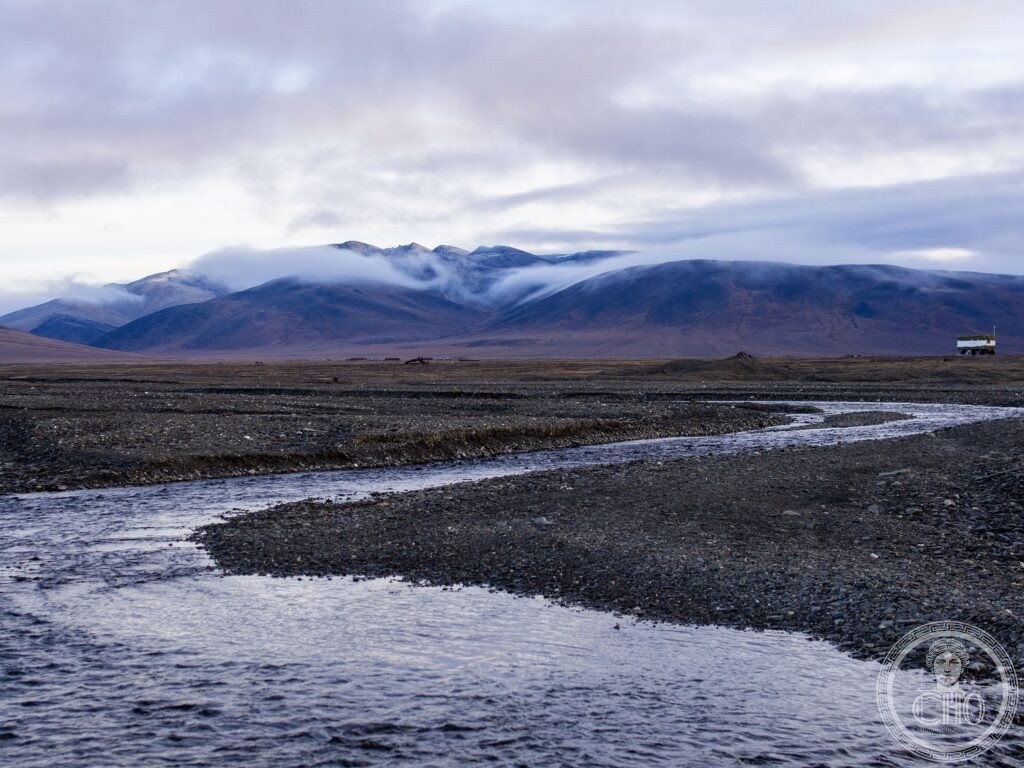
An island in the Chukchi Sea where woolly mammoths outlived the rest of their species by roughly six thousand years, and where polar bears now dig more maternity dens than anywhere else on Earth. Wrangel Island combines an extraordinary fossil record with a living Arctic ecosystem still largely undisturbed.
At a glance
Wrangel Island Reserve covers the island itself, about 7,600 square kilometres of Arctic tundra and a central mountain range rising to 1,096 metres, together with roughly 4,700 square kilometres of surrounding sea. It sits in the Chukchi Sea, straddling the 180° meridian in Chukotka, in Russia’s Far East.
The island is best known for two things: it was the last place on Earth where woolly mammoths survived, isolated long after the species had died out everywhere else, and it now holds the highest concentration of polar bear maternity dens found anywhere in the Arctic.
Key facts
- Location: Chukchi Sea, Chukotka, Arctic Russia, at approximately 71.2° N, 179.9° E
- Protected area: around 7,600 km² of land plus 4,700 km² of sea
- Highest point: a peak of 1,096 metres in the island’s central mountain range
- UNESCO status: inscribed as a World Heritage Site in 2004, listed as the Natural System of Wrangel Island Reserve
- Wildlife significance: the world’s largest known concentration of polar bear maternity dens and one of the largest Pacific walrus haulouts
History
The island takes its name from Ferdinand von Wrangel, a Russian naval officer who searched for it in 1823 without success. American whaler Thomas Long sighted and named it in 1867, and the USS Rodgers confirmed its geography in 1881.
Between 1921 and 1923 the Canadian-American explorer Vilhjalmur Stefansson attempted to claim the island for Canada and then Britain, landing a small colonising party of four Canadians and one American. Three of the Canadians died of scurvy and starvation and the sole survivor was rescued by a supply ship. A second attempt was forcibly removed by a Soviet gunship in 1924. The Soviet Union established a permanent presence on the island in 1926, with a border post and ongoing Chukchi and Russian administration, and the island later served as a staging post for Soviet polar aviation.
Long before any of this, the island held the most recent known population of woolly mammoths anywhere in the world. Mammoths died out on the Eurasian and North American mainland around eight to ten thousand years ago, but an isolated population survived on Wrangel until roughly 2000 BCE, meaning they were still alive while the Great Pyramid of Giza was being built. Cut off from the mainland gene pool, these mammoths were smaller than their mainland relatives through insular dwarfism, though still larger than an Asian elephant, and numbered perhaps five hundred to a thousand individuals by the time they disappeared. Genomic analysis of their remains points to inbreeding depression, alongside a warming climate that shrank their tundra-steppe habitat and, possibly, the arrival of the first human settlers on the island, as the likely causes of their final extinction.
What you see
Wrangel Island supports an unusually dense concentration of Arctic wildlife. Polar bears are drawn ashore earlier than elsewhere because sea ice forms late and breaks up early around the island, and its snow-covered hillsides provide good denning terrain; in some seasons density reaches roughly one bear per six square kilometres. Females dig snow dens in autumn, give birth in mid-winter and emerge with cubs in spring, foraging mainly on ringed seals and walrus. The island is also a calving area for the Western Arctic population of bowhead whales.
Along the coast, Pacific walrus gather in some of the largest haulouts anywhere, with tens of thousands of animals hauling out at Cape Pierce and Cape Blossom. Musk ox, absent from the island for around three thousand years, were reintroduced in 1975 and now number several hundred, one of the more successful large-mammal reintroductions in the Arctic. Snowy owls and ivory gulls nest here, Arctic foxes hunt across the tundra, and the boom-and-bust cycles of lemmings drive the fortunes of the island’s predators in turn. The flora is notably rich for a High Arctic island.
There is no permanent tourist infrastructure on Wrangel. Visitors arrive by expedition cruise ship and go ashore by Zodiac, landing under permits issued by the state nature reserve and arranged through the cruise operator. The short season runs from August into September, once the ice has retreated from the southern coast.
Practical information
- Access: by expedition cruise ship only, with permits for landings arranged by the operator through the state nature reserve
- Season: August to September, when the ice has retreated; conditions become unpredictable later in the autumn
- Documentation: a Russian visa is required for departures from Anadyr
- Booking: check current itineraries, permit requirements and fares directly with expedition operators such as those running the Spirit of Enderby, Silver Cloud Expedition or Quark Expeditions vessels
Getting there
Wrangel Island can only be reached by expedition cruise. The two logistics hubs are Nome, in Alaska, and Anadyr, the administrative centre of Chukotka, both linked onward to Anchorage or Moscow respectively by scheduled air services. Cruises dedicated to Wrangel typically run somewhat longer from Anadyr than from Nome, given the greater distance travelled.
Nearby
- Cape Dezhnev — the easternmost point of the Eurasian continent, marked by a clifftop memorial to the Cossack explorer Semyon Dezhnev, who first rounded it in 1648; from here the Diomede Islands are visible across the Bering Strait, with the Alaskan mainland sometimes visible on clear days
- Chukotka Peninsula — homeland of the Chukchi people, the region’s largest indigenous group, traditionally reindeer herders and whale hunters, speaking a Paleosiberian language related to Koryak; Provideniya Bay serves as a refuelling stop for Bering Strait crossings
Sources
- Wikipedia
- UNESCO
Find it on the map
See this place and what’s around it →📷 Become a Cultural Heritage Online photographer
Share your photos of places: they stay published under your name as the author. The more they're seen, the more you get noticed — and soon a contest will reward the most appreciated photos.
Log in or sign up free to add a photo