
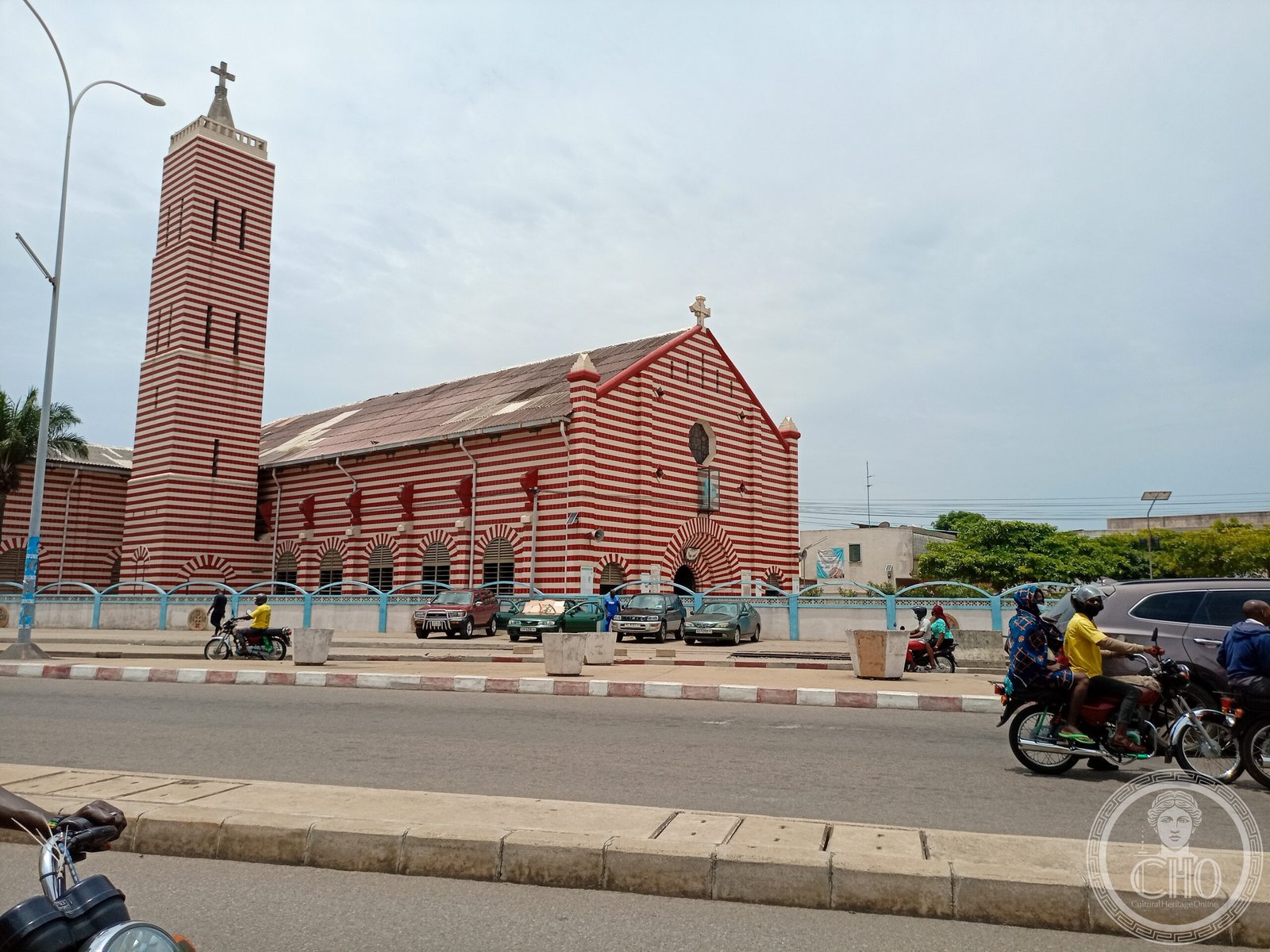
In the heart of Cotonou, the largest city of Benin and its economic capital, the cathedral of Notre-Dame-de-Miséricorde is the seat of the metropolitan archdiocese of Cotonou. It is not the seat of the political capital, Porto-Novo, which has a suffragan diocese of its own. Work began, according to Wikipedia and to the history of the archdiocese, in 1912, though a specialist source gives 1901 instead, perhaps referring to an earlier mission chapel on the same site. The building was paid for in part by a personal gift of two hundred and fifty thousand francs of the day from Father Firmin Colineaux, active in Cotonou from 1909, and was solemnly blessed on 8 December 1938 by Bishop Louis Parisot. That date comes from a single family of sources and has not been cross-checked against a second, independent one. No architect’s name is documented. The Catholic jurisdiction in Benin was erected as the apostolic prefecture of Dahomey on 26 June 1883, raised to an apostolic vicariate in 1901, renamed the apostolic vicariate of Ouidah in 1948, and finally raised to the metropolitan archdiocese of Cotonou on 14 September 1955. The present archbishop is Roger Houngbédji, a Dominican, in office since 25 June 2016. The first Catholic missionaries landed at Ouidah, a place distinct from Cotonou and about forty-two kilometres away, on 18 April 1861. The link between this cathedral and the history of the transatlantic slave trade therefore runs through Ouidah, not through the building at Cotonou. Benin is the homeland of Vodun, and the government officially recognised it as a religion in the middle of the nineties, with 10 January declared a national holiday — the sources differ between 1996 and 1997 on the exact year — ending the ban imposed during the Marxist period of Mathieu Kérékou. On 4 February 1993, during a journey to Benin, Uganda and Khartoum, Pope John Paul II addressed priests, religious, seminarians and lay people in this cathedral, and the same day, according to the official itinerary published by the Vatican, he also met a group of Vodun followers in Cotonou. On 18 November 2011 Pope Benedict XVI was welcomed in this cathedral and prayed before the tombs of his predecessors as archbishop, Christophe Adimou and Isidore de Sousa, before going the next day to Ouidah to sign the post-synodal apostolic exhortation Africae munus. Pope Francis has never visited Benin.
About the Cathedral
The Cathédrale Notre-Dame-de-Miséricorde in Cotonou, Benin’s economic capital and largest city, is the seat of the Metropolitan Archdiocese of Cotonou. Construction began around 1912, and the building was solemnly blessed on 8 December 1938 by Bishop Louis Parisot.
Key facts
- 26 June 1883: Catholic jurisdiction in Benin erected as the Apostolic Prefecture of Dahomey.
- 1912–1938: Cotonou Cathedral built and solemnly blessed, financed partly by Fr. Firmin Colineaux’s personal donation.
- 14 September 1955: elevated to the Metropolitan Archdiocese of Cotonou.
- 4 February 1993: Pope John Paul II addresses the faithful at this cathedral and meets Vodun followers in Cotonou the same day.
- 18 November 2011: Pope Benedict XVI prays at the tombs of his predecessor archbishops here, the day before signing Africae Munus in nearby Ouidah.
- Roughly 1.07 million Catholics in the archdiocese’s own territory, 42.3% of its population, as of 2022.
History
Built through the early 20th century and solemnly blessed in 1938, Cotonou Cathedral has twice hosted popes visiting a country famous as the birthplace of Vodun. In 1993, on the same day John Paul II addressed clergy and laity here, he also met formally with Vodun practitioners elsewhere in the city — a juxtaposition the Vatican’s own published itinerary records without comment. Benedict XVI’s 2011 visit paired a prayer at this cathedral’s archbishops’ tombs with the signing, the next day at Ouidah’s basilica, of his major exhortation on the future of the Catholic Church in Africa.
What you see
A striking facade of alternating burgundy-and-white ceramic tile bands covers a basilical, triple-nave building with a central portal, an oculus, twin rectangular pinnacles, and a bell tower on the north side — a design that departs from the Latin-cross plan common to most cathedrals.
Practical information
- Opening hours: generally open daily outside services; check current hours before visiting.
- Address: near the Ancien Pont, central Cotonou, Littoral Department, Benin.
Getting there
The cathedral stands in central Cotonou, near the city’s Ancien Pont (old bridge). GPS: 6°21′26″N, 2°26′24″E.
Nearby
- Ouidah — the coastal town about 42 km away, site of the transatlantic slave trade’s “Door of No Return” and Benin’s first Catholic mission landing in 1861.
Sources
- Wikipedia (English and French) — “Cotonou Cathedral,” “Roman Catholic Archdiocese of Cotonou,” “Religion in Benin”
- GCatholic.org and Catholic-Hierarchy.org — Archdiocese of Cotonou records.
- Vatican.va — official itineraries of Pope John Paul II’s 1993 and Pope Benedict XVI’s 2011 visits to Benin.
- SMA Ireland (Society of African Missions) — history of Catholic mission arrival at Ouidah, 1861.
Find it on the map
See this place and what’s around it →📷 Become a Cultural Heritage Online photographer
Share your photos of places: they stay published under your name as the author. The more they're seen, the more you get noticed — and soon a contest will reward the most appreciated photos.
Log in or sign up free to add a photo