

In 1198 Rory O’Connor — the last High King of Ireland — gave up the throne and retired to Cong Abbey, where he spent the last fifteen years of his life. It was his father, Turlough Mor O’Connor, who refounded the abbey as an Augustinian house in 1138, and who commissioned the Cross of Cong, a reliquary made to hold a fragment of the True Cross — today considered one of the absolute masterpieces of medieval Irish goldsmithing, kept at the National Museum of Ireland.
About Cong Abbey
The history of Cong Abbey traces back to the 6th century, when a church was first established on the site by Saint Feichin, a missionary credited with founding several monasteries across Ireland. This early foundation was destroyed by fire in 1114, but was soon rebuilt by Turlough Mor O’Connor, High King of Ireland, who formally reformed the abbey as an Augustinian settlement in 1138 — one of the earliest Augustinian foundations anywhere in Ireland, following closely behind the example set at Armagh in 1126. Turlough also commissioned one of medieval Ireland’s most celebrated works of ecclesiastical metalwork: the Cross of Cong, a processional cross created in the early 12th century to house a relic believed to be a fragment of the True Cross, its surface inscribed with Turlough’s own name and richly decorated in a manner reflecting the close intertwining of religious devotion and royal authority in medieval Irish kingship. The abbey’s most poignant later association came in 1198, when Ruaidrí Ua Conchobair — Rory O’Connor, the last High King of Ireland — abdicated his throne and retired to Cong Abbey, spending the final fifteen years of his life there in religious retirement before his death; he was initially buried at the abbey itself, though his remains were later exhumed and re-interred at Clonmacnoise, another of Ireland’s most significant early monastic sites. Today, the Cross of Cong is preserved and displayed at the National Museum of Ireland, its physical origins forever tied to the abbey that once safeguarded it, even as the object itself has long since left Cong for a national collection.
Key facts
- 6th century: first church founded on the site by Saint Feichin
- 1114: the earlier church destroyed by fire
- 1138: Turlough Mor O’Connor reforms the abbey as an Augustinian house
- Early 12th century: the Cross of Cong created, commissioned by Turlough O’Connor
- 1198: Rory O’Connor, last High King of Ireland, retires to the abbey
- Rory’s final years: fifteen years spent in religious retirement at Cong
- Today: the Cross of Cong preserved at the National Museum of Ireland
History
Rory O’Connor’s retirement to Cong Abbey following his 1198 abdication marks a symbolically significant moment in Irish history, as the last man to hold the title of High King of Ireland chose to end his days not in political exile or continued struggle, but in the quiet religious retirement of the very abbey his own father had refounded decades earlier — a fitting closure to the era of the Gaelic High Kingship as Anglo-Norman power increasingly reshaped Ireland’s political landscape. The Cross of Cong, commissioned by Rory’s father Turlough to house a fragment of the True Cross, stands among the finest surviving examples of Irish medieval metalwork, its craftsmanship and royal inscription embodying the close fusion of religious relic veneration and dynastic political legitimacy characteristic of 12th-century Irish kingship.
The eventual transfer of Rory’s remains from Cong to Clonmacnoise reflects the particular prestige Clonmacnoise held as a preferred royal burial site among medieval Irish kings, even as Cong itself retained the deeper personal association with the final years of Ireland’s last High King.
What you see
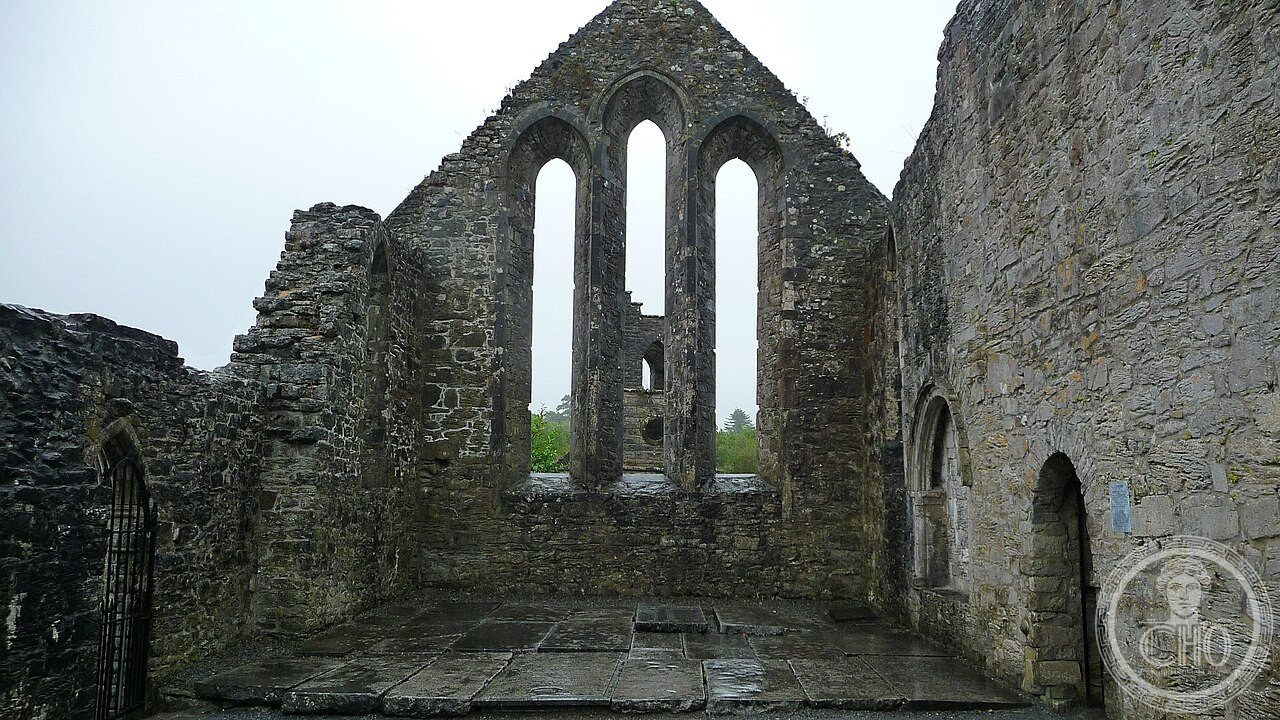
The surviving ruins of Cong Abbey, dating largely from the 13th century, preserve fine examples of medieval ecclesiastical architecture, including cloister arcades, carved arches, and Celtic cross fragments scattered across the site. The nearby Monk’s Fishing House, built out over the River Cong, remains a distinctive and unusual surviving feature of the abbey’s medieval monastic economy, allowing monks to fish directly from within the structure itself.
Practical information
- Opening hours: generally accessible daily; check current hours before visiting; free admission
- Address: Cloister, Cong, County Mayo, Ireland
Getting there
Cong Abbey is located in the village of Cong, in County Mayo, on the border with County Galway, reachable by road. GPS: 53.5402° N, -9.2870° E.
Nearby
- Monk’s Fishing House — the distinctive medieval fishing house on the River Cong
- Ashford Castle — a historic castle estate adjoining Cong
- Cong village — the surrounding historic village
Sources
- Wikipedia — “Cong Abbey” (en.wikipedia.org)
- National Museum of Ireland — “Cong and the Cross” (museum.ie)
- Heritage Ireland — “Cong Augustinian Abbey and Monks Fishing House” (heritageireland.ie)
Find it on the map
See this place and what’s around it →📷 Become a Cultural Heritage Online photographer
Share your photos of places: they stay published under your name as the author. The more they're seen, the more you get noticed — and soon a contest will reward the most appreciated photos.
Log in or sign up free to add a photo