

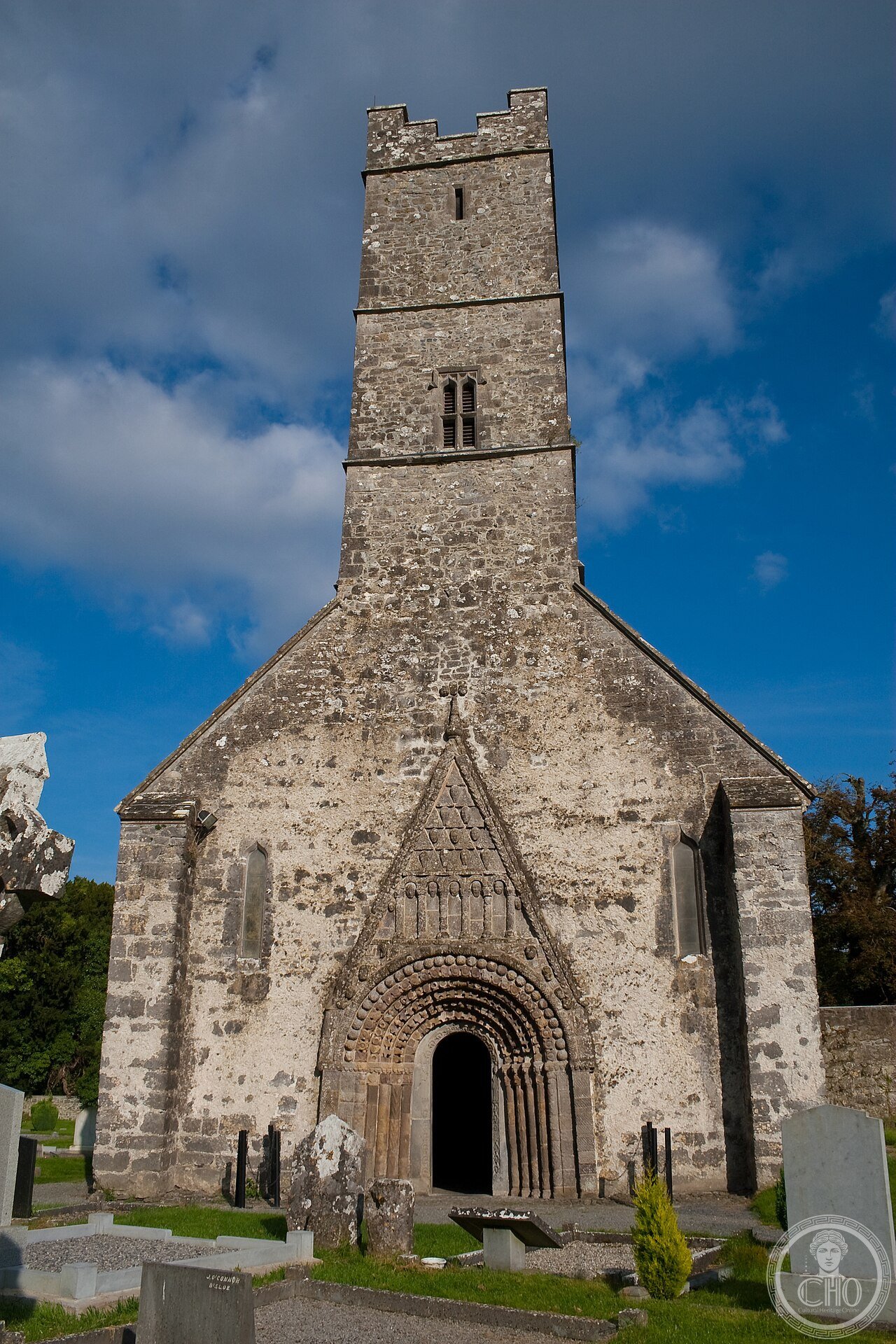
Saint Brendan, the seafaring monk whose legendary Atlantic crossings would inspire centuries of tales about lands beyond the ocean, founded a church at Clonfert in 563. At its height the monastery housed up to 3,000 monks. When Brendan died, around 584, he was buried here: his grave, a plain stone slab, still lies just outside the great west doorway — considered the high point of Romanesque art in Ireland, with decorative influences reaching it from Scandinavia and France.
About Clonfert Cathedral
Saint Brendan, known to posterity as Brendan the Navigator for the legendary Atlantic voyages attributed to him in later medieval literature, founded a church at Clonfert in 563, establishing a monastery that grew to house some 3,000 monks at its height, making it one of the most significant monastic communities in early medieval Ireland. Upon Brendan’s death around 584, he was buried at Clonfert; his grave, marked by a simple stone slab, still lies today just outside the cathedral’s great west door. The monastery endured repeated destruction over the following centuries, suffering Viking raids and being burned down in 1016, 1164, and 1179, before the present building was erected in the 12th century in the distinctive Hiberno-Romanesque style. The cathedral’s most celebrated feature is its finely carved Romanesque west doorway, dating from around 1200 and widely regarded as the crowning achievement of Romanesque architectural art in Ireland and “the architectural gem of the West.” Measuring some four metres in width and rising almost eight metres to its apex, the doorway comprises six orders of richly decorated brown sandstone, later supplemented by an inner order of 15th-century blue limestone, its remarkable sculptural programme drawing on decorative motifs traced to influences from as far afield as Scandinavia and France — including animal heads, human heads, interlace patterns, zigzags, floral and foliage designs, beaded circles, chevrons, and carved bosses.
Key facts
- 563: church founded by Saint Brendan the Navigator
- Peak population: up to 3,000 monks at the monastery’s height
- c. 584: Saint Brendan dies and is buried at Clonfert
- 1016, 1164, 1179: the monastery repeatedly burned in Viking-era raids
- 12th century: present cathedral built in Hiberno-Romanesque style
- c. 1200: the celebrated west doorway carved
- Doorway scale: four metres wide, nearly eight metres to its apex, six decorated orders
History
Saint Brendan’s later medieval reputation as a legendary Atlantic voyager, celebrated in the widely circulated “Voyage of Saint Brendan,” gives Clonfert an unusual cultural resonance extending well beyond Ireland’s borders, its founder’s name later associated by some with speculative claims of pre-Columbian transatlantic contact — claims that, whatever their historical merit, testify to the enduring imaginative power of Brendan’s story across medieval and later European culture. The cathedral’s Romanesque doorway, incorporating decorative motifs traced to Scandinavian and French sources, situates 12th-century Clonfert within the wider artistic exchange networks connecting Ireland to continental and Norse decorative traditions during the period.
The monastery’s repeated destruction by Viking raids across the 11th and 12th centuries, followed by its rebuilding into one of Ireland’s finest surviving examples of Hiberno-Romanesque architecture, illustrates the broader pattern of resilience shown by major Irish monastic sites throughout the Viking Age, their religious and cultural significance repeatedly reasserted through reconstruction after each cycle of destruction.
What you see
The cathedral’s west doorway remains its outstanding architectural feature, its six orders of carved brown sandstone and later blue limestone inner order presenting an exceptionally dense and varied sculptural programme of animal and human heads, interlace, chevrons, and foliage patterns. Saint Brendan’s grave slab lies just outside this same doorway, directly connecting the building’s most celebrated artistic achievement to the site’s founding saint.
Practical information
- Opening hours: generally accessible daily; check current hours before visiting; free admission
- Address: Nun’s Walk, Clonfert, County Galway, Ireland
Getting there
Clonfert Cathedral is located in the townland of Clonfert, near Ballinasloe, County Galway, reachable by road. GPS: 53.2407° N, -8.0585° E.
Nearby
- Ballinasloe — the nearest town
- River Shannon — the river valley near Clonfert’s historic monastic site
- Clonmacnoise — another major early Irish monastic site, within the same region
Sources
- Wikipedia — “Clonfert Cathedral” (en.wikipedia.org)
- Galway Tourism — “Clonfert Cathedral guide with history, photos & directions” (galwaytourism.ie)
- Megalithic Ireland — “Clonfert Cathedral, Galway” (megalithicireland.com)
Find it on the map
See this place and what’s around it →📷 Become a Cultural Heritage Online photographer
Share your photos of places: they stay published under your name as the author. The more they're seen, the more you get noticed — and soon a contest will reward the most appreciated photos.
Log in or sign up free to add a photo