
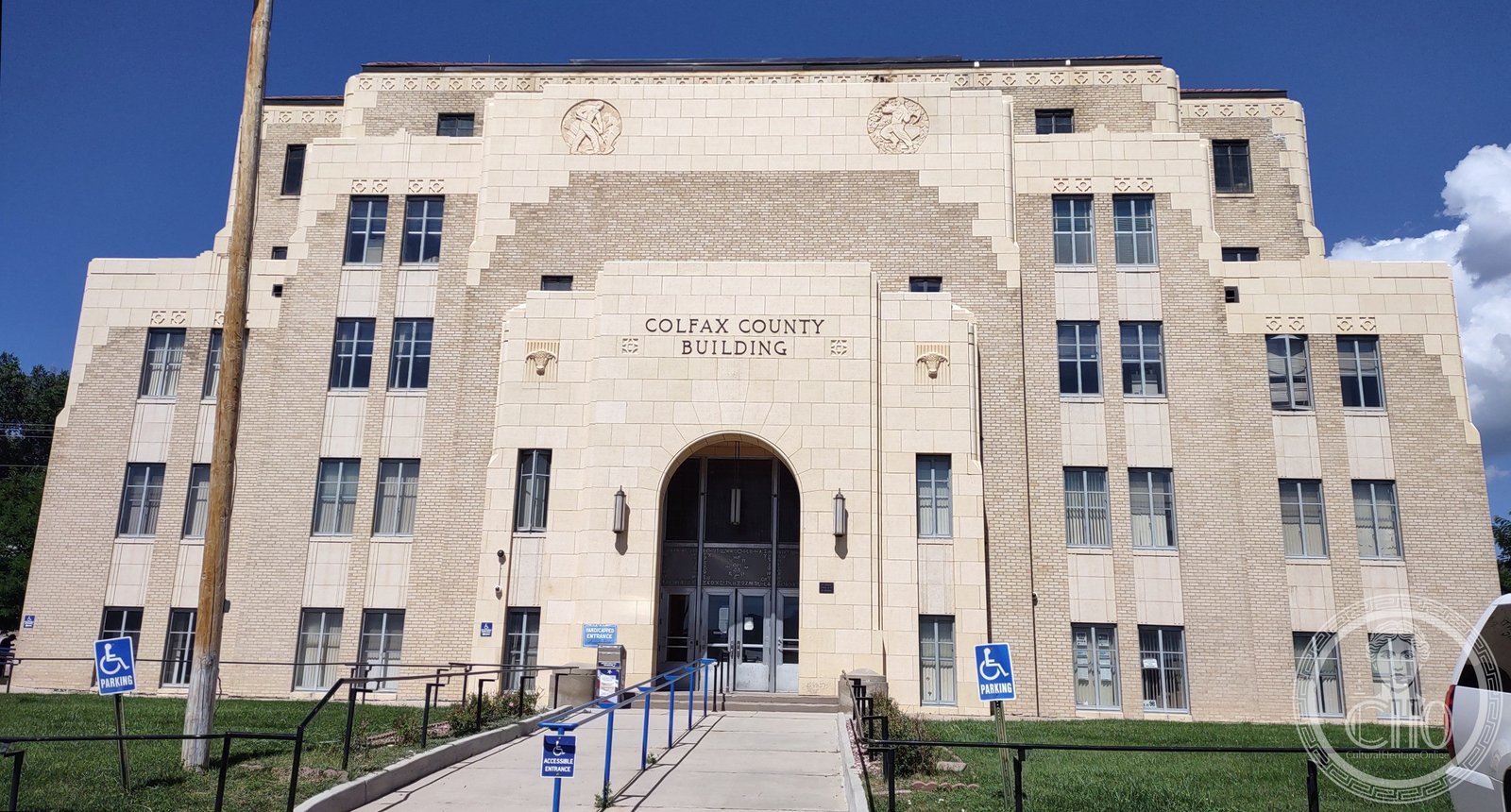
A five-story Art Deco courthouse built in 1936 with bas relief panels depicting the ranching, mining, and farming life of northeastern New Mexico—its cattle brands cast in metal alongside glazed terracotta cornices.
At a glance
Completed in 1936 by the Albuquerque firm Townes & Funk with R. W. Vorhees, the Colfax County Courthouse stands five stories in warm blond brick at 230 North 3rd Street in Raton, the county seat near the Colorado border. Its Art Deco facade introduces glazed tile cornices and bas relief metal panels depicting the industries that defined Colfax County—farming, mining, and cattle ranching—alongside actual cattle brands from local ranches cast into the metalwork. Terrazzo flooring and tile wainscoting finish the interior. The building is listed on both the National Register of Historic Places and the New Mexico State Register of Cultural Properties, and a new judicial facility that opened in 2010 now handles court proceedings, leaving the 1936 structure as a preserved historic landmark.
Key facts
- Architects: Townes & Funk; R. W. Vorhees
- Style: Art Deco
- Completed: 1936
- Height: Five stories, blond brick
- Exterior details: Glazed tile cornices; bas relief metal panels with ranching/mining/farming scenes; local cattle brands cast in metal
- Interior: Terrazzo flooring; tile wainscoting
- NRHP listed: June 18, 1987; also New Mexico State Register of Cultural Properties
History
Raton, situated where the Mountain Branch of the Santa Fe Trail crossed Raton Pass into New Mexico, grew as a railroad and ranching town in the late nineteenth century. By the mid-1930s, Colfax County had the prosperity to invest in a new courthouse that would reflect both New Deal-era ambitions and the specific character of the region. The Depression years were paradoxically productive for public architecture in the American West: federal relief programs funded construction projects that gave county seats their most distinguished buildings.
Townes & Funk, the Albuquerque firm responsible for the design, chose an Art Deco vocabulary that was prevalent in New Mexico courthouses of the period—modern in feeling but amenable to decoration that referenced regional character rather than national symbols. The decision to cast actual cattle brands from local ranches into the bas relief metalwork was distinctive: it rooted the building’s iconographic program in the specific social fabric of Colfax County rather than generic courthouse symbolism. Ranching families whose brands appeared on the courthouse facade had a personal stake in the building that municipal architecture rarely achieves.
The building served as the county’s judicial center until 2010, when a new legislative facility opened to handle District and Magistrate Courts. The 1936 structure was listed on the National Register of Historic Places in 1987, securing its future as a landmark even as active court use ended. It remains one of the most distinctive examples of New Deal-era Art Deco civic architecture in the Southwest.
What you see
The blond brick facade reads as warm and substantial against the high-desert light of Raton, a material choice that connects the building to the ranching landscape of northeastern New Mexico rather than to the limestone civic tradition of the East. The glazed tile cornices introduce a polychrome element typical of Southwest Art Deco, where color in architectural ceramics carried regional meaning. The bas relief metal panels are the building’s most unusual feature: their program of farming, mining, and ranching scenes is common to New Deal-era courthouse decoration, but the inclusion of actual cattle brands from Colfax County ranches transforms an iconographic convention into something more intimate—a record of the specific families and operations that shaped this county rather than an allegory of American agriculture.
Inside, the terrazzo flooring and tile wainscoting give the public spaces a crisp, geometric finish that has held up well over ninety years. The building’s five-story height, modest by urban standards, commands the Raton streetscape by virtue of being the most architecturally confident building in a small town whose scale it was designed to anchor.
Practical information
- Access: No longer used for active court proceedings; exterior freely visible
- Address: 230 N. 3rd Street, Raton, NM 87740
- Recommended time: 20–30 minutes for exterior viewing
- Admission: Free (exterior)
- Context: Raton is 90 minutes north of Santa Fe via I-25; useful stop on a New Mexico heritage route
Getting there
Raton sits on I-25 in northeastern New Mexico, 12 miles south of the Colorado border and approximately 100 miles northeast of Taos. The nearest commercial airports are Pueblo Memorial (PUB) in Colorado (45 miles north) and Santa Fe Regional (SAF) (160 miles south). Amtrak’s Southwest Chief stops in Raton; the station is four blocks from the courthouse. Route 66 historic automobile travelers often include Raton in itineraries linking Colorado with Santa Fe.
Nearby
- Raton Museum: Local history collection covering coal mining, ranching, and the Santa Fe Trail, two blocks from the courthouse
- Capulin Volcano National Monument: A dormant cinder cone with panoramic views of the high plains, 30 miles east via US-64
- Cimarron: A historic ranch town with the 1872 St. James Hotel, 40 miles southwest on US-64
Sources
- Wikipedia, “Colfax County Courthouse (Raton, New Mexico)” — en.wikipedia.org/wiki/Colfax_County_Courthouse_(Raton,_New_Mexico)
- National Register of Historic Places, listed June 18, 1987
- New Mexico State Register of Cultural Properties
Find it on the map
See this place and what’s around it →Record researched and written by Luigi De Marchi for Cultural Heritage Online, 2026.
📷 Become a Cultural Heritage Online photographer
Share your photos of places: they stay published under your name as the author. The more they're seen, the more you get noticed — and soon a contest will reward the most appreciated photos.
Log in or sign up free to add a photoIs this page about you?
This page is read by travellers and heritage enthusiasts who find it on Google. Tell us how you are connected to this place and we will take it from there.