
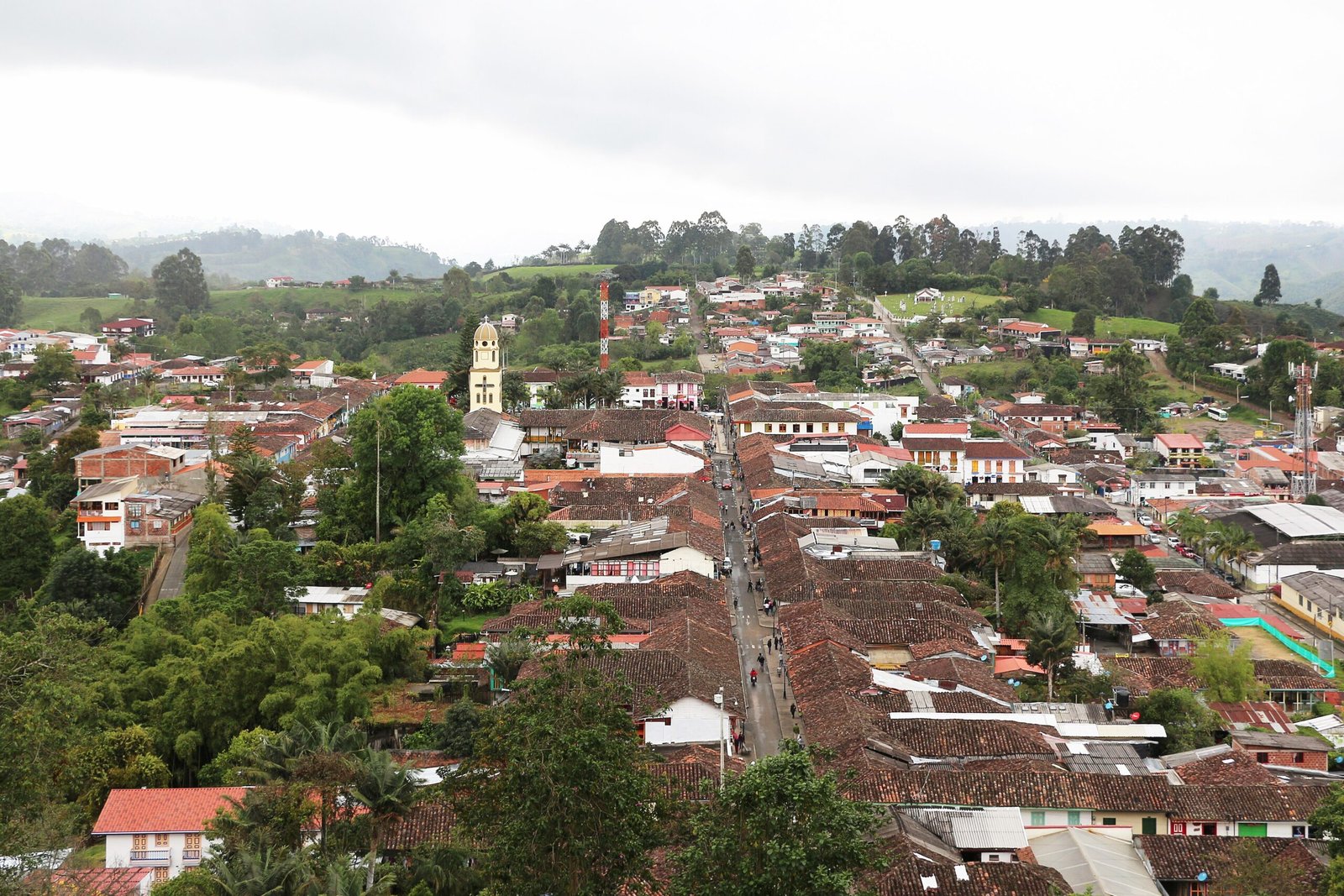
Steep Andean hillsides dressed in coffee shade, bamboo-framed towns painted in vivid primary colours, and a settler culture that built one of the world’s most distinctive agro-industrial landscapes — UNESCO-listed as living heritage.
At a glance
The Coffee Cultural Landscape of Colombia (Paisaje Cultural Cafetero) was inscribed as a UNESCO World Heritage Site in 2011. It is a serial property comprising six farming zones across the departments of Caldas, Risaralda, Quindio, and Valle del Cauca in the western Colombian Andes — collectively known as the Coffee Axis (Eje Cafetero). The Outstanding Universal Value recognised by UNESCO is the exceptional combination of a distinctive Andean agricultural landscape, a living building tradition (bahareque architecture), and a specific cultural identity (the paisa settler culture) that together form an integrated human-landscape system still functioning and evolving today.
Key facts
- UNESCO inscription: 2011 (Cultural, criteria v, vi)
- Location: Departments of Caldas, Risaralda, Quindio, and Valle del Cauca, western Colombian Andes
- Altitude: 1,300-1,800 m; micro-climate optimal for arabica coffee production
- Architecture: Bahareque — bamboo (guadua) framing with lime-plastered panels, vivid polychrome facades
- Cultural identity: Paisa (Antioqueno settler) culture — colonisation wave from 1840s-1890s CE
- Notable feature: Valle de Cocora — towering Quindio wax palms (world’s tallest palm species, Colombia’s national tree)
- Key towns: Salento, Jardin, Jerico, Filandia
History
The Colombian coffee-growing landscape is the product of the Antioqueno colonisation (colonizacion antioquena) — one of the most remarkable demographic movements in 19th-century Latin America. From the 1840s to the 1890s, waves of settlers from the department of Antioquia pushed southward along the western cordillera of the Andes, clearing forest and establishing small family farms on steep hillsides at altitudes between 1,000 and 2,000 metres. The settlers brought a distinctive folk culture, construction techniques using the guadua bamboo native to the region, and a willingness to farm the most difficult terrain. Coffee, introduced to Colombia in the late 18th century, proved perfectly suited to the altitude, rainfall, and temperature of the region: the combination of warm days, cool nights, cloud cover, and well-drained volcanic soils produced arabica beans of exceptional quality.
By 1900, the Eje Cafetero had become the core of Colombian coffee production, and by the 1950s Colombia was the world’s second-largest coffee exporter after Brazil. The landscape that developed is distinctive: coffee planted on slopes too steep for mechanisation, grown under shade canopy of banana, plantain, and native trees, harvested by hand by chapoleras (coffee pickers) during the October and March harvest seasons. The family finca (farm) — a small landholding of 3-10 hectares — remained the dominant production unit, and the associated culture of the paisa family farm, with its distinctive cuisine, music (the vals and pasillo forms), religious festivals, and handicraft traditions, persisted largely intact into the 21st century.
The bahareque architecture of the coffee towns — multi-coloured facades with ornate wooden balconies (balcones), vivid paintwork (white walls with blue, yellow, red, or green window frames and doors), and zocalo tiling — developed as a practical adaptation to earthquake country: the guadua bamboo frame, lime-plastered on both sides, is both seismically flexible and locally abundant. The towns of Salento (founded 1850), Jardin (1863), and Jerico (1851) preserve their 19th-century urban layout and bahareque building stock most completely. UNESCO inscription in 2011 recognised the landscape as a living cultural landscape that continues to evolve while retaining its exceptional integrity.
What you see
The visual signature of the Eje Cafetero is immediately recognisable: steep hillsides of dark-green coffee interspersed with the tall stems of guadua bamboo, above which rise the wax palms of the Cocora valley (up to 60 metres tall, the world’s highest palm species). The town centres — especially Salento’s Calle Real and Jardin’s central plaza — display bahareque architecture at its finest: two-storey commercial buildings with deep covered porticos, carved wooden brackets, and facades in contrasting primary colours. The interior of a traditional finca shows the sequence from drying patios to fermenting tanks to the beneficiadero (wet-processing mill). The chapolera harvest festival (October-November) brings traditional dress, music, and a beauty contest celebrating coffee-picking culture.
Practical information
- Base towns: Salento and Armenia (Quindio); Manizales (Caldas); Pereira (Risaralda)
- Best season: December-February (dry season) or after the October harvest for festival atmosphere
- Coffee farm tours: Multiple fincas offer guided half-day tours with cupping; book in Salento or via Armenia
- Valle de Cocora: Hiking trail from Salento to the wax palm forest — 5-8 hours return; horses available
- Safety: Tourist infrastructure well-developed in Salento, Jardin, and Filandia; check current advisories for rural areas
Getting there
Armenia (Quindio) is the main gateway city, served by El Eden International Airport with connections to Bogota (1 hour), Medellin, and Cali. Salento is 35 km from Armenia by road (1 hour by bus or jeep willys). Pereira and Manizales are alternative gateways. From Bogota, the drive via the La Linea tunnel takes approximately 6-7 hours. Bus services connect Armenia to all coffee towns; traditional Willys jeeps (WWII-vintage) serve as the local mountain transport.
Nearby
- Valle de Cocora: Wax palm forest immediately above Salento — Colombia’s most iconic landscape photograph
- Jardin: Best-preserved bahareque town in Antioquia, 3 hours from Salento via Manizales
- Parque Nacional Natural Los Nevados: Snow-capped Andean volcanoes (Nevado del Ruiz), 50 km from Manizales
- Bogota: 300 km east; Gold Museum (Museo del Oro) provides essential pre-Colombian context
Sources
- UNESCO World Heritage List — Coffee Cultural Landscape of Colombia (2011)
- ProColombia — Colombia Tourism Authority
- Wikipedia EN — Coffee Cultural Landscape of Colombia, Eje Cafetero, Bahareque, Salento Quindio
Find it on the map
See this place and what’s around it →📷 Become a Cultural Heritage Online photographer
Share your photos of places: they stay published under your name as the author. The more they're seen, the more you get noticed — and soon a contest will reward the most appreciated photos.
Log in or sign up free to add a photo