

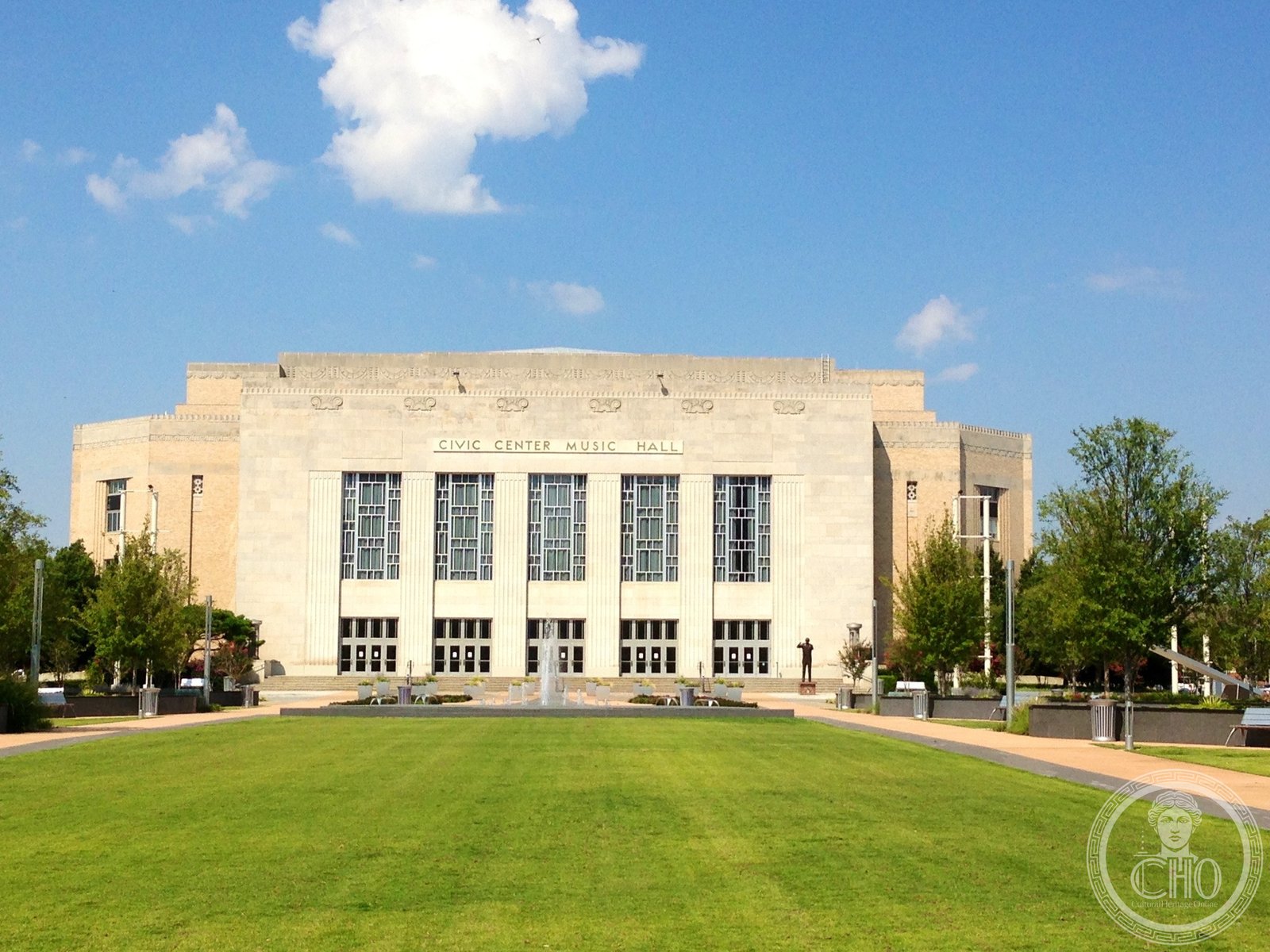

Built in 1937 with New Deal federal funding as part of Oklahoma City’s civic centre complex, the Civic Center Music Hall is one of the finest PWA Moderne performing arts venues in the south-central United States — its limestone facade, Art Deco relief panels, and landmark auditorium the home of the Oklahoma City Philharmonic since the hall’s restoration in 2001.
At a glance
Standing at 201 N Walker Avenue in downtown Oklahoma City, the Civic Center Music Hall was completed in 1937 by Oklahoma City architects Hawk & Parr with Public Works Administration funding as part of a broader civic centre development. The building’s PWA Moderne exterior — buff limestone, geometric ornamental panels, vertical tower form, and restrained Art Deco detail — presents a composed civic facade that was among the most ambitious public architectural statements of the New Deal era in Oklahoma. The main auditorium seats approximately 2,600 and has been home to the Oklahoma City Philharmonic since the orchestra’s founding; a major $53 million renovation completed in 2001 restored the hall to full operational condition. The building is listed on the National Register of Historic Places.
Key facts
- Completed: 1937
- Architects: Hawk & Parr
- Style: PWA Moderne / Art Deco
- Address: 201 N Walker Ave, Oklahoma City, OK 73102
- Main auditorium: approximately 2,600 seats
- NRHP: Listed
- Renovation: $53 million, completed 2001
- Signature feature: Buff limestone facade with geometric Art Deco relief panels and civic tower form
History
Oklahoma City’s ambition for a civic centre complex dates to the early 1930s. Federal PWA funding, available from 1933 under Harold Ickes’s administration of the programme, made the realisation of this ambition financially viable. Local architects Hawk & Parr were engaged to design the Music Hall as a component of a broader civic complex that would include municipal offices, a convention facility, and a performing arts venue. The result, completed in 1937, was a PWA Moderne building whose limestone exterior and interior auditorium placed it among the most ambitious New Deal civic projects in Oklahoma.
The Music Hall opened in 1937 and became the principal venue for major cultural events in Oklahoma City through the mid-twentieth century. The Oklahoma City Philharmonic, founded in 1988, established the hall as its permanent home; the orchestra’s growing ambitions made clear that the mid-century interior required significant investment. A $53 million renovation project, the largest public arts investment in Oklahoma history at the time, was completed in 2001. The renovation restored and upgraded the auditorium’s acoustic properties, modernised the stage machinery and backstage facilities, and brought the limestone exterior back to its 1937 condition. The restored hall has become one of the best mid-size performing arts venues in the American south.
The building gained wider public recognition during the period of the Oklahoma City bombing of 1995 and its aftermath. Located within walking distance of the Alfred P. Murrah Federal Building site on NW 5th Street — the target of the 1995 bombing — the Civic Center Music Hall became associated with the city’s processes of mourning and cultural renewal in the years following the attack. The memorial concerts held in the hall in the late 1990s, and the physical evidence of the building’s proximity to the site, gave it a significance beyond its architectural and cultural history.
What you see
The Civic Center Music Hall’s Walker Avenue facade is the most expressive PWA Moderne elevation in downtown Oklahoma City: a buff limestone composition organised around a central tower form that rises above the roof line, flanked by lower wings with large window bays and decorative relief panels. The ornamental programme is distinctly Art Deco — stylised eagles, geometric interlace, and stylised foliate forms in low relief at the parapet and entrance level — but deployed with the restraint and civic gravity characteristic of the best New Deal public architecture. The limestone has weathered to a warm tone over the decades that gives the facade a unified presence in the Oklahoma City streetscape.
At street level the Walker Avenue entrance presents a composed sequence of carved limestone panels, bronze door hardware, and the building’s identifying inscription. The auditorium interior, restored in 2001, combines the original Art Deco plasterwork of the hall with modern acoustic and stage systems: the side wall panels, the proscenium arch treatment, and the ceiling ornament are all substantially intact from the 1937 opening. The hall has excellent sight lines from the upper balconies; the acoustic quality after the 2001 renovation is suited to orchestral and choral performance. From the intersection of Walker and Park Avenue, the full height of the civic tower is visible, providing the building with a landmark presence at the western edge of the civic centre complex.
Practical information
- Access: Open for performances; lobby and exterior accessible. Box office open on event days and by appointment
- Best time: Exterior any time; interior during Oklahoma City Philharmonic season (September–May)
- Time needed: 20 minutes exterior; full concert visit 2–3 hours
- GPS: 35.4690° N, 97.5234° W
- Nearest transit: Oklahoma City Streetcar Civic Center stop
Getting there
The Civic Center Music Hall stands at 201 N Walker Avenue in downtown Oklahoma City, one block west of the First National Center and 3 minutes from the Oklahoma City Streetcar. Will Rogers World Airport is approximately 10 miles (16 km) south-west; taxi or rideshare to downtown takes 15–20 minutes.
Nearby
- First National Center (1931) — Gothic Art Deco skyscraper with spectacular banking hall at 120 N Robinson Ave, 3 minutes east
- Oklahoma City National Memorial — memorial to the 1995 bombing, 5 minutes north-east
- Oklahoma City Museum of Art — Dale Chihuly glass collection, Couch Drive, adjacent to the Civic Center complex
Sources
- National Register of Historic Places, Civic Center Music Hall nomination — nps.gov
- Oklahoma City Philharmonic, hall history — okphil.org
- Living New Deal, Oklahoma City Civic Center Music Hall — livingnewdeal.org
- Oklahoma Historical Society, civic centre records — okhistory.org
- Wikidata, Civic Center Music Hall Q5124287 — wikidata.org
Find it on the map
See this place and what’s around it →📷 Become a Cultural Heritage Online photographer
Share your photos of places: they stay published under your name as the author. The more they're seen, the more you get noticed — and soon a contest will reward the most appreciated photos.
Log in or sign up free to add a photoIs this page about you?
This page is read by travellers and heritage enthusiasts who find it on Google. Tell us how you are connected to this place and we will take it from there.