

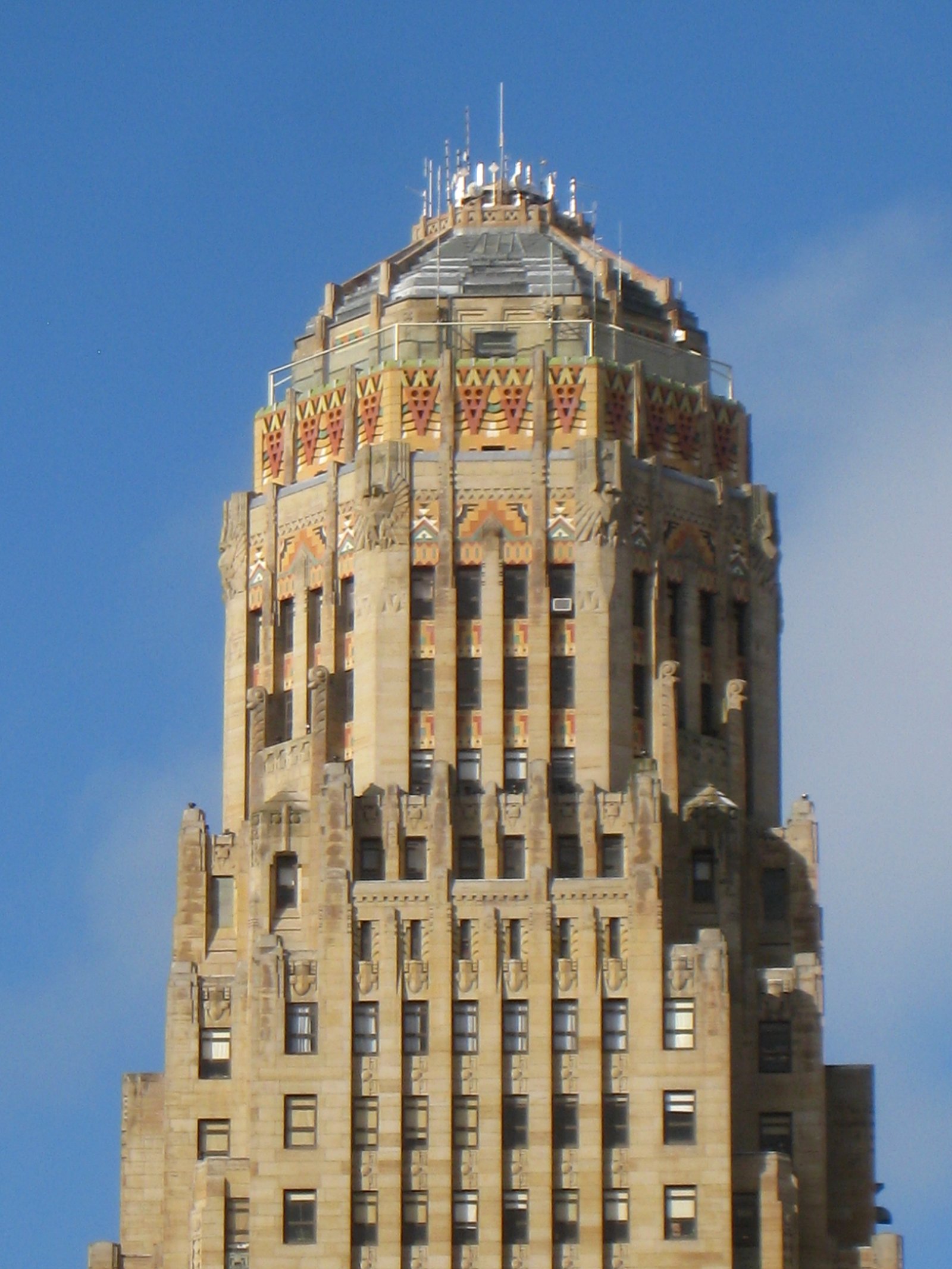

Completed in 1931 at the apex of Niagara Square, Buffalo City Hall is one of the largest and most architecturally ambitious Art Deco municipal buildings in the United States — a 32-story tower of buff limestone and polychrome terracotta rising above a civic forecourt that places it among the greatest public buildings of the inter-war period.
At a glance
Standing 378 feet above Niagara Square in downtown Buffalo, the City Hall was designed by the firm Dietel, Wade & Jones and completed in 1931. It is the tallest building in Buffalo that has functioned continuously as the seat of city government since its opening. The Art Deco vocabulary is expressed with exceptional richness: polychrome terracotta panels, carved figural reliefs, and a pyramid crown define a silhouette that is visible from the Lake Erie waterfront and from the surrounding street grid. The observation deck at the 28th floor is one of the few publicly accessible vantage points of its period to remain open in a North American city hall. The building was listed on the National Register of Historic Places in 1975.
Key facts
- Completed: 1931
- Architects: Dietel, Wade & Jones
- Style: Art Deco
- Address: 65 Niagara Square, Buffalo, NY 14202
- Height: 32 stories, 378 ft (115 m)
- NRHP: Listed 1975
- Observation deck: 28th floor, free public access during business hours
- Signature feature: Polychrome terracotta reliefs; figural sculpture programme; pyramid crown; civic forecourt at Niagara Square
History
Buffalo’s decision to build a new city hall in the late 1920s was an expression of civic confidence at a moment when the city’s industrial and commercial standing made it one of the largest in the United States. The site at Niagara Square — the circular terminus of Main Street, from which radial avenues fan out through the street grid — had been laid out by Joseph Ellicott in his 1804 plan for Buffalo. The choice to place the new City Hall here, at the geometric heart of Ellicott’s plan, was both a practical and a symbolic decision: it anchored the seat of government at the civic focal point of the original urban design.
The architects Dietel, Wade & Jones designed a building whose Art Deco programme is among the richest of any American city hall. The polychrome terracotta panels — in blue, gold, and grey-green tones — cover the upper floors of the tower with a dense programme of relief ornament: stylised foliate forms, geometric interlace, and figural sculptures representing the history and industries of Buffalo (grain, steel, shipping). The main entrance sequence, with its carved stone reliefs and bronze doors, is a set piece of civic Art Deco design on the level of the greatest government buildings of the period.
The building opened in 1931 and has functioned without interruption as the seat of Buffalo city government. It survived the 20th-century reversals of Buffalo’s industrial economy — the steel industry’s decline, the loss of the Erie Canal trade — that emptied many of the surrounding downtown buildings. Listed on the National Register of Historic Places in 1975, it is one of the anchors of Buffalo’s argument for its place among the great Art Deco cities of North America.
What you see
The Buffalo City Hall is best approached from Main Street, where the tower appears at the end of the street as a framed vertical composition: the lower floors in limestone, the upper tower in a programme of polychrome terracotta that shifts from grey-buff at the base to blue-gold at the crown. The setback profile — characteristic of American Art Deco towers of the late 1920s and early 1930s — produces a series of terraced recessions as the tower rises, each setback zone decorated with terracotta panels of increasing density. The pyramid crown, with its carved ornament and coloured tile, reads from street level as a jewel-like terminus to a building whose lower floors are composed in a more restrained register.
The observation deck at the 28th floor is the building’s most surprising public space: a narrow outdoor terrace at 300 feet that provides a panoramic view of Buffalo, the Niagara River corridor, and on clear days the lake horizon to the south-west. Below, Niagara Square reads as the civic forecourt it was designed to be — the radial avenues converging on the circular space, the City Hall’s main facade centred on the view from Delaware Avenue. The interior sequence — lobby, council chamber, mayor’s suite — is a tour of 1930s civic interior design in excellent preservation. The lobby ceiling, with its painted lunettes representing the forces of law and commerce, is among the best Art Deco interiors in New York State.
Practical information
- Access: Open Monday–Friday during business hours; free public access to lobby and observation deck
- Observation deck: 28th floor; take elevator to 25th floor + stairs to 28; free, no ticket required
- Best time: Clear day for Lake Erie views; early morning for light on the eastern terracotta facade
- Time needed: 45–60 minutes (lobby + observation deck)
- GPS: 42.8866° N, 78.8793° W
Getting there
Buffalo City Hall stands at 65 Niagara Square at the heart of downtown Buffalo, immediately adjacent to the NFTA Metro Rail’s Niagara Square / City Hall station. Buffalo Niagara International Airport is approximately 9 miles (14 km) east; taxi or rideshare to downtown takes 15–20 minutes. Amtrak serves Buffalo-Exchange Street station (0.5 miles) and Buffalo-Depew station (outside the city).
Nearby
- Hotel Lafayette (1904) — Beaux-Arts hotel on Washington Street, 3 minutes north; restored and now a boutique hotel
- Shea’s Performing Arts Center (1926) — elaborately decorated movie palace at 646 Main Street, 4 minutes north
- Albright-Knox Art Gallery — now known as Buffalo AKG Art Museum; major collection in Delaware Park, 15 minutes north
Sources
- National Register of Historic Places, Buffalo City Hall nomination (1975) — nps.gov
- Preservation Buffalo Niagara, Buffalo City Hall building record — preservationbuffaloniagara.org
- City of Buffalo, City Hall visitor information — buffalony.gov
- Grossman, Mark. Buffalo Deco: Architecture from the Jazz Age. Relevant sections.
- Wikidata, Buffalo City Hall Q1001988 — wikidata.org
Find it on the map
See this place and what’s around it →📷 Become a Cultural Heritage Online photographer
Share your photos of places: they stay published under your name as the author. The more they're seen, the more you get noticed — and soon a contest will reward the most appreciated photos.
Log in or sign up free to add a photoIs this page about you?
This page is read by travellers and heritage enthusiasts who find it on Google. Tell us how you are connected to this place and we will take it from there.