
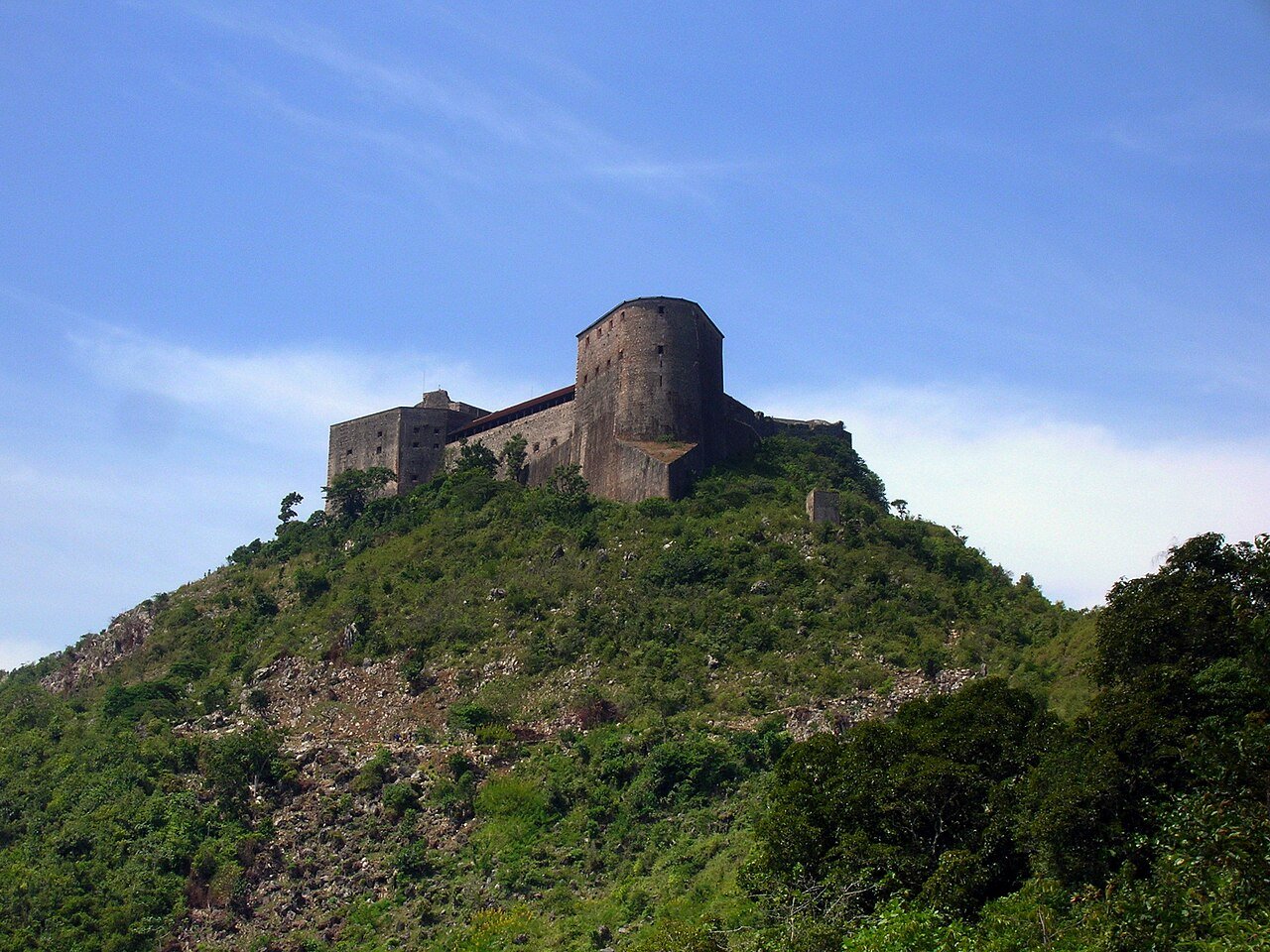
The black citadel: freedom built in stone
On a mountain summit 970 metres above the Caribbean coast of northern Haiti, the Citadelle Laferrière stands as the most powerful symbol of Haitian independence. Built between 1805 and 1820 by Henri Christophe — one of the leaders of the Haitian Revolution who proclaimed himself King Henri I — it is the largest fortress in the Western Hemisphere, a monument to the determination of the first Black republic to defend its freedom against any European attempt at reconquest.
UNESCO inscription: freedom’s architecture
Inscribed in 1982 together with the nearby Sans-Souci Palace and the archaeological site of Ramiers, the Citadelle Laferrière was recognised by UNESCO as a masterpiece of military architecture and as a symbol of unique historical significance — the physical expression of the aspirations of a people who had won their freedom through the only successful slave revolution in history.
Engineering on the heights: building without roads
The construction of the Citadelle was a feat of extraordinary human effort. An estimated 20,000 workers — many of them former slaves — carried building materials up the mountain on their backs, along paths that were too steep and narrow for carts. The walls, up to 4 metres thick and 40 metres high, were built to withstand cannon fire from any direction. Some 365 bronze and iron cannons still line the parapets.
Henri Christophe: king, builder, tyrant
Henri Christophe (1767–1820) was a figure of extraordinary ambition and contradictions. Born into slavery in Grenada, he rose through the revolutionary armies to become one of Haiti’s founding leaders. After the country split, he ruled the northern Kingdom of Haiti with autocratic severity, demanding the construction of the Citadelle, the Sans-Souci Palace, and dozens of other structures as expressions of Black royal sovereignty — and at enormous cost in human life and suffering.
The Sans-Souci Palace: a Versailles in the tropics
At the foot of the mountain, the ruined Sans-Souci Palace completes the UNESCO site. Built around 1813, it was Christophe’s royal court — a baroque complex with formal gardens, fountains, and a throne room designed to rival any European palace. Destroyed by the earthquake of 1842 and looted in subsequent decades, its roofless walls now stand in the town of Milot, 15 kilometres south of Cap-Haïtien.
1492 and 1804: Haiti as the pivot of Atlantic history
Haiti (formerly Saint-Domingue) was where Columbus first landed in the Americas in 1492. It became the richest sugar colony in the world under French rule — and the site of the Haitian Revolution (1791–1804), the only slave uprising in history to result in a permanent free state. The Citadelle was built in the immediate aftermath of independence, when France, Spain, and Britain all threatened reconquest. It was never attacked.
Climbing to the Citadelle today
The ascent from Milot takes 1–2 hours on foot or horseback via a path of historical authenticity — no road has been built to the summit, intentionally. The view from the ramparts encompasses the northern plain where the decisive battles of the Revolution were fought. The site is managed by the ISPAN (Haitian Institute for the Preservation of National Heritage) and receives visitors year-round, though infrastructure remains basic.
A fragile UNESCO site in a fragile state
The Citadelle Laferrière is listed among the world’s most endangered heritage sites due to Haiti’s chronic political instability and the damage inflicted by the 2010 earthquake. Ongoing conservation work is supported by UNESCO, the World Monuments Fund, and several international donors. Despite the challenges, the fortress remains Haiti’s most visited tourist attraction and its most powerful symbol of national identity.
Find it on the map
See this place and what’s around it →📷 Become a Cultural Heritage Online photographer
Share your photos of places: they stay published under your name as the author. The more they're seen, the more you get noticed — and soon a contest will reward the most appreciated photos.
Log in or sign up free to add a photo