
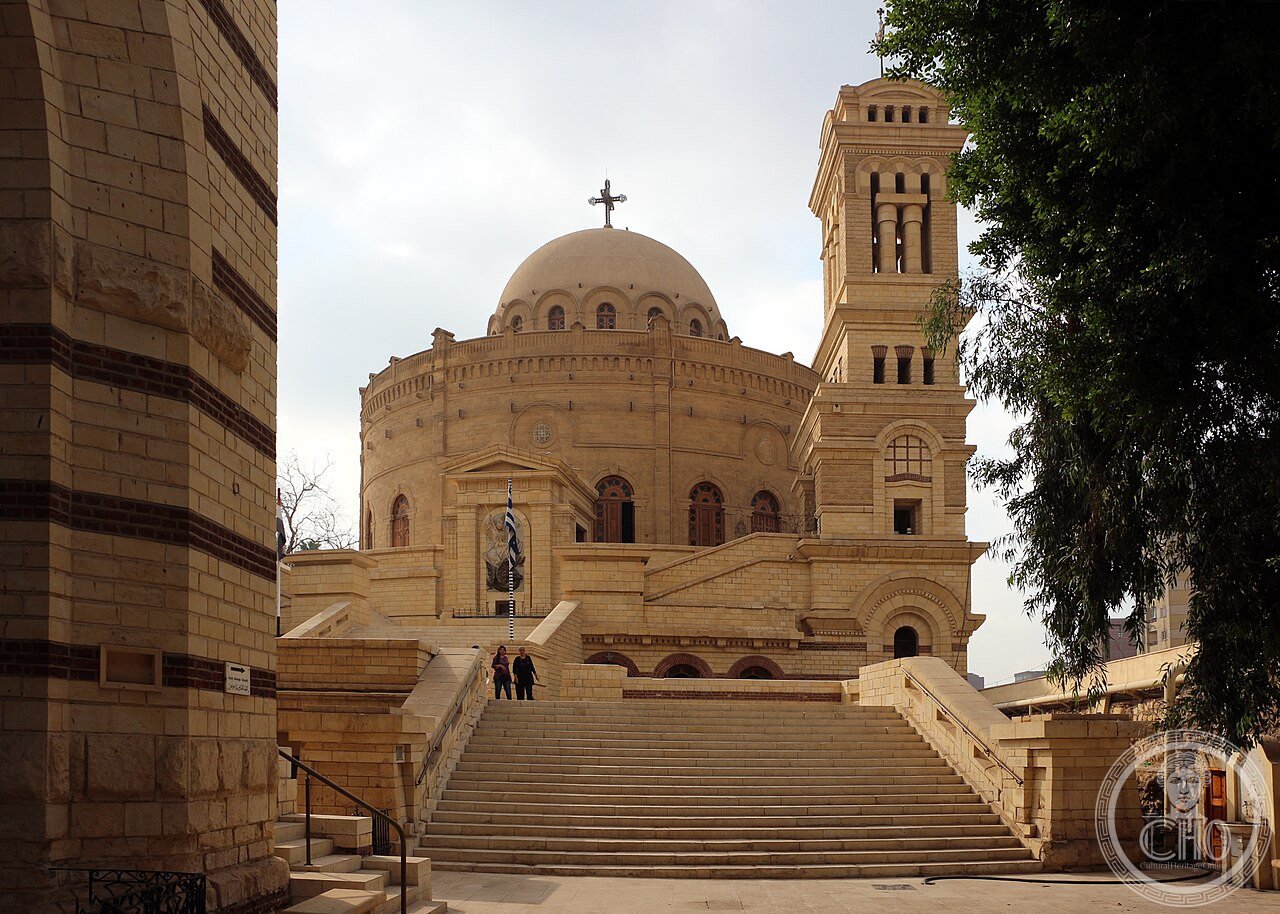
In Old Cairo, the Greek Orthodox Church of St. George, known as Mari Girgis, stands above one of the round towers of the Roman fortress of Babylon. An earlier building on the same site was destroyed by fire in 1904, and the present church was rebuilt and completed in 1909, associated with the Greek community and the Greek Orthodox Patriarchate of Alexandria, though the sources give neither the name of an architect nor precise details on how the work was funded. The building, the only circular church in Egypt, is supported by eight internal columns, a layout that sources compare architecturally to the basilica of San Vitale in Ravenna, and is built directly on top of one of the round towers of the Roman fortifications of Babylon, dating from the 2nd-3rd century AD. Beside the church stands the Monastery, or Convent, of St. George, traditionally dated to the 7th century, with a main hall of the 10th century. It holds a reliquary room containing chains traditionally associated with the torments suffered by St. George under the Persian king Dadianos. According to a devotional practice still alive, documented by several tourist and historical sources, some pilgrims have themselves wrapped in those chains by the resident nuns, in a rite linked to requests for healing or blessing, especially for nervous or spiritual ailments: a popular, devotional tradition, not a recognised medical practice. The church also gives its name to the Cairo metro station “Mar Girgis”, which serves the Coptic Cairo area, confirming its status as a landmark of the district. The church today serves as the Greek Orthodox patriarchal seat in Cairo, led by a cleric who since 2009 has held the title of Bishop of Babylonos. It remains active for services and is a regular stop on the Coptic Cairo tourist circuit, even though it is Greek Orthodox and not Coptic.
About the Church of St. George
In Old Cairo, the Greek Orthodox Church of St. George, known as Mari Girgis, stands atop one of the round towers of the Roman fortress of Babylon; an earlier building on the site was destroyed by fire in 1904, and the present church was rebuilt and completed in 1909, associated with the Greek community and the Greek Orthodox Patriarchate of Alexandria, though sources do not record an architect’s name or precise funding details for the work. The building, the only circular church in Egypt, is supported by eight internal columns, a layout sources compare architecturally to the Basilica of San Vitale in Ravenna, and is built directly atop one of the round towers of the Roman fortifications of Babylon, dating to the 2nd-3rd century AD. Beside the church stands the Monastery, or Convent, of St. George, traditionally dated to the 7th century, with a main hall from the 10th century, which holds a shrine room containing chains traditionally associated with St. George’s torments under the Persian king Dadianos; according to a still-living devotional practice documented by several travel and history sources, some pilgrims are wrapped in these chains by the resident nuns, in a ritual tied to requests for healing or blessing, particularly for nervous or spiritual afflictions — a folk and devotional tradition, not a recognised medical practice. The church’s name also gives its name to the Cairo Metro station “Mar Girgis,” serving the Coptic Cairo area, confirming its landmark status in the neighborhood. The church today serves as the Greek Orthodox patriarchal seat in Cairo, led by a cleric who has held the title Bishop of Babylonos since 2009, remains active for services, and is a regular stop on the Coptic Cairo tourist circuit despite being Greek Orthodox rather than Coptic.
Key facts
- 1904: an earlier church on the site destroyed by fire.
- 1909: the present church rebuilt, the only circular church in Egypt.
- Built atop a round Roman tower of the Babylon Fortress, 2nd-3rd century AD.
- Adjoining Monastery of St. George, traditionally dated to the 7th century.
- Chains ritual at the adjoining convent, a documented folk devotional tradition.
- Names the Cairo Metro’s “Mar Girgis” station, serving Coptic Cairo.
History
Rebuilt in 1909 after fire destroyed its predecessor, the Church of St. George stands as the sole example of a circular church plan in Egypt, its position atop a genuine Roman defensive tower embedding nearly two millennia of continuous structural history into a single site. Its adjoining monastery’s chains ritual, still practiced today, connects the church to a long tradition of devotional healing practices that predate and coexist with its formal role as the Greek Orthodox Patriarchate’s Cairo seat.
What you see
A circular church rises directly from the round stonework of a Roman tower, its interior ringed by eight columns in a form unique among Egyptian churches. In the adjoining monastery, a shrine room holds chains tied to St. George’s martyrdom, still used today in a folk healing ritual practiced by resident nuns.
Practical information
- Opening hours: generally open daily; check current hours before visiting.
- Address: Old Cairo (Coptic Cairo), near Mar Girgis Metro station, Cairo, Egypt.
Getting there
The church stands within Coptic Cairo, directly above the Mar Girgis metro station, which takes its name from the site. GPS: 30°00′23″N, 31°13′48″E.
Nearby
- Church of Abu Serga — the nearby church associated with the Holy Family’s flight into Egypt.
- The Hanging Church — the celebrated Coptic church suspended over a Roman gate.
- Church of St. Barbara — another ancient church within the Coptic Cairo complex.
Sources
- Wikipedia — “Church of St. George (Cairo)” (en.wikipedia.org).
- OrthodoxWiki — “Monastery of St. George (Old Cairo)”
- Fodor’s Travel — “Convent of St. George Review, Cairo”
Find it on the map
See this place and what’s around it →📷 Become a Cultural Heritage Online photographer
Share your photos of places: they stay published under your name as the author. The more they're seen, the more you get noticed — and soon a contest will reward the most appreciated photos.
Log in or sign up free to add a photo