

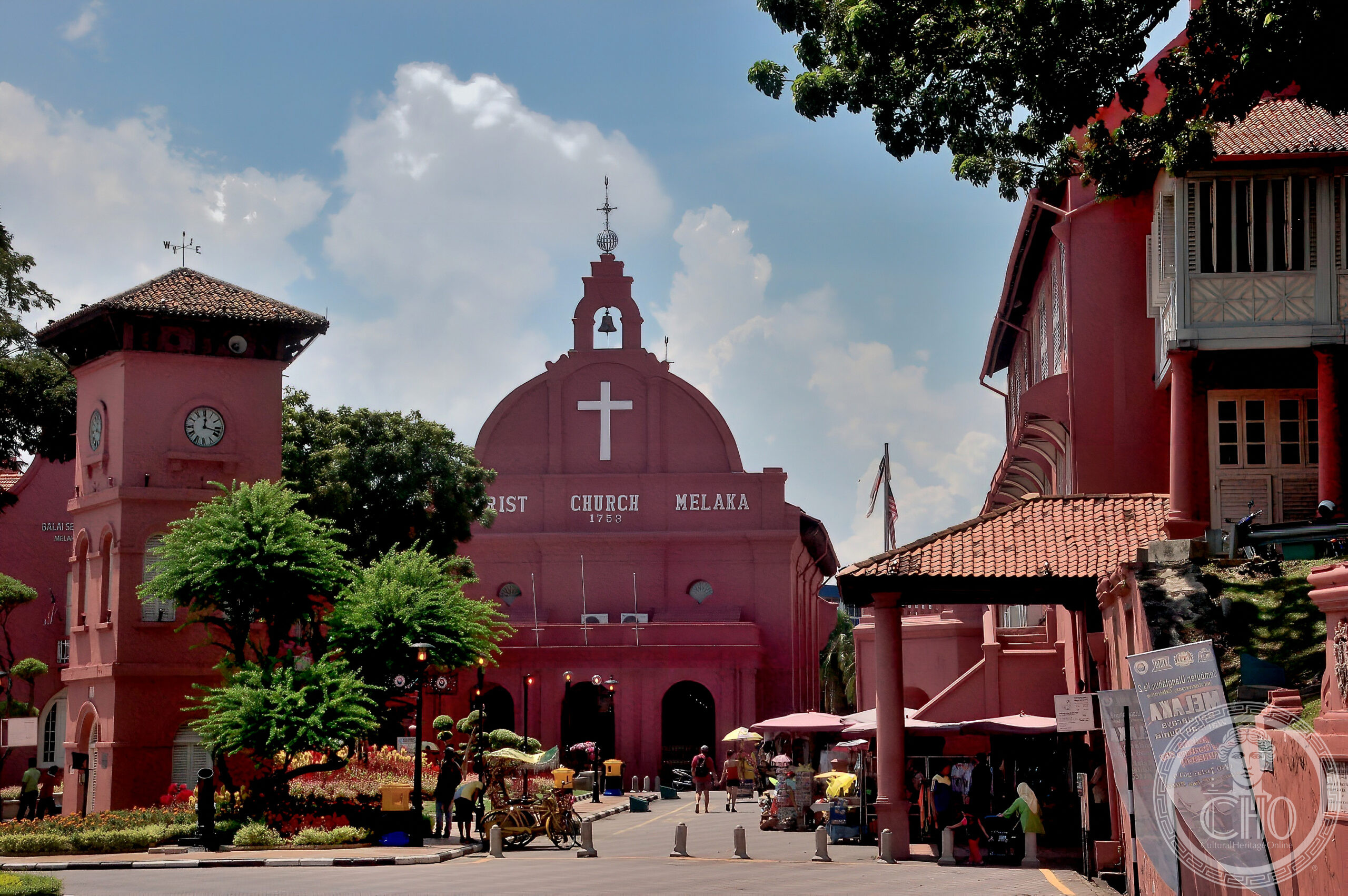
On Jalan Gereja, on the Dutch Square of Melaka, in Malaysia, Christ Church is the oldest Protestant church still in use in the country. The foundation stone was laid in 1741 by Abraham de Wind, captain of the burghers, born in Malacca, on behalf of his father Claas de Wind, then Dutch deputy governor of the city. It marked the centenary of the Dutch conquest of Malacca from the Portuguese in 1641. The works lasted twelve years and were completed in 1753. The name of the architect is not documented in any source. The building replaced the earlier Dutch Reformed church, the so-called Bovenkerk, or “high church”. That in turn occupied a Portuguese chapel built in 1521 by Captain Duarte Coelho on the hill of Malacca, the base of Saint Francis Xavier from 1548. After the Dutch conquest of 1641 the chapel was turned over to Reformed worship, then abandoned and deconsecrated once Christ Church was completed in 1753. Under the later British administration the ruined building on the hill was renamed the Church of St Paul, the site visitors still see today, distinct from Christ Church itself. The church was built of Dutch bricks on foundations of local laterite, faced with Chinese plaster, with tiles imported from the Netherlands and a floor of granite blocks that had served as ballast for ships. It was originally painted white, and was repainted red in 1911. The available sources do not document the precise reason, beyond unverified theories such as an attempt to mask the colour of the bricks beneath, or the stains left by betel chewing. In 1824 the Anglo-Dutch treaty transferred Malacca to British control. In 1838 the church was reconsecrated according to the rite of the Church of England by the Bishop of Calcutta, Daniel Wilson, and renamed Christ Church. From 1858 the upkeep of the building passed to the government of the Straits Settlements. It is today an active Anglican parish, part of the Anglican diocese of West Malaysia. Christ Church is among the monuments of the historic core of Melaka, inscribed on the UNESCO World Heritage List on 7 July 2008, as part of the site “Melaka and George Town, historic cities of the Straits of Malacca”.
About the Church
Christ Church Melaka, on Dutch Square in Malaysia’s historic city of Melaka, is the country’s oldest still-functioning Protestant church, built by the Dutch 1741–1753. Originally white, it was repainted its now-iconic red in 1911, and stands as a named landmark within the UNESCO-listed historic core of the Straits of Malacca cities.
Key facts
- 1741–1753: built by the Dutch to mark the centenary of their 1641 conquest of Malacca from Portugal.
- Replaced the earlier Bovenkerk, a former Portuguese chapel of 1521 now surviving as the ruined St. Paul’s Church on Malacca Hill.
- 1911: repainted red from its original white, for reasons no source documents.
- 1838: reconsecrated under the Church of England by Daniel Wilson, Bishop of Calcutta, and renamed Christ Church.
- 7 July 2008: included within the UNESCO World Heritage listing “Melaka and George Town, Historic Cities of the Straits of Malacca”
- Widely described as the oldest functioning Protestant church in Malaysia.
History
Built by the Dutch to mark a century of colonial rule in Malacca, Christ Church replaced an earlier Reformed church on the hill above — itself a former Portuguese chapel where St. Francis Xavier once based his missionary work, and which survives today only as the ruined St. Paul’s Church. Passed to British administration and Anglican worship in the 19th century, Christ Church acquired its now-famous red paint in 1911 for reasons no surviving record actually explains, and remains an active parish within a UNESCO-listed historic city center.
What you see
A red-painted Dutch colonial facade with a white cross and lettering, on a rectangular plan roughly 25 by 13 metres, its ceiling beams each cut from a single tree trunk without joints, its floor paved with reused Portuguese and Armenian tombstones, and a bell inscribed with the date 1698, inherited from an earlier structure.
Practical information
- Opening hours: generally open daily outside services; check current hours before visiting.
- Address: Jalan Gereja, Dutch Square, Melaka City, Malaysia.
Getting there
The church fronts Dutch Square (Stadthuys) in the heart of Melaka’s historic center. GPS: 2.1943°N, 102.2494°E.
Nearby
- St. Paul’s Church ruins — the older Portuguese-founded, later Dutch-used predecessor church on Malacca Hill above.
- Stadthuys — the former Dutch governor’s residence, immediately adjoining the church on Dutch Square.
Sources
- Wikipedia — “Christ Church, Malacca,” “Church of Saint Paul, Malacca,” “Historic Cities of the Straits of Malacca”
- UNESCO World Heritage Centre — “Melaka and George Town, Historic Cities of the Straits of Malacca”
- britishmalaya.home.blog — construction history.
Find it on the map
See this place and what’s around it →📷 Become a Cultural Heritage Online photographer
Share your photos of places: they stay published under your name as the author. The more they're seen, the more you get noticed — and soon a contest will reward the most appreciated photos.
Log in or sign up free to add a photo