

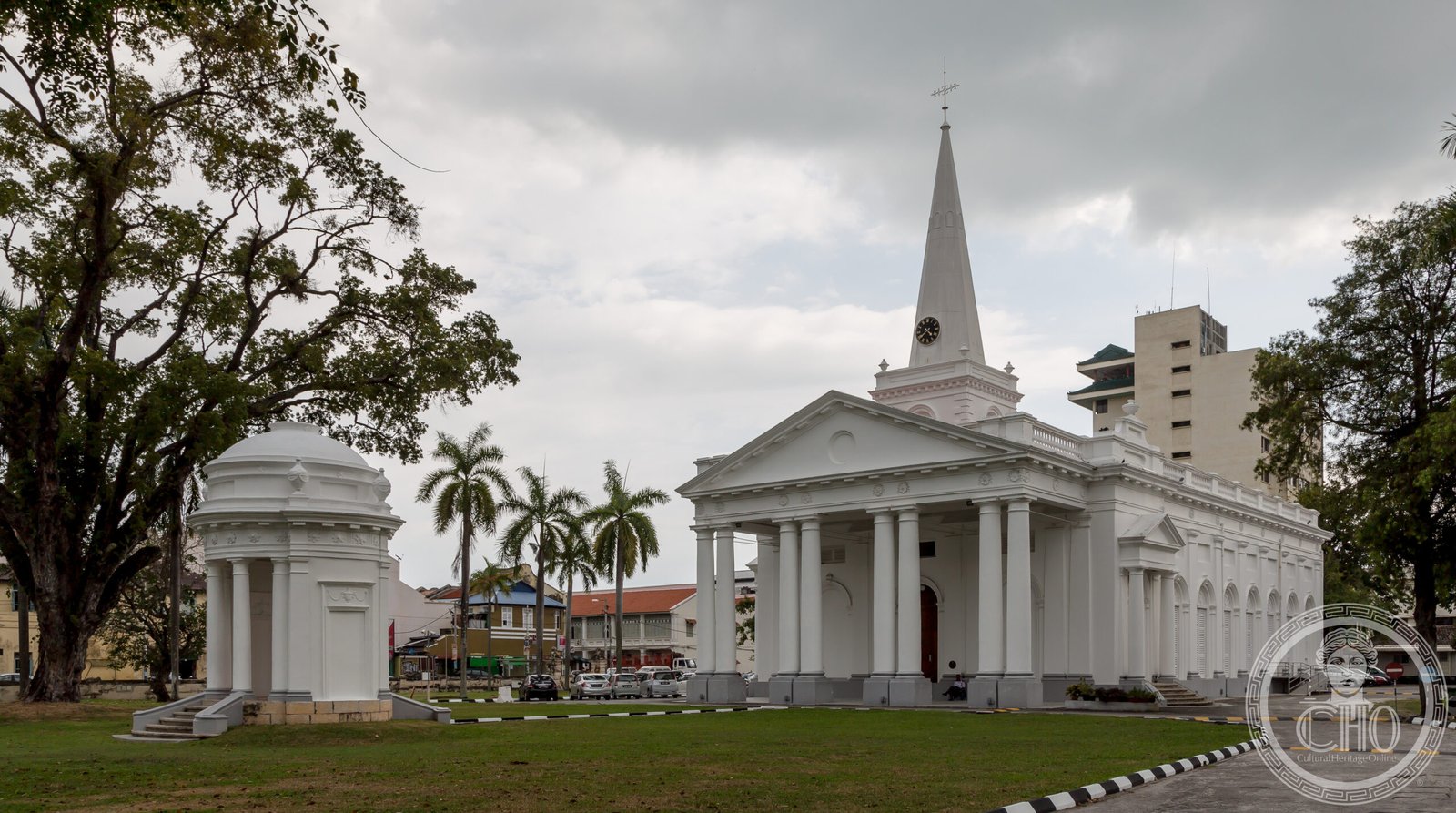
On Lebuh Farquhar, in the historic centre of George Town, in Penang, Malaysia, the church of St George was built by the British East India Company from 1816, or from 1817 according to conflicting sources. It was completed in 1818 — the first service was held there on Christmas Day of that year, under Governor John Alexander Bannerman — and consecrated on 11 May 1819 by the Bishop of Calcutta, Thomas Fanshawe Middleton, at a cost of sixty thousand Spanish dollars borne by the Company. The name of the designer remains a matter of conflicting versions. Some sources credit the first plans to Governor William Petrie, later modified by Lieutenant Robert N. Smith; others name Major Thomas Anbury as the author of the original proposal; others again suggest a design by the Madras engineer James Lillyman Caldwell, inspired by St George’s Cathedral in Madras. One local history, finally, mentions none of these names, and credits the initiative to Sir George Leith, the first lieutenant-governor of Penang, who is said to have submitted plans to the Company in Madras as early as 1800, approved only in 1816. The building is neoclassical, Anglo-Palladian, with Doric columns at the entrance and an octagonal spire. It was built entirely by Indian convict labour, in brick on a plastered stone base. According to some sources, which appear to trace back to a single origin, the convicts left carvings on the entrance steps. The church is commonly described as the oldest Anglican church in South-East Asia built as such from the start. The claim needs qualifying: the physically oldest building in the region used for Anglican worship is in fact Christ Church in Malacca, built by the Dutch between 1741 and 1753 as a Reformed church and Anglican only from 1838. St George, consecrated Anglican from 1819, therefore has the longest continuity of Anglican worship in the region, without being the oldest building outright. Hit by Japanese bombing in December 1941, the church suffered serious structural damage and was abandoned, its furnishings, pipe organ, font and marble floor looted. Repairs funded by the British government after the recapture of Penang in 1945 allowed it to reopen for worship in 1948. A major restoration followed in 2009, coinciding with the inscription of George Town on the UNESCO World Heritage list in 2008, with further work between 2010 and 2012 and the installation of a new pipe organ, dedicated in 2017. On the church grounds stands a monument to Francis Light, founder of the British colony of Penang, though the sources differ on the date — between 1824, the years 1840-50 and 1886 — and even on how many monuments actually exist.
About the Church
St. George’s Church, on Lebuh Farquhar in George Town, Penang, Malaysia, was built by the British East India Company in 1816–1818 and consecrated in 1819. It is widely described as the oldest purpose-built Anglican church in Southeast Asia, standing within the UNESCO-listed historic core of George Town.
Key facts
- 1816–1818: built by the East India Company for 60,000 Spanish dollars, using Indian convict labor.
- 11 May 1819: consecrated by Thomas Fanshawe Middleton, Bishop of Calcutta.
- Widely cited as the oldest purpose-built Anglican church in Southeast Asia — Christ Church Melaka’s building is physically older but only became Anglican in 1838.
- December 1941: heavily damaged in a Japanese bombing raid; furnishings and organ looted.
- 1948: reopened for services after British-funded post-war repairs.
- 2008: included within the UNESCO World Heritage listing “Melaka and George Town, Historic Cities of the Straits of Malacca”
History
Built by the East India Company using Indian convict labor and consecrated in 1819, St. George’s has the longest continuous history of Anglican worship of any church in Southeast Asia, even though a slightly older building in nearby Melaka predates it — that church was built Dutch Reformed and only became Anglican decades later. Devastated by Japanese bombing in December 1941 and left derelict through the war, St. George’s was rebuilt with British government funding and reopened in 1948, later benefiting from restoration tied to George Town’s 2008 UNESCO World Heritage inscription.
What you see
A white Anglo-Palladian portico with Doric columns and a pediment fronts the church, rising into a tall octagonal spire, in a Georgian Neo-Classical style typical of early 19th-century British colonial ecclesiastical architecture.
Practical information
- Opening hours: generally open daily outside services; check current hours before visiting.
- Address: 1, Lebuh Farquhar, 10200 George Town, Penang, Malaysia.
Getting there
The church stands on Lebuh Farquhar (Farquhar Street) in the heart of George Town’s historic core. GPS: 5.4197°N, 100.3391°E.
Nearby
- Francis Light memorial — a domed pavilion honoring Penang’s colonial founder, on the church grounds.
- Christ Church, Melaka — the physically older, formerly Dutch Reformed church elsewhere in the same UNESCO World Heritage listing.
Sources
- Wikipedia — “St George’s Church, George Town,” “Christ Church, Malacca”
- Malay Mail — coverage of the church’s history and restoration.
- Mander Organ Builders — construction and organ restoration history.
- UNESCO World Heritage Centre — “Melaka and George Town, Historic Cities of the Straits of Malacca”
Find it on the map
See this place and what’s around it →📷 Become a Cultural Heritage Online photographer
Share your photos of places: they stay published under your name as the author. The more they're seen, the more you get noticed — and soon a contest will reward the most appreciated photos.
Log in or sign up free to add a photo