
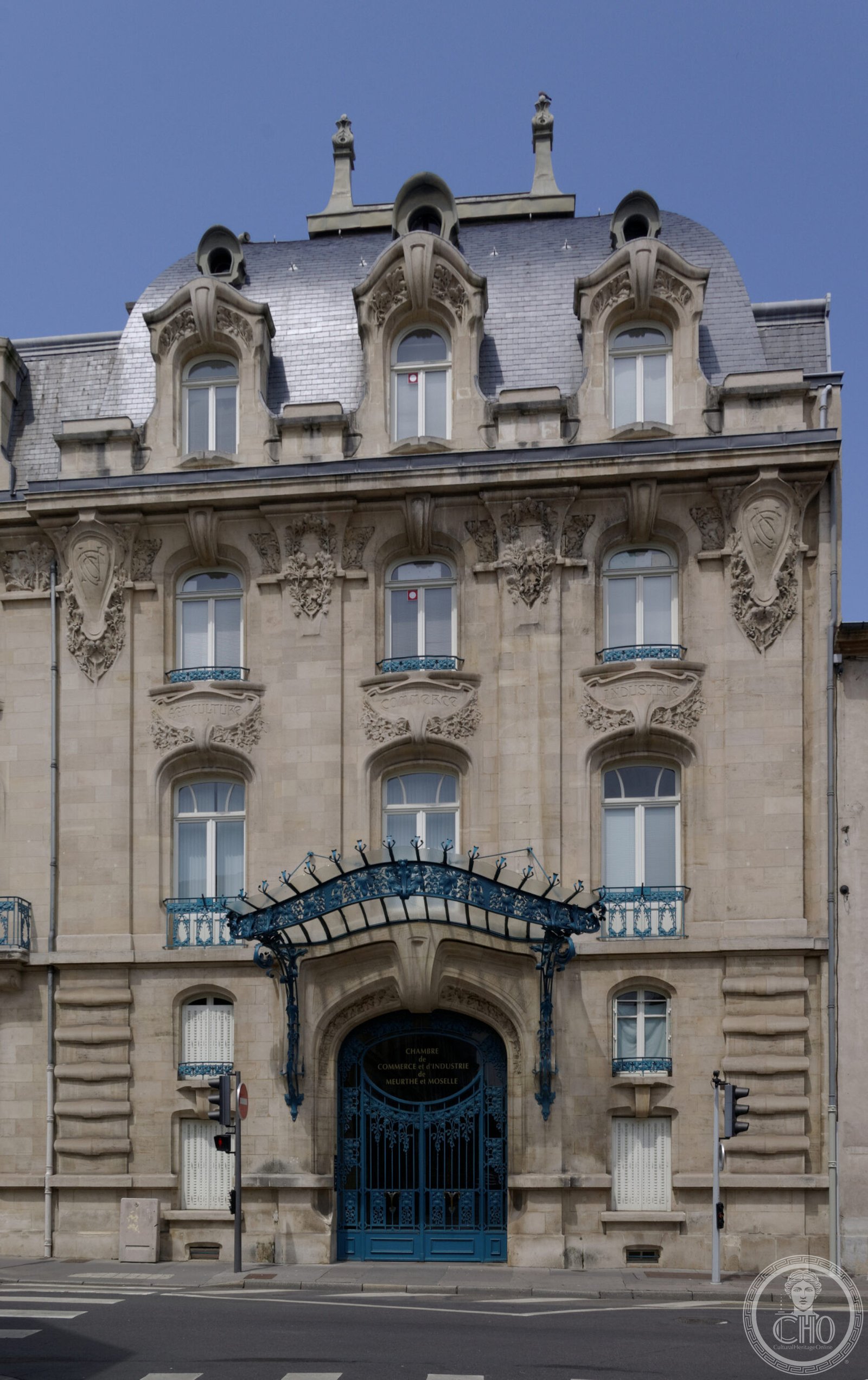
When the merchants of Nancy built their headquarters, they hired the same artists who built the villas.
At a glance
The headquarters of the Meurthe-et-Moselle chamber of commerce stands at 40 rue Henri-Poincaré in Nancy, an Art Nouveau building shaped by the leading names of the École de Nancy. Built between 1906 and 1908 and inaugurated in June 1909, it brought the movement’s domestic craftsmanship into a public, institutional building — stained glass by Antonin Daum and Jacques Gruber, ironwork by Louis Majorelle. Much of it is protected as a historic monument.
Key facts
- Architects: Louis Marchal and Émile Toussaint
- Built: 1906–1908; inaugurated June 1909
- Address: 40 rue Henri-Poincaré, Nancy
- Stained glass: Antonin Daum and Jacques Gruber
- Ironwork & canopy: Louis Majorelle
- Commissioned by: the chamber of commerce and the Société industrielle de l’Est
- Listed: monument historique (from 1994)
History
The chamber of commerce and the Société industrielle de l’Est wanted a headquarters that would represent the industrial confidence of Lorraine. A competition was launched in 1905, and the commission went to the architects Louis Marchal and Émile Toussaint. The building rose between 1906 and 1908 and was inaugurated in June 1909.
Its decoration is a directory of the École de Nancy at its peak. The ground-floor windows, showing Lorraine landscapes, were designed by Antonin Daum and Jacques Gruber. Louis Majorelle provided the architectural ironwork, including the great iron canopy over the entrance.
A substantial part of the building has been listed as a historic monument since 4 May 1994 — the street facade and roof, Majorelle’s canopy, the vestibule and staircase, the former exchange hall with its Gruber windows, and the council chamber. Gruber’s windows were given the higher classification in 1996.
What you see
The set piece on the street is Majorelle’s iron canopy, a sweeping marquise that announces the building as Art Nouveau before the eye reaches the facade above. It is one of the most photographed pieces of architectural metalwork in the city.
Inside, the former exchange hall carries Gruber’s landscape windows, turning a working trading room into a coloured interior. The point of the building was exactly this: that a commercial institution, and not only a private villa, could be a total work of the Nancy school.
Practical information
- The building is a working chamber of commerce; interior access is limited and tied to its activities.
- The facade and Majorelle canopy are visible from rue Henri-Poincaré at any time.
- Interiors may open during heritage days — check before visiting.
- Time needed: 10–15 minutes for the exterior.
Getting there
The building is on rue Henri-Poincaré, between Nancy-Ville station and Place Stanislas, in the heart of the city. It is a few minutes’ walk from the station.
Nearby
- Place Stanislas and the historic centre of Nancy.
- The Brasserie Excelsior, another École de Nancy interior, nearby.
- Maison Bergeret and the École de Nancy quarter.
Sources
- Wikipedia (FR), “Chambre de commerce et d’industrie de Meurthe-et-Moselle”.
- Base Mérimée (French Ministry of Culture) listing.
- Musée de l’École de Nancy resources.
Find it on the map
See this place and what’s around it →Record researched and written by Luigi De Marchi for Cultural Heritage Online, 2026.
📷 Become a Cultural Heritage Online photographer
Share your photos of places: they stay published under your name as the author. The more they're seen, the more you get noticed — and soon a contest will reward the most appreciated photos.
Log in or sign up free to add a photoIs this page about you?
This page is read by travellers and heritage enthusiasts who find it on Google. Tell us how you are connected to this place and we will take it from there.