
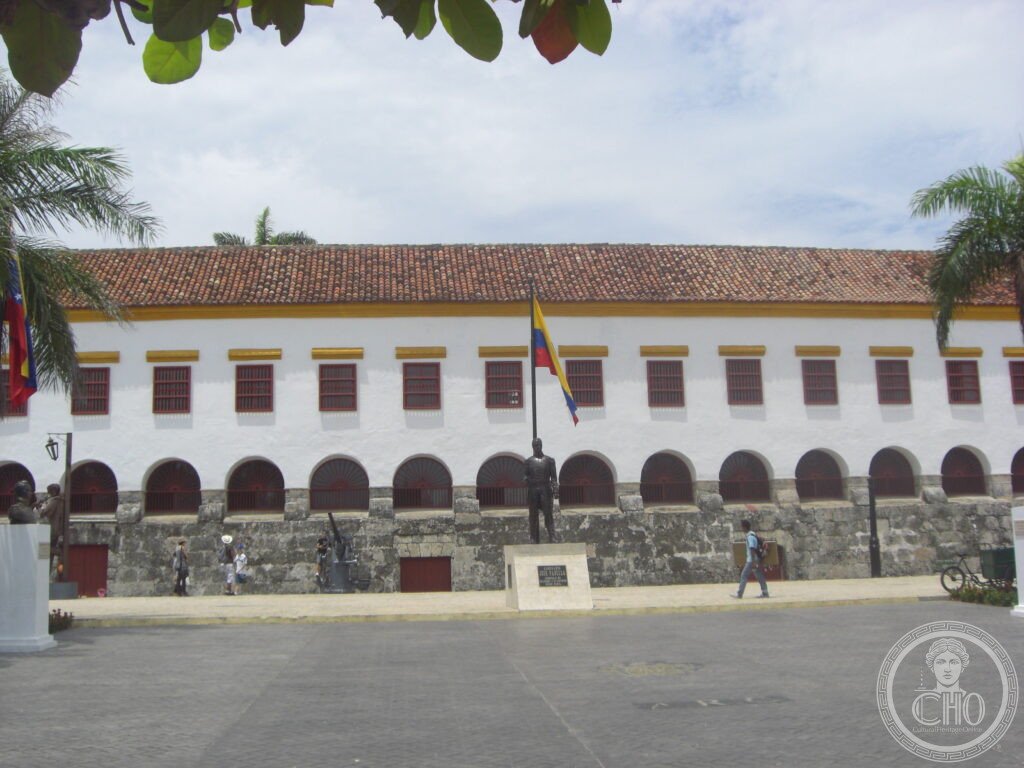
Behind eleven kilometres of intact Spanish colonial wall, Cartagena de Indias keeps the most complete fortified city to survive from the Spanish Empire in the Americas. It was once the treasure fleet’s Caribbean gateway and the main port through which enslaved Africans were brought into South America, a history still legible in its streets, gates and hilltop fortress.
At a glance
Cartagena de Indias, on Colombia’s Caribbean coast in Bolívar Department, is the most complete surviving Spanish colonial walled city in the Americas. Founded in 1533, it became the principal Atlantic port of the Spanish Empire, the departure point for Peruvian and Colombian silver and gold bound for Spain, and the main entry point for enslaved Africans brought into the Spanish colonies.
Its defences, built and strengthened between 1586 and 1796, form the most extensive Spanish colonial fortification system in the Americas, and the historic centre has been a UNESCO World Heritage Site since 1984.
Key facts
- Founded: 1533, by the Spanish conquistador Pedro de Heredia
- City walls: Las Murallas, built between 1586 and 1796, running for about 11 kilometres and standing 15 to 18 metres high with a base 17 to 20 metres thick
- Main fortress: Castillo de San Felipe de Barajas, begun in 1657 and enlarged between 1762 and 1769, the largest fortress built by Spain in the Americas
- World Heritage status: inscribed by UNESCO in 1984
- Notable figure: the Jesuit priest Pedro Claver, who worked among enslaved Africans in the city from 1610 until 1654 and was later canonised as patron saint of enslaved peoples and of Colombia
History
Cartagena de Indias was founded in 1533 by the Spanish conquistador Pedro de Heredia on the site of a Carib settlement, drawn by one of the best natural harbours on Colombia’s Caribbean coast. It took its name from the Spanish city of Cartagena, itself descended from Carthago Nova, founded by Hasdrubal of Carthage in 227 BCE.
After the English privateer Francis Drake sacked the city in 1586 and extracted a heavy ransom, Spain began building the Las Murallas walls that still ring the old town, and later raised the Castillo de San Felipe de Barajas on the hill above it, enlarged in the 1760s by the military engineer Antonio de Arévalo. In 1741 the British admiral Edward Vernon attacked Cartagena with a fleet of 186 warships and around 27,000 men, in what is remembered in Colombia as the greatest Spanish colonial military victory. The Spanish defence was led by Admiral Blas de Lezo, who had already lost an eye at Gibraltar, a leg at Toulon and an arm at Barcelona; after three months Vernon withdrew, having lost a large part of his force to fighting and disease.
Between 1533 and 1811 Cartagena was the main port through which enslaved Africans entered the Spanish colonies. The Jesuit priest Pedro Claver spent decades meeting arriving slave ships to offer medicine, food and comfort, and is said to have baptised around 300,000 enslaved people; his former cell survives as a museum on the Plaza de San Pedro Claver. Cartagena was among the first Colombian cities to declare independence from Spain, in 1811, and Simón Bolívar later used it as a base for his campaigns of liberation.
What you see
Inside the walls, the historic centre is Latin America’s most complete surviving Spanish colonial townscape. The wall walk runs almost continuously around the old city, giving views over the Bay of Cartagena and the Caribbean. The Torre del Reloj, the main gate, carries a baroque clocktower above the original 1609 entrance, and opens onto the Plaza de los Coches, once the city’s slave market and now lined with cafés. The Cathedral of Santa Catalina de Alejandría, built between 1575 and 1612, has a yellow-painted baroque façade and a bell tower damaged during Drake’s 1586 attack.
The Palace of the Inquisition, completed in 1776, has one of the most refined baroque façades in the city, its balconies carried on twisted Solomonic columns; inside, a museum sets out the history of the Inquisition in New Granada.
Two kilometres from the walled city, the Castillo de San Felipe de Barajas rises over the harbour, its tunnel system, some 300 metres of passages linking the bastions, built so that defenders could hear approaching enemies through the rock. Beyond the walls, Getsemaní, once home to Cartagena’s enslaved and free Afro-Colombian population, is now known for its street art and nightlife.
Practical information
- Getting around: the walled city is compact and best explored on foot; taxis serve the Castillo de San Felipe and Getsemaní.
- Climate: hot and humid throughout the year; it is worth checking seasonal conditions before travelling.
- Visiting the monuments: current admission arrangements and opening times for the Castillo, the Cathedral and the Palace of the Inquisition are best confirmed with the relevant local tourism or museum authority before visiting.
Getting there
Cartagena is served by Rafael Núñez International Airport, with connections to cities including Miami, New York, Madrid and Bogotá; schedules and routings are best checked directly with the airlines. The airport lies a short taxi ride from the walled city.
Nearby
- Castillo de San Felipe de Barajas — about two kilometres from the walled city, the hilltop fortress with its tunnel system.
- Getsemaní — the neighbourhood just outside the walls, known today for street art and nightlife.
- Bocachica fort — part of the outer chain of defences guarding the entrance to the bay.
- Bocagrande — the modern beach district along the coast.
Sources
- UNESCO
Find it on the map
See this place and what’s around it →📷 Become a Cultural Heritage Online photographer
Share your photos of places: they stay published under your name as the author. The more they're seen, the more you get noticed — and soon a contest will reward the most appreciated photos.
Log in or sign up free to add a photo