
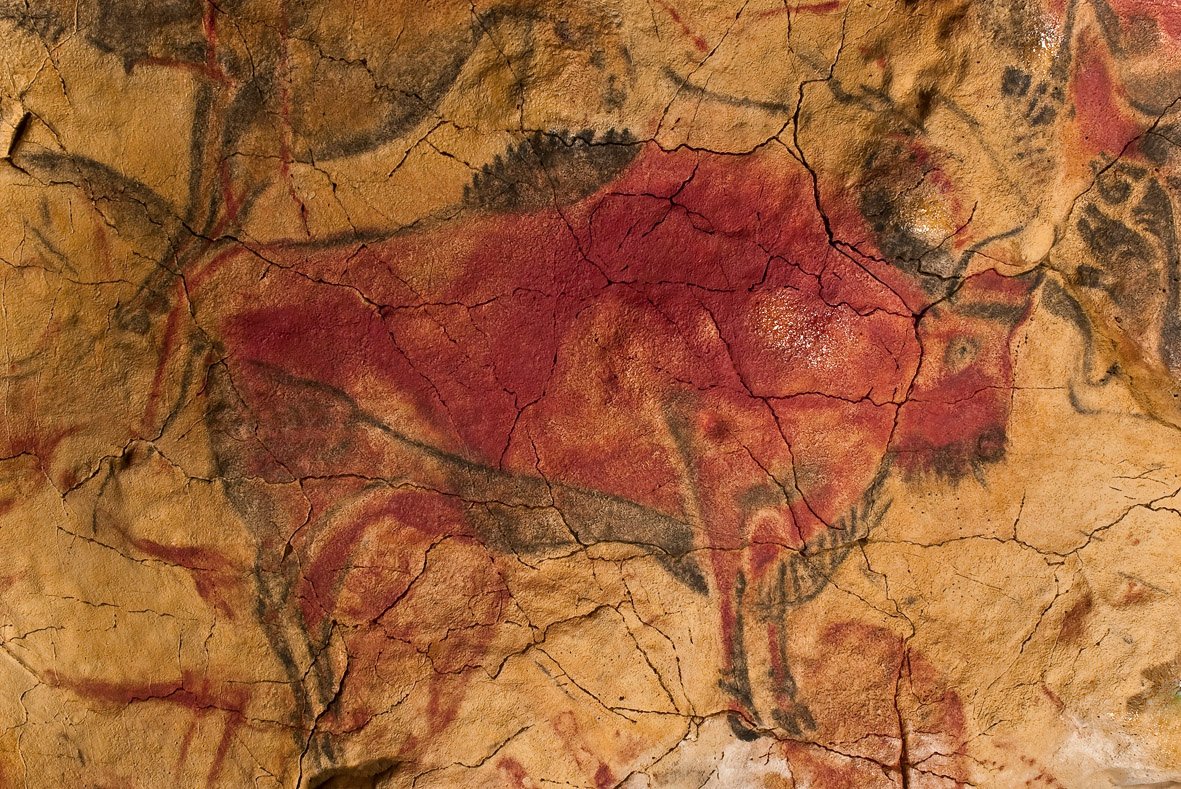
Cave of Altamira
A Girl Looked Up. Her Father Was Called a Liar. He Died Before the World Believed Her.
Overview
The Cave of Altamira, located near Santillana del Mar in Cantabria, northern Spain, contains one of the most extraordinary collections of prehistoric art in the world. Its painted ceiling — covered in polychrome bison, horses, deer, and other animals — represents Upper Paleolithic art spanning from approximately 36,000 BC to 14,000 BC, a period of over 22,000 years during which different human communities repeatedly used and painted the cave. Altamira was the first prehistoric cave site in the world to be discovered and recognised, in 1879, and the story of that discovery — including the eight-year-old girl who first saw the paintings, her father who was publicly denounced as a forger, and the posthumous vindication that came 14 years after his death — is one of the most remarkable episodes in the history of archaeology.
Location: Santillana del Mar, Cantabria, Spain — 43.3814° N, 4.1152° W
"Papá, Mira, Bueyes!" — The Discovery
On November 8, 1879, Marcelino Sanz de Sautuola entered the cave he owned on his estate near Santillana del Mar, accompanied by his eight-year-old daughter María. Sautuola had visited the cave before, examining the floor for stone tools and bones. This time María came with him. While her father worked bent over the ground, María wandered deeper into the cave and looked up at the low ceiling in the main chamber. She called out: "¡Papá, mira, bueyes!" — "Papa, look, bulls!"
What she saw on the ceiling was a cluster of bison — great, dark, muscular animals painted in ochre and charcoal with a sophistication that seemed impossible. The figures used natural protrusions in the rock to give the animals a three-dimensional quality. Some bison were curled as if resting, others stood alert. The composition was dynamic, even narrative. María Sanz de Sautuola, aged eight, had just discovered what are now recognised as among the finest Paleolithic paintings in the world.
The Fraud Accusation and a Life Destroyed
Sautuola presented his discovery at the International Congress of Prehistoric Anthropology and Archaeology in Lisbon in 1880. The response was immediate and hostile. The leading prehistoric archaeologists of the day — including Gabriel de Mortillet and Émile Cartailhac — declared the paintings obvious forgeries. The reasoning was circular: prehistoric humans were not capable of art at this level of sophistication, therefore these paintings could not be prehistoric. Some suggested Sautuola had hired a contemporary Spanish artist to paint the cave. The accusations were delivered with the full authority of the scientific establishment.
Sautuola spent the rest of his life attempting to defend his discovery. He died in 1888, still widely considered either a forger or a credulous fool. He was 48 years old. His daughter María — the girl who had first seen the paintings — lived to see the vindication her father never received.
Vindication: Fourteen Years Too Late
In 1901, archaeologists Louis Capitan and Henri Breuil discovered painted caves at Les Combarelles and Font-de-Gaume in the Dordogne valley of France. The paintings — undeniably Paleolithic, found in undisturbed contexts — were stylistically identical to those at Altamira. The scientific case for prehistoric forgery collapsed.
In 1902, Émile Cartailhac — one of the men who had most vocally condemned Sautuola — published a formal public retraction in the journal L'Anthropologie. The paper was titled "Mea Culpa d'un Sceptique" — "The Mea Culpa of a Sceptic." That same year, the Scientific Society of Spain formally rehabilitated Sautuola's reputation. It was 14 years after his death. María Sanz de Sautuola, by then a young woman, was finally believed.
The Paintings: 22,000 Years of Human Art
What makes Altamira unique among Paleolithic sites is its temporal depth. The cave's images were not created by a single human community: dating has established that the paintings span from approximately 36,000 BC to 14,000 BC — a period of over 22 millennia. Different groups of Upper Paleolithic humans, separated by thousands of years, returned to this same cave and added to its walls and ceiling.
The most famous section is the Polychrome Chamber (the Sala de los Polícromos), where approximately 25 animals are painted on the ceiling, largely bison, with additional horses, deer, and signs. The polychrome technique — using multiple pigments including ochre, hematite, charcoal, and manganese dioxide, blended and applied to exploit the natural contours of the rock — represents a sophisticated understanding of both materials and form. Some of the bison appear to have been created by a single dominant artist working in the same session; others are overlapping compositions from different periods.
The cave was first entered in 1868 by local hunter Modesto Cubillas, who showed it to Sautuola. Systematic excavation of the floor deposits was conducted by Sautuola (1879) and later by E. Hernández Pacheco (1924–1925).
Closure, Preservation, and the Lottery
Altamira was opened to the public in the 20th century and drew large visitor numbers. But human breath introduces CO2, moisture, and heat; body warmth raises the temperature inside the cave; foot traffic disturbs the floor. By the late 20th century, the paintings were showing signs of serious deterioration: green algae, fungal growth, and calcite deposits were advancing across surfaces that had survived 14,000 years of geological stability undisturbed.
The original cave is now essentially closed. Only 275 visitors per year are admitted, selected by lottery, under strictly controlled conditions. The waiting list is years long. Most visitors experience Altamira through the Neocueva ("New Cave"), a full-scale replica of the Polychrome Chamber built adjacent to the original and opened in 2001, which allows visitors to walk beneath reproductions of the paintings at 1:1 scale. The museum complex — Museo de Altamira — provides context through archaeological displays.
UNESCO and the Northern Spain Cave Art Network
Altamira was inscribed as a UNESCO World Heritage Site in 1985. In 2008, the designation was extended under the title "Cave of Altamira and Paleolithic Cave Art of Northern Spain," grouping Altamira with 17 other decorated caves in the Asturias and Cantabria regions, including El Castillo, La Pasiega, and Cueva de las Monedas. The extension recognised that the concentration of Paleolithic rock art in Cantabrian Spain is unparalleled — northern Spain and the French Périgord together contain roughly half of all known Upper Paleolithic cave art sites in the world.
Visitor Information
- Address
- Museo de Altamira, 39330 Santillana del Mar, Cantabria, Spain
- Original Cave Access
- Lottery only; 275 visitors per year; apply through the Museo de Altamira
- Neocueva (Replica)
- Open to general visitors year-round; full-scale reproduction of the Polychrome Chamber
- UNESCO
- WHS 1985 (extended 2008 as "Cave of Altamira and Paleolithic Cave Art of Northern Spain")
- Nearest City
- Santander, 30 km east; Santillana del Mar is a medieval town worth visiting in combination
Sources and Further Reading
- Cave of Altamira — Wikipedia
- Museo de Altamira — Official Site
- Cartailhac, Émile (1902). "Mea Culpa d'un Sceptique." L'Anthropologie, 13: 348–354.
- Sanz de Sautuola, Marcelino (1880). Breves apuntes sobre algunos objetos prehistóricos de la Provincia de Santander.
Find it on the map
See this place and what’s around it →📷 Become a Cultural Heritage Online photographer
Share your photos of places: they stay published under your name as the author. The more they're seen, the more you get noticed — and soon a contest will reward the most appreciated photos.
Log in or sign up free to add a photo