
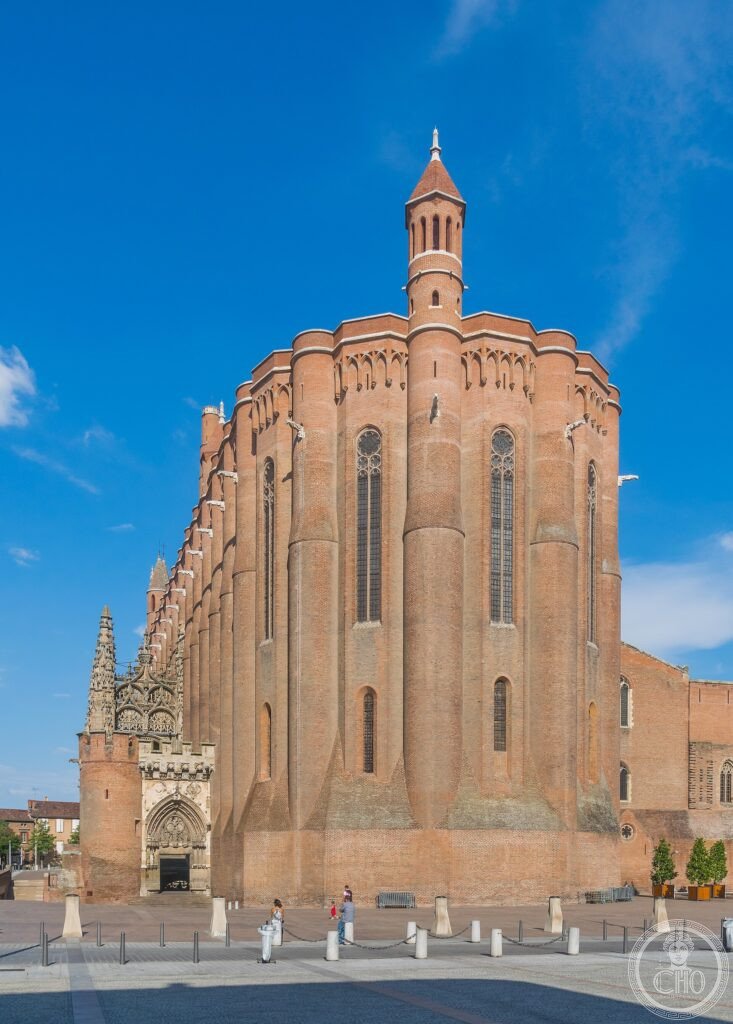
It does not look like a church but a castle: a single enormous block of pink brick as tall as a cliff, raised by the bishops after the crusade against the Cathars to remind everyone who was in charge. Inside, the surprise: the largest painted surface in Europe, from the Last Judgement to the blue-and-gold Renaissance vault.
At a glance
The cathedral of Sainte-Cécile dominates the old brick city of Albi, on the river Tarn in south-western France. Begun in 1282, it is the largest brick building in the world and one of the strangest of all Gothic cathedrals — an austere, windowless-looking fortress of rose-coloured brick, raised by the bishops in the decades after the Albigensian Crusade as a statement of the Church’s reconquered power over a land that had embraced the Cathar heresy. Inside, that severity gives way to the largest painted surface of any cathedral in Europe. With the bishops’ Berbie Palace and the surrounding episcopal city, it was inscribed by UNESCO in 2010.
Key facts
- UNESCO: World Heritage since 2010 (Episcopal City of Albi)
- Largest brick cathedral in the world: about 113 m long and 35 m high, built almost entirely of local rose-pink brick
- Begun 1282 by Bishop Bernard de Castanet, a former inquisitor of Languedoc; the fortress form proclaimed Church authority after the crushing of the Cathars
- Southern (Meridional) Gothic: a single vast hall without flying buttresses, utterly unlike its contemporaries Chartres, Reims and Amiens
- The most painted cathedral in Europe: a huge Last Judgment on the west wall and an early-16th-century vault painted blue and gold by Italian artists; a richly carved choir screen and rood loft
- Toulouse-Lautrec: the painter was born in Albi; the Berbie Palace beside the cathedral holds the world’s largest collection of his work
History
Albi gave its name to the Albigensians — the Cathars — and to the crusade launched against them in 1209. When the long war ended in the submission of the Languedoc to the French crown and the Church, the bishops of Albi set out to make their authority unmistakable. Bernard de Castanet began the cathedral in 1282 in brick (cheaper and quicker than stone) and in a deliberately military style: high blind walls, a single great keep-like tower, an entrance defended like a gate. The message was political as much as religious.
The interior was transformed in the late 15th and early 16th centuries, when the choir screen, the Last Judgment and the painted vault turned the fortress into a jewel-box. The episcopal city around it — the Berbie Palace, the Pont-Vieux, the old town of brick houses — survived intact, and the whole ensemble entered the World Heritage list in 2010.
What you see
From the outside the cathedral is overwhelming and bare: a cliff of brick with a single ornate stone porch (the Baldaquin) grafted onto its flank like an afterthought. Step inside and the effect reverses. The vast single nave is covered, wall and vault, with painting: the blue-and-gold Renaissance ceiling, the largest in France; on the west wall the great late-Gothic Last Judgment (its central Christ lost when a chapel was cut through it); and across the heart of the church the stone choir screen and rood loft, a lacework of Flamboyant carving filled with painted and gilded statues of prophets and saints.
Beside the cathedral, the Berbie Palace — one of the oldest and best-preserved bishops’ palaces in France — now houses the Toulouse-Lautrec Museum and its gardens above the Tarn.
Practical information
- Visiting: the cathedral is free; the choir/rood-loft area and the treasury are ticketed
- Combine with: the Musée Toulouse-Lautrec in the Berbie Palace next door
- Time needed: 1 hour for the cathedral, half a day with the museum and old town
Getting there
Albi is in the Tarn, about 75 km north-east of Toulouse. Trains from Toulouse reach Albi-Ville in about an hour; the cathedral is a short walk in the old town. GPS: 43.9281° N, 2.1428° E.
Nearby
- Musée Toulouse-Lautrec — in the Palais de la Berbie, beside the cathedral
- Cordes-sur-Ciel — a hilltop bastide town, 25 km north-west
- Toulouse — the “pink city” and the basilica of Saint-Sernin, 75 km south-west
Sources
- UNESCO World Heritage Centre — “Episcopal City of Albi” (ref. 1337)
- Albi Tourisme — Cathédrale Sainte-Cécile (albi-tourisme.fr)
- Encyclopaedia Britannica — Albi Cathedral
Find it on the map
See this place and what’s around it →
📷 Become a Cultural Heritage Online photographer
Share your photos of places: they stay published under your name as the author. The more they're seen, the more you get noticed — and soon a contest will reward the most appreciated photos.
Log in or sign up free to add a photoIs this page about you?
This page is read by travellers and heritage enthusiasts who find it on Google. Tell us how you are connected to this place and we will take it from there.