
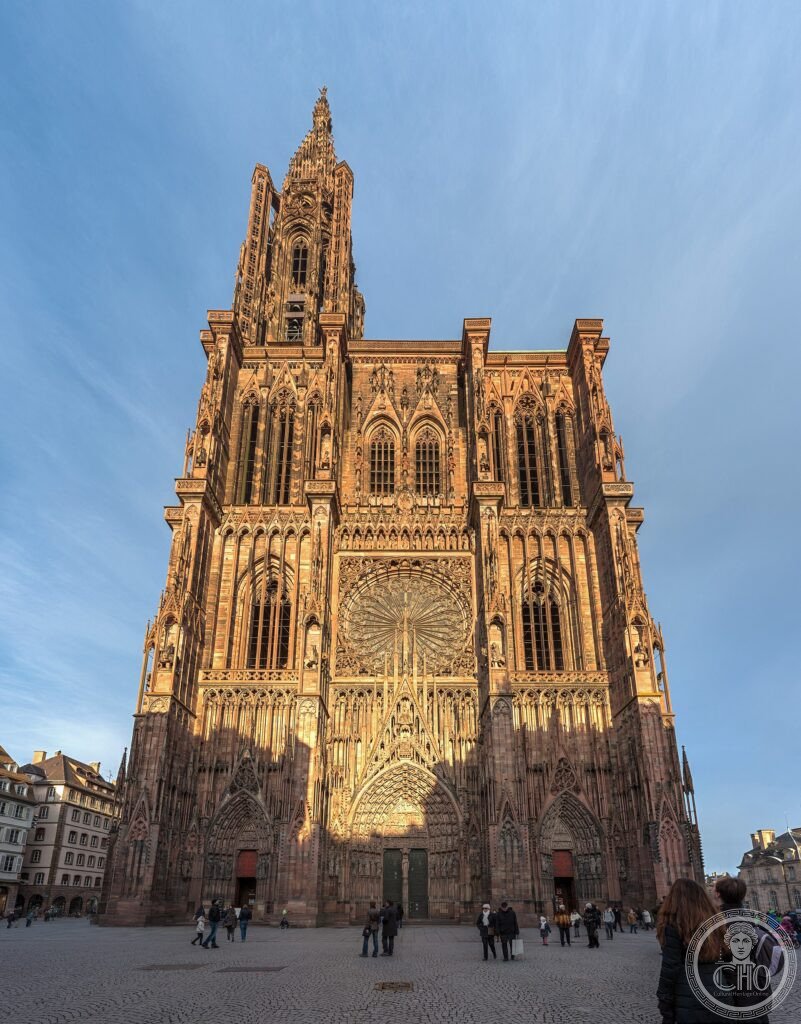
For more than two centuries — from 1647 to 1874 — it was the tallest building in the world, and it remains the tallest built entirely in the Middle Ages: the spire of Strasbourg, 142 metres of pink Vosges sandstone that changes colour with the sky. Inside, an astronomical clock stages the procession of the apostles every day.
At a glance
Strasbourg Cathedral rises in pink Vosges sandstone above the old town of the Grande Île, the island heart of the Alsatian city between the two arms of the river Ill. One of the masterpieces of Rayonnant Gothic, its single spire reaches 142 m — from 1647 to 1874 the tallest building in the world, and still the tallest structure built entirely in the Middle Ages. The lace-like west front, the Renaissance astronomical clock and the surrounding Grande Île — with the half-timbered Petite France quarter and the Palais Rohan — were inscribed by UNESCO in 1988.
Key facts
- UNESCO: World Heritage since 1988 (Strasbourg, Grande Île; extended in 2017 to include the Neustadt)
- The spire: 142 m, completed in 1439; the tallest building in the world from 1647 to 1874 and the highest surviving fully-medieval structure
- Material: the warm pink sandstone of the Vosges, whose colour shifts with the light and the sky
- Architects: Erwin von Steinbach is credited with the design of the great west front from 1277; the work passed through his family and later masters
- Astronomical clock: the present clock (1838–43, by Jean-Baptiste Schwilgué), third on the site since 1354 — at solar noon its automata stage the procession of the Apostles before Christ
- Grande Île: the historic island centre, with the Petite France quarter, the covered bridges, and the Palais Rohan
History
Begun in the late 12th century on the site of earlier churches, Strasbourg Cathedral grew from Romanesque beginnings into one of the great works of Gothic. From 1277 Erwin von Steinbach gave the west front its soaring, sculpture-rich design; the north tower and its single spire were finished in 1439, an engineering triumph that crowned the city skyline. For Goethe, who studied at Strasbourg, the cathedral was the very emblem of German Gothic art; its history, like the city’s, has been both French and German across the centuries.
The cathedral survived the Reformation (when it served Protestant worship for a time), the Revolution and the bombardments of 1870 and 1944. Restored each time, it remains a working cathedral and the focal point of a historic centre that, uniquely, was the first entire city centre to be listed by UNESCO.
What you see
The west front is a screen of pink stone tracery, its central rose window and the deep portals dense with statuary — among them the famous figures of the Church and the Synagogue and the Wise and Foolish Virgins. Inside, the tall nave leads to the great organ on its swallow’s-nest loft and to the astronomical clock in the south transept, beside the slender “Pillar of the Angels.” Climbing the 332 steps to the viewing platform at the foot of the spire gives a view over the rooftops of Alsace to the Black Forest and the Vosges.
Around the cathedral, the Grande Île repays wandering: the Petite France quarter with its timbered houses and locks, the covered bridges and the Vauban dam, and the Palais Rohan with its museums on the riverbank.
Practical information
- Visiting: the cathedral is free; the platform climb and the astronomical-clock show (with a film, around midday) are ticketed
- When: the Christmas market (Christkindelsmärik) around the cathedral is among the oldest in Europe
- Time needed: 1–2 hours for the cathedral, half a day for the Grande Île
Getting there
TGV trains reach Strasbourg from Paris in about 1h45; the cathedral is a 15-minute walk or a short tram ride from the station, in the pedestrian heart of the Grande Île. GPS: 48.5819° N, 7.7511° E.
Nearby
- Petite France & the covered bridges — the picturesque tanners’ quarter on the Ill
- Palais Rohan — the prince-bishops’ palace, now museums of fine arts, decorative arts and archaeology
- Alsace Wine Route — the villages and vineyards south toward Colmar
Sources
- UNESCO World Heritage Centre — “Strasbourg, Grande-Île and Neustadt” (ref. 495)
- Office de tourisme de Strasbourg — Cathédrale Notre-Dame (visitstrasbourg.fr)
- Encyclopaedia Britannica — Strasbourg Cathedral
Find it on the map
See this place and what’s around it →
📷 Become a Cultural Heritage Online photographer
Share your photos of places: they stay published under your name as the author. The more they're seen, the more you get noticed — and soon a contest will reward the most appreciated photos.
Log in or sign up free to add a photoIs this page about you?
This page is read by travellers and heritage enthusiasts who find it on Google. Tell us how you are connected to this place and we will take it from there.