
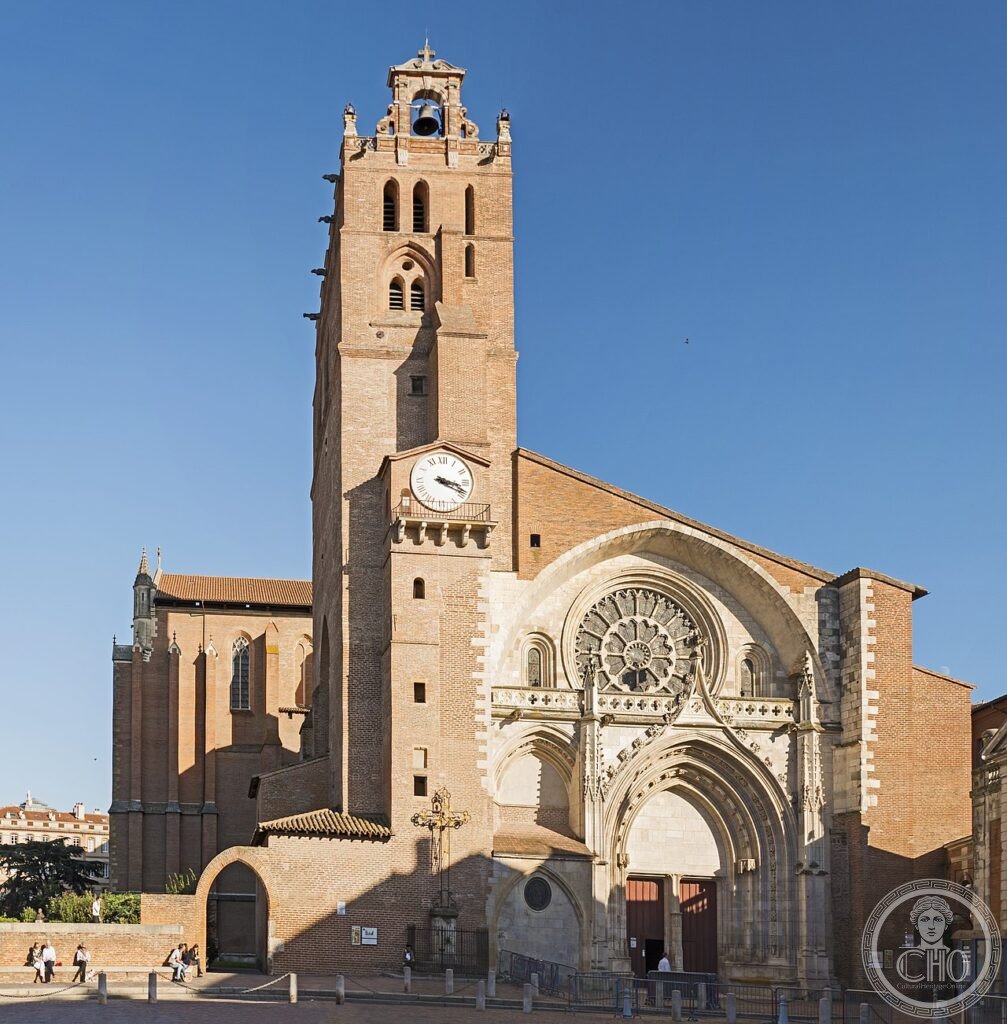
Il coro è il doppio della larghezza della navata, e l’asse centrale si spezza con un angolo visibile a occhio nudo: un cantiere mai completato ha lasciato alla cattedrale di Tolosa una facciata asimmetrica e un campanile che sembra schiacciare il portale.
At a glance
Toulouse Cathedral (Cathédrale Saint-Étienne) began its present form in 1272 under Bishop Bertrand de l’Isle, though the building’s overall appearance results primarily from two distinct and stylistically different construction campaigns: an early 13th-century nave built over the remains of the earlier Romanesque cathedral, in the Southern Gothic style, and a late-13th-century choir built in the Northern Gothic style more familiar from cathedrals like Chartres or Reims. The nave, known as the “Raimondine” nave for its long-standing (though likely inaccurate) attribution to Count Raymond VI of Toulouse, represents the first fully developed example of Southern Gothic architecture, characterised by a single wide-span volume supported by powerful external buttresses rather than the multiple narrower aisles typical of Northern Gothic — a design favouring open interior space suited to preaching. The building’s most famous and immediately visible characteristic, however, is structural rather than stylistic: the choir is roughly twice the width of the nave, meaning the cathedral’s central axis breaks at a visible angle where the two sections meet, a consequence of construction never being completed according to any single unified plan, leaving the building with an asymmetrical facade and a massive bell tower that appears to crowd against the main portal.
Key facts
- Construction: present building begun 1272 under Bishop Bertrand de l’Isle; combines an early 13th-century Southern Gothic nave with a late 13th-century Northern Gothic choir
- Raimondine nave: the first fully developed example of Southern Gothic architecture — a single wide-span volume on powerful buttresses, favouring open preaching space over multiple narrow aisles
- Off-axis design: the choir is roughly twice the width of the nave, causing the cathedral’s central axis to break at a visible angle — the building’s most distinctive and immediately noticeable architectural quirk
- Unfinished construction: the resulting asymmetrical facade and a massive bell tower that appears to crowd the main portal are both direct consequences of the project never being completed to any single unified plan
- Historic designation: the cathedral is documented in the French Base Mérimée heritage database and remains a functioning place of worship in the heart of Toulouse
History
Toulouse Cathedral’s genuinely unusual architectural profile reflects a specific and well-documented building history rather than any deliberate original design intention: the Raimondine nave, built in the early 13th century in the newly developed Southern Gothic style, and the Northern Gothic choir, added later in the same century, were conceived and executed as sequential rather than coordinated building campaigns, and the choir’s builders — working in a period when Toulouse and the wider Languedoc region had been drawn more closely into the political and cultural orbit of northern France following the Albigensian Crusade — appear to have planned the new choir at a scale and orientation that simply did not align with the already-completed nave, producing the visible axial break that remains the building’s most immediately noticeable feature today. Rather than being demolished and rebuilt to correct this misalignment, a costly and disruptive undertaking that most subsequent generations of builders chose not to pursue, the mismatch was simply left as a permanent structural characteristic of the completed building.
The broader pattern of interrupted, non-unified construction across the cathedral’s history — evident not only in the nave-choir axial break but in the asymmetrical facade and the disproportionately massive bell tower crowding the main portal — reflects the practical reality that major medieval cathedral projects frequently spanned periods of political, financial, and ecclesiastical instability long enough to prevent any single coherent building campaign from reaching full completion, with successive bishops, architects, and patrons each contributing partial work according to their own period’s resources and priorities rather than a single sustained master plan. Toulouse’s cathedral is, in this sense, a particularly legible example of a broader pattern visible in reduced form at numerous other French Gothic cathedrals whose construction similarly spanned multiple disconnected campaigns.
What you see
The visible break in the cathedral’s central axis, where the wide Northern Gothic choir meets the narrower Southern Gothic Raimondine nave, is the building’s single most distinctive feature and rewards deliberate attention when walking through the interior from nave to choir — a structural quirk immediately apparent to anyone looking for it, though easily missed by visitors unaware of the building’s specific construction history. The Raimondine nave’s wide, buttressed single-span volume gives a clear sense of Southern Gothic architecture’s distinctive open-preaching-space design philosophy, in direct visual contrast to the choir’s more conventionally Northern Gothic proportions and structure. The asymmetrical facade and the bell tower’s disproportionate mass relative to the main portal complete the building’s overall impression of accumulated, non-unified construction phases.
Practical information
- Opening hours: Monday-Saturday 8:00-19:00, Sunday 9:00-19:00; free admission
- Time needed: approximately 30-60 minutes for a self-guided visit
- Address: Place Saint-Étienne, 31000 Toulouse
Getting there
Toulouse has direct TGV rail connections from Paris (approximately 4.5 hours) and its own major airport. The cathedral stands near the François-Verdier metro station (Line B), approximately 10 minutes’ walk from Place du Capitole, with a dedicated underground car park (Parking Saint-Étienne) directly adjacent. GPS: 43.5999° N, 1.4507° E.
Nearby
- Basilique Saint-Sernin — in Toulouse’s centre; the largest surviving Romanesque church in Europe, UNESCO World Heritage as part of the Routes of Santiago de Compostela in France listing
- Les Jacobins — in the historic centre; a Gothic Dominican church famous for its palm-tree vaulted ceiling and the relics of Saint Thomas Aquinas
- Place du Capitole — Toulouse’s main square, approximately 10 minutes’ walk from the cathedral
Sources
- Toulouse Métropole — official heritage information (metropole.toulouse.fr)
- Archives de Toulouse — historical documentation (archives.toulouse.fr)
- Ministère de la Culture — heritage listing (culture.gouv.fr)
- Wikipedia — “Cathédrale Saint-Étienne de Toulouse” (fr.wikipedia.org)
Find it on the map
See this place and what’s around it →📷 Diventa un fotografo di Cultural Heritage Online
Condividi le tue foto dei luoghi: restano pubblicate con la tua firma come autore. Più vengono viste, più ti fai conoscere — e presto un concorso premierà le foto più apprezzate.
Accedi o registrati gratis per aggiungere una fotoDo you manage this place?
This page is read by travellers and heritage enthusiasts who find it on Google. Keep it accurate — and make it work for you. Free for non-profit heritage institutions.