
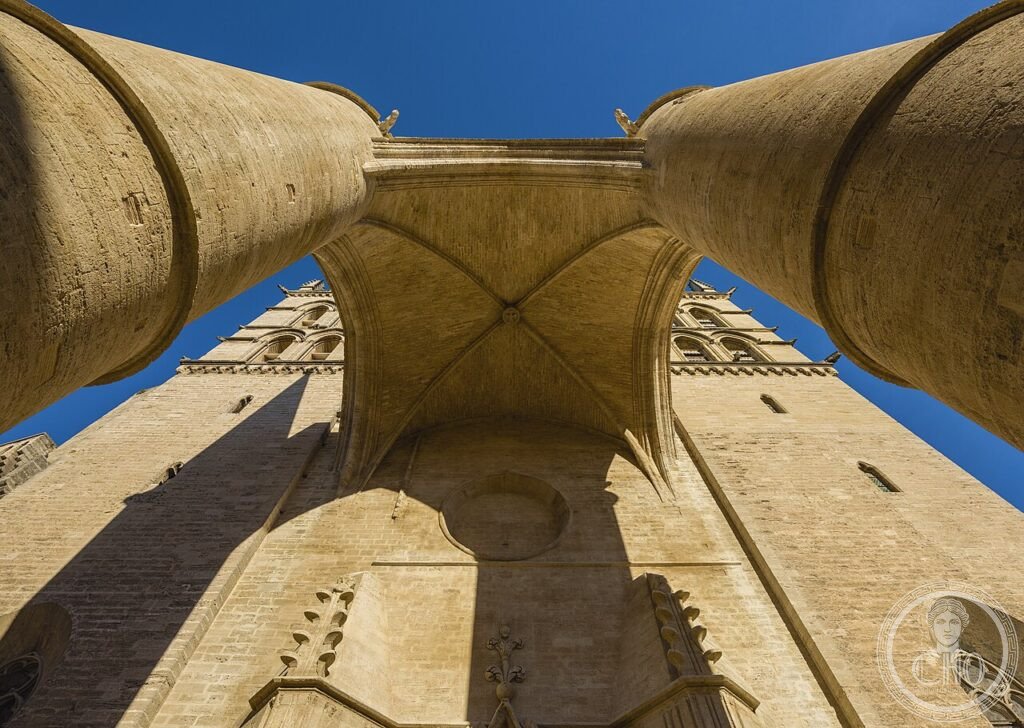
Due colonne circolari di 4,55 metri di diametro, coronate da coni di pietra, sorreggono un baldacchino gotico alto 25 metri: un ingresso che sembra più una fortezza che una chiesa. Sul fianco ovest, la cattedrale confina direttamente con la storica Facoltà di Medicina di Montpellier, tra le più antiche del mondo ancora attive.
At a glance
Montpellier Cathedral (Cathédrale Saint-Pierre) began as the chapel of the Saint-Benoît Saint-Germain monastery-college, founded in 1364 by Pope Urban V, a native of the Montpellier region, and only became a cathedral in 1536, when the episcopal seat was transferred from the nearby town of Maguelone to Montpellier itself. Its most immediately striking architectural feature is the west facade’s monumental porch, a 14th-century structure built in shell-bearing limestone whose vault rises to 25 metres, supported by two massive circular piers 4.55 metres in diameter, originally topped with Urban V’s coat of arms and crowned with distinctive conical stone caps — a design that gives the entrance a genuinely fortress-like character rather than the more typically ornamental Gothic portal treatment seen elsewhere. The cathedral’s west lateral facade directly adjoins the historic Faculty of Medicine of Montpellier, and when the episcopal seat (the former Saint-Benoît monastery) was secularised in 1795, the same complex became the seat of the medical school — physically and institutionally linking the cathedral to one of the world’s oldest continuously operating medical faculties.
Key facts
- Origins: chapel of the Saint-Benoît Saint-Germain monastery-college, founded 1364 by Pope Urban V; became a cathedral in 1536 when the episcopal seat transferred from Maguelone
- Baldaquin porch: 14th century, shell-bearing limestone, vault rising to 25 metres, supported by two circular piers 4.55 metres in diameter, originally bearing Urban V’s coat of arms, capped with conical stone crowns
- West facade: a harmonic two-tower facade combined with the monumental porch, giving the entrance a distinctively fortified appearance
- Faculty of Medicine connection: the west lateral facade directly adjoins Montpellier’s historic Faculty of Medicine; in 1795, the former episcopal palace (the old Saint-Benoît monastery) itself became the seat of the medical school
- Significance: Montpellier’s Faculty of Medicine, founded in the 12th century, is among the oldest continuously operating medical faculties in the world
History
Pope Urban V’s 1364 foundation of the Saint-Benoît Saint-Germain monastery-college reflected his personal connection to the Montpellier region and the broader medieval pattern of popes and senior clergy channelling patronage toward institutions in their home territories; the massive scale of the porch he commissioned — its 4.55-metre-diameter piers and 25-metre vault far exceeding what a purely functional monastic chapel entrance would require — suggests a deliberate ambition to give the building genuine monumental, almost defensive presence within the townscape, consistent with the broader fortified-church tradition found at various points across southern France during periods of regional instability. The building’s elevation to cathedral status only in 1536, more than 170 years after its original foundation, followed the administrative transfer of the diocese’s episcopal seat from Maguelone — itself a significant earlier cathedral site, now a proximity guide subject in its own right — to the larger, more strategically and economically significant city of Montpellier, a pattern of diocesan seat relocation toward growing urban centres documented at several French sees during the medieval and early modern periods.
The cathedral’s direct physical and institutional relationship with Montpellier’s Faculty of Medicine represents a particularly striking instance of ecclesiastical and secular/scientific institutions sharing continuous urban space: Montpellier’s medical school, with origins reaching back to the 12th century and formal university recognition from 1220, developed for centuries alongside the cathedral complex, and the 1795 secularisation that transformed the former episcopal palace into the medical faculty’s own seat — occurring in the immediate aftermath of the French Revolution’s sweeping reorganisation of both church property and higher education — formalised and made permanent a spatial relationship between religious and medical institutional life in Montpellier that had already existed, informally, for centuries.
What you see
The baldaquin porch is the cathedral’s essential architectural feature, its massive circular piers and soaring 25-metre vault giving visitors an immediate sense of the building’s unusually fortified, monumental character relative to typical Gothic cathedral entrances elsewhere in France. The harmonic twin-tower west facade frames this porch, while the immediate adjacency of the historic Faculty of Medicine building on the cathedral’s west side offers visitors a direct physical sense of the site’s dual religious and scientific institutional history, best appreciated by walking the full length of the shared complex from the cathedral porch toward the medical school’s own historic entrance.
Practical information
- Opening hours: Monday-Friday 10:30-11:45 and 14:30-18:00, Saturday 14:30-18:00; free admission, closed during services
- Guided tours: free tours organised by the cathedral’s Pastorale du Tourisme; contact 04 67 66 04 12
- Address: Rue de la Corraterie Saint-Germain, 34000 Montpellier
Getting there
Montpellier has direct TGV rail connections from Paris (approximately 3.5 hours) and its own airport. From Montpellier-Saint-Roch station, the cathedral is approximately 15 minutes’ walk, or reachable by tram line 1 (Louis Blanc stop) or lines 1/2 (Comédie stop). GPS: 43.6133° N, 3.8741° E.
Nearby
- Faculté de Médecine de Montpellier — directly adjoining the cathedral; one of the world’s oldest continuously operating medical faculties, with its own historic anatomical and botanical collections
- Jardin des Plantes de Montpellier — near the medical faculty; France’s oldest botanical garden, founded 1593
- Place de la Comédie — Montpellier’s central square, a short walk from the cathedral
Sources
- Paroisse Cathédrale Montpellier — official visitor portal (cathedrale-montpellier.fr)
- Montpellier Tourisme — official visitor information (montpellier-tourisme.fr)
- Ministère de la Culture — official cathedral visitor page (cathedrale-saint-pierre-de-montpellier.culture.gouv.fr)
- Wikipedia — “Cathédrale Saint-Pierre de Montpellier” (fr.wikipedia.org)
Find it on the map
See this place and what’s around it →📷 Become a Cultural Heritage Online photographer
Share your photos of places: they stay published under your name as the author. The more they're seen, the more you get noticed — and soon a contest will reward the most appreciated photos.
Log in or sign up free to add a photoIs this page about you?
This page is read by travellers and heritage enthusiasts who find it on Google. Tell us how you are connected to this place and we will take it from there.