
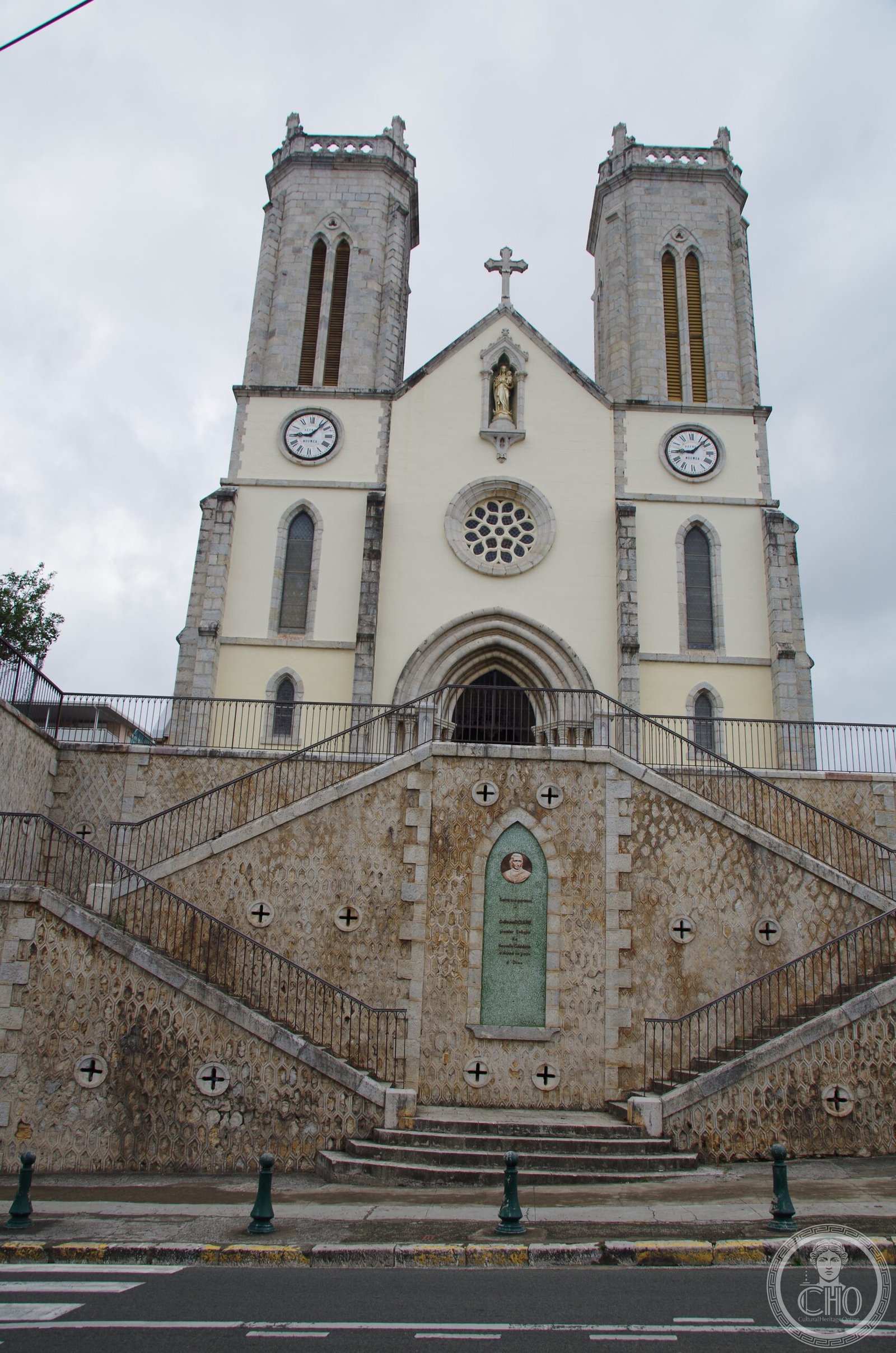
In Nouméa, the capital of New Caledonia, earthworks on the cathedral’s raised site began in 1876. The church itself was built between 1887 and 1897, though some sources date the building to 1888 instead. The labour came from the bagne, the French penal colony active on the island from 1864 to 1897. The design is credited to «Labulle», a former convict, and not to a professional architect in the usual sense. The church was blessed on 26 October 1890 by Father Xavier Montrouzier, a hospital chaplain, opened for worship on the following All Saints’ Day, and consecrated by Bishop Julien Vidal, Vicar Apostolic of Fiji, before the facade and the bell towers were finished. The exact date of the consecration is reported inconsistently: 1893 according to Wikipedia, 1894 according to other sources. The Marist missionaries, who founded the Catholic presence on the island, had landed north of Nouméa on 18 December 1843, decades before this particular building went up. The style is colonial with neo-Gothic elements, and has sometimes been compared to the cathedrals of Latin America. The plan is a Latin cross 56 metres long, with a transept 36 wide and a height of 15.5 metres. The nave has five bays with sexpartite rib vaults, and the choir two straight bays and five polygonal ones. The two towers, 25 metres high, and the buttresses are of cut stone; the walls are of pebble masonry with lime mortar; the vaults and the load-bearing frame are of red kauri wood. A taller spire was given up at the design stage, because of the risk of cyclones. Inside there are 28 stained-glass windows and a high altar carved in 1860, brought from the earlier Mission of Saint-Louis. There are carvings in tamanu wood in the choir, the pulpit and the chapels, and fonts made from the shells of giant clams. A chandelier was made from one of the first pieces of New Caledonian nickel, inspired by a similar one in the church of the Madeleine in Paris. The organ is a Mutin-Cavaillé-Coll of 1908. The apostolic vicariate of New Caledonia was erected by Pope Pius IX on 1 July 1847 — 27 June, according to another source — as a division of the apostolic vicariate of Western Oceania. Pope Paul VI raised it to the archdiocese of Nouméa on 21 June 1966, and the church of Saint-Joseph became its cathedral. Between 1966 and 1968 Father Jean-Marie Tjibaou served here as second curate, before he left the priesthood for politics. He became the leader of the Kanak independence movement and was assassinated in 1989: a direct and well documented link between the cathedral and the later history of Kanak independence. No papal visit is documented, and there is no record of a specific episode of cyclone damage, or of the cathedral being caught up in the Kanak independence clashes of the Eighties and Nineties. An association called «La cathédrale, notre patrimoine» was set up in 2007 to lead a restoration campaign: the outside works are complete, and a third phase of interior restoration, on the wiring and the woodwork, ended in 2020. The cathedral was also named a jubilee church for the Extraordinary Jubilee of Mercy of 2016. The present archbishop is Monsignor Susitino Sionepoe, appointed on 14 January 2025. The building has been listed as a French historic monument since 20 August 1992.
About Cathédrale Saint-Joseph
In Nouméa, the capital of New Caledonia, earthworks on the cathedral’s elevated site began in 1876, while the church’s actual construction ran from 1887 to 1897 — though some sources instead date the building to 1888 — using labor from the bagne, the French penal colony active on the island from 1864 to 1897; the design is attributed to “Labulle,” a former convict, rather than a conventionally credentialed architect. The church was blessed on 26 October 1890 by Father Xavier Montrouzier, a hospital chaplain, opened for worship the following All Saints’ Day, and consecrated by Bishop Julien Vidal, Vicar Apostolic of Fiji, before its façade and bell towers were even complete; the exact consecration date is reported inconsistently, as either 1893 or 1894.
Key facts
- 1887-1897: the cathedral designed and built by penal-colony convict labor.
- 1890-1893/94: blessed, opened for worship, and consecrated.
- 21 June 1966: elevated to the seat of the newly created Archdiocese of Nouméa.
- 1966-1968: future Kanak independence leader Jean-Marie Tjibaou serves as its vicar.
- 20 August 1992: classified a French historic monument.
- 2007-2020: a long community-led restoration campaign.
History
Designed by a former convict and built by prisoners of France’s Pacific penal colony, Cathédrale Saint-Joseph is a rare building whose very construction is a physical artifact of New Caledonia’s history as a bagne. Its later biographical link to Jean-Marie Tjibaou — who served as the cathedral’s vicar in the 1960s before leaving the priesthood to lead the Kanak independence movement, ultimately assassinated in 1989 — connects the building, however indirectly, to one of the defining political struggles of modern New Caledonia.
What you see
A colonial building with Neo-Gothic elements, sometimes compared to Latin American cathedrals, rises in a Latin-cross plan with twin 25-metre stone towers, its taller spire abandoned at the design stage specifically because of cyclone risk. Inside, an 1860 high altar inherited from the earlier Mission de Saint-Louis, tamanu-wood carvings, baptismal fonts made from giant clam shells, and a chandelier fashioned from early New Caledonian nickel furnish a nave built with red kauri wood vaulting over rubble-masonry walls.
Practical information
- Opening hours: generally open daily outside services; check current hours before visiting.
- Address: 3 rue Frédéric Surleau, 98845 Nouméa, New Caledonia.
Getting there
The cathedral stands on an elevated site overlooking Nouméa, easily reached on foot from the city center. GPS: 22°16′22″S, 166°26′40″E.
Nearby
- Central Nouméa — the city’s main commercial and administrative district, visible from the cathedral’s hilltop site.
Sources
- French Wikipedia — “Cathédrale Saint-Joseph de Nouméa” and “Archidiocèse de Nouméa”
- Wikipedia — “Nouméa Cathedral” and “Roman Catholic Archdiocese of Nouméa” (en.wikipedia.org).
- Diocese of Nouméa — official parish page (diocese.ddec.nc).
Find it on the map
See this place and what’s around it →📷 Become a Cultural Heritage Online photographer
Share your photos of places: they stay published under your name as the author. The more they're seen, the more you get noticed — and soon a contest will reward the most appreciated photos.
Log in or sign up free to add a photo