

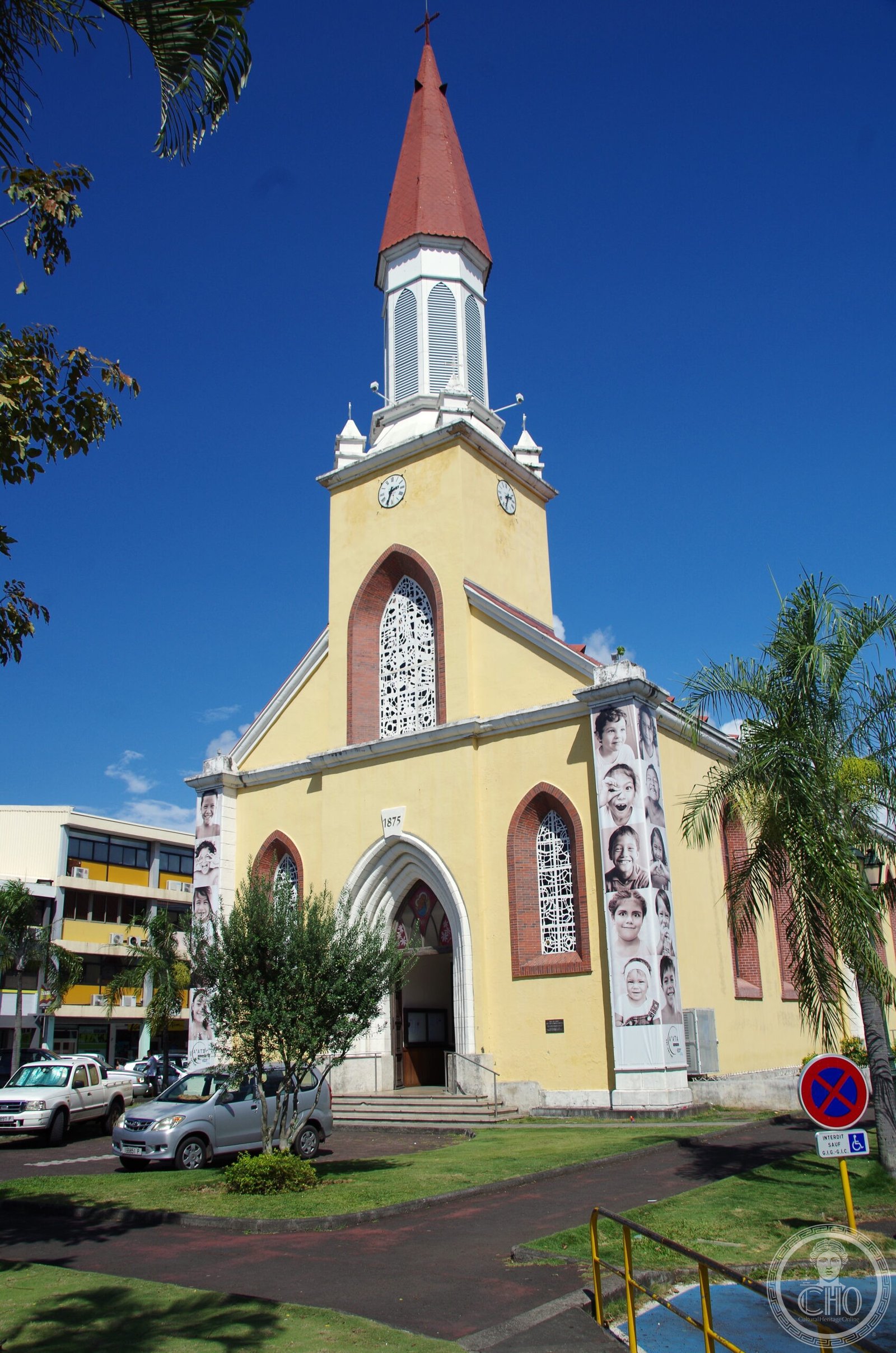
In Papeete, the capital of Tahiti, in French Polynesia, the plan for the Cathedral of the Immaculate Conception was conceived as early as 1844. Building began only in 1856-1857, directed by the bishop and carried out by about fifty skilled craftsmen brought from the island of Mangareva, in the Gambier Islands. Work stopped between 1857 and 1870. In that time the Mangarevan craftsmen took three already carved portals home with them to finish the sculpting, before the French colonial administration resumed and completed the work between 1870 and 1875. The cathedral was consecrated on 23 December 1875 by Bishop Étienne «Tepano» Jaussen, the first Vicar Apostolic of Tahiti and a member of the Congregation of the Sacred Hearts of Jesus and Mary. The authorship of the design is shared: Jaussen inspired and directed the first phases, and the colonial administration paid for and carried out the completion. It is described as the oldest Catholic church on Tahiti, in a style that combines partly Gothic forms with Polynesian ornament. The facade is yellow, restored to its original colour in 2005 after decades painted white, then white and blue. It has two pilasters, three pointed-arch windows with stained glass, and a hexagonal bell tower crowned by a red spire 39 metres high. The building is about 40 metres long and 15 wide, and holds an estimated 400 worshippers. Inside are a Madonna and Child carved in wood, from the Marquesas, the Child shown holding a breadfruit; a Polynesian Way of the Cross of 1971, the work of Yuel Durnad and «St Fond», which shows only Polynesian figures; and a marble mosaic of Christ Pantocrator, whose date the sources give variously as 1968 or 2008. Three bells, blessed on 19 December 1875, bear the names «Marie Charlotte» — the gift of Marshal Mac-Mahon, then president of France — «Emilie Octavie» and «Anne Martin», given by Admiral Fourichon. The use of coral stone in the building is not confirmed, although the technique is documented for other churches in the region, such as Rikitea in the Gambiers. Protestantism, brought by the London Missionary Society, dominated the religious life of Tahiti from the early nineteenth century, with Queen Pomare IV close to the British consul and missionary agent George Pritchard. The Catholic missionaries, who arrived in 1834, met resistance and were expelled between December 1836 and January 1837 under Pritchard’s influence. France answered with the naval interventions of Commander Abel Aubert Dupetit-Thouars in 1838 and in 1842, which led to a French protectorate in 1842, ratified in 1843, with full religious freedom guaranteed. The episode is known as the «Pritchard affair», and lies at the origin of the so-called Franco-Tahitian war. The apostolic vicariate of Eastern Oceania, set up in 1833, was renamed the apostolic vicariate of Tahiti on 9 May 1848, with Jaussen as its first vicar, and raised to the metropolitan archdiocese of Papeete on 21 June 1966, when the cathedral of 1875 became its seat. The archdiocese today also has a co-cathedral, «Maria no te Hau», likewise in Papeete. A cyclone in 1906 came close to destroying the building, which survived, while in 1914 a German naval bombardment of Papeete, during the First World War, is said to have damaged the cathedral. A cyclone in 1983 and the civil unrest of 1987 are cited as events the building «lived through», with no precise account of the damage. No pope has ever visited French Polynesia. The building has belonged to the commune of Papeete since 1890, and does not appear on the list of historic monuments of French Polynesia: it enjoys only informal cultural recognition, not legal heritage protection. The present archbishop of Papeete is Monsignor Jean-Pierre Edmond Cottanceau, in office since 15 December 2016. The cathedral also marks the zero kilometre point from which road distances on the island of Tahiti are measured.
About Cathédrale Notre-Dame de Papeete
In Papeete, the capital of Tahiti, French Polynesia, the project for the Cathedral of the Immaculate Conception was conceived as early as 1844, but construction only began in 1856-1857, directed by the bishop and carried out by roughly fifty skilled craftsmen brought from Mangareva in the Gambier Islands; work halted between 1857 and 1870, during which time the Mangarevan craftsmen took three already-carved portals back home to finish the sculpting, before the French colonial administration resumed and completed the work between 1870 and 1875. The cathedral was consecrated on 23 December 1875 by Bishop Étienne “Tepano” Jaussen, the first Vicar Apostolic of Tahiti, a member of the Congregation of the Sacred Hearts of Jesus and Mary.
Key facts
- 1856-1875: the cathedral built in phases, with a work stoppage between 1857 and 1870.
- 23 December 1875: consecrated by Bishop Étienne “Tepano” Jaussen.
- 19 December 1875: three bells blessed, including one donated by French President Mac-Mahon.
- 21 June 1966: the cathedral of the newly created Archdiocese of Papeete.
- 2005: a full restoration returns the façade to its original yellow color.
- 1890-present: owned by the commune of Papeete, without formal historic-monument protection.
History
Built by Mangarevan craftsmen who paused construction for over a decade to finish carving the cathedral’s doors back on their home island, Notre-Dame de Papeete’s unusual, interrupted building history reflects the wider Catholic-Protestant rivalry that shaped 19th-century Tahiti — a rivalry that saw French Catholic missionaries expelled in 1836-37 under the influence of British Protestant consul George Pritchard, provoking French naval intervention and the establishment of a French protectorate in 1842. Surviving a nearly catastrophic 1906 cyclone and reported damage from a 1914 German naval bombardment, the cathedral remains municipal property of Papeete without formal heritage-monument status, unlike some of French Polynesia’s other historic churches.
What you see
A yellow façade with pointed-arch stained-glass windows and a hexagonal bell tower topped by a 39-metre red spire blends partly Gothic form with Polynesian decorative elements. Inside, a Marquesan wood-carved Madonna and Child depicts the Child holding a breadfruit, alongside a 1971 Stations of the Cross rendered entirely in Polynesian figures and three named bells, one a gift from French President Mac-Mahon in 1875.
Practical information
- Opening hours: generally open daily outside services; check current hours before visiting.
- Address: Place de la Cathédrale, Papeete, Tahiti, French Polynesia.
Getting there
The cathedral stands on Place de la Cathédrale in central Papeete, marking the zero-kilometer point for road distances on Tahiti, and is easily reached on foot from the city center. GPS: 17°32′25″S, 149°34′01″W.
Nearby
- Place de la Cathédrale — the central square adjoining the cathedral.
Sources
- French Wikipedia — “Cathédrale Notre-Dame de Papeete” and “Archidiocèse de Papeete”
- Wikipedia — “Cathedral of Notre Dame of Papeete” and “Franco-Tahitian War” (en.wikipedia.org).
- Tahiti Heritage — “Cathédrale Notre-Dame, Papeete” (tahitiheritage.pf).
Find it on the map
See this place and what’s around it →📷 Become a Cultural Heritage Online photographer
Share your photos of places: they stay published under your name as the author. The more they're seen, the more you get noticed — and soon a contest will reward the most appreciated photos.
Log in or sign up free to add a photo