
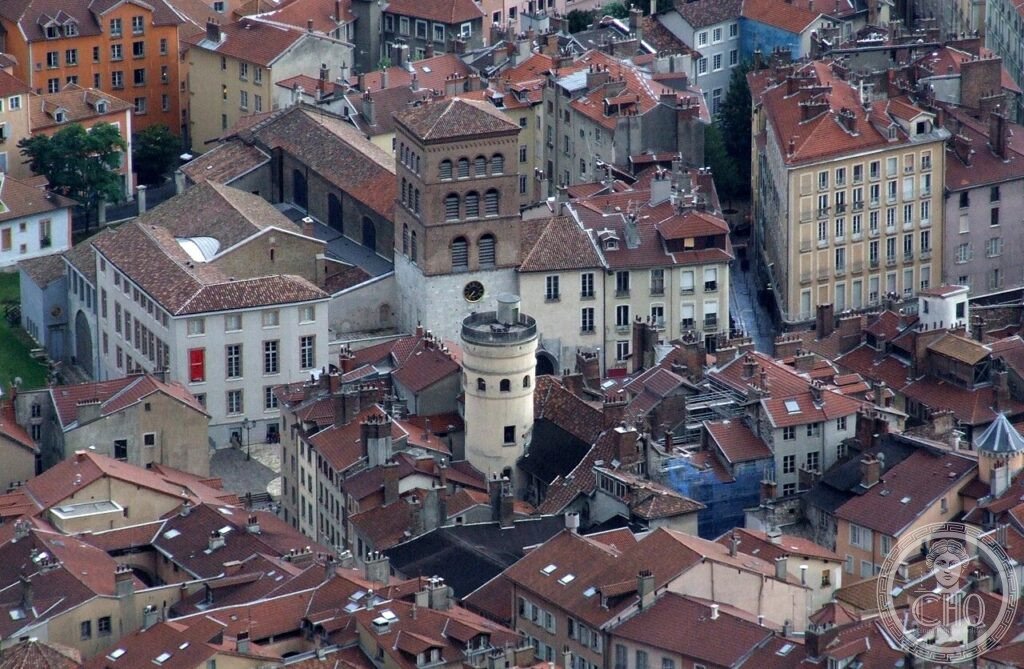
Beneath the forecourt, the remains of the cathedral’s first baptistery, of the fourth century, lay forgotten until 1989. Inside, a Flamboyant Gothic ciborium 14 metres high, commissioned in 1455 by Bishop Siboud Alleman, lost its statues in 1562, destroyed by the Calvinists of the Baron des Adrets during the wars of religion.
At a glance
Grenoble Cathedral (Cathédrale Notre-Dame) stands on a site with continuous religious use traceable to the Roman period, located near the ancient Roman rampart of Cularo, close to the Viennese or Herculean gate dedicated to Emperor Maximian. Construction of the present cathedral began in the 10th century, and the building fell into gradual neglect through the mid-20th century, its restoration incomplete by 1966, before an unexpected 1989 discovery reinvigorated both scholarly and civic interest: the remains of the cathedral’s first baptistery, dating to the 4th century, were found beneath the site, connecting the building directly to some of the earliest documented Christian activity in the region. Inside, the cathedral’s principal artistic treasure is its ciborium, commissioned in 1455 by Bishop Siboud Alleman: a richly decorated Flamboyant Gothic structure in Voreppe stone standing 14 metres tall, presented as an elaborate facade topped by a crocket-adorned bell tower with flying buttresses, though the statues that originally filled its niches were destroyed in 1562 by Calvinist forces under the Baron des Adrets during the French Wars of Religion.
Key facts
- Site history: located near the Roman rampart of ancient Cularo, close to the Viennese/Herculean gate dedicated to Emperor Maximian; continuous religious use traceable to the Roman period
- Construction: present cathedral begun 10th century
- 4th-century baptistery: remains discovered unexpectedly in 1989, connecting the site to the earliest documented Christian presence in Grenoble
- Ciborium: commissioned 1455 by Bishop Siboud Alleman; Flamboyant Gothic, Voreppe stone, 14 metres tall, with a crocket-adorned bell tower and flying buttresses
- 1562 destruction: the ciborium’s original statues, filling its niches, were destroyed by Calvinist forces under the Baron des Adrets during the French Wars of Religion
History
Grenoble’s religious history at this specific site stretches back to the Roman period, when the settlement of Cularo stood as a fortified town with its own defensive rampart, and the cathedral’s later medieval and early modern development occupied ground already carrying centuries of prior significance — a continuity dramatically confirmed by the 1989 discovery of the 4th-century baptistery remains, a find that had gone entirely undetected through all the building’s medieval and early modern construction phases and only came to light following a period of 20th-century neglect during which restoration work had stalled by 1966. The baptistery’s rediscovery gave the cathedral renewed civic and diocesan significance, connecting the present building physically and historically to the earliest phase of organised Christian practice in the region, a connection now presented to visitors via the adjoining Musée de l’Ancien Évêché.
The ciborium’s history illustrates the broader pattern of religious violence that swept through French cities during the Wars of Religion (1562-1598): Bishop Siboud Alleman’s 1455 commission had produced, by the standards of Flamboyant Gothic ecclesiastical furnishing, an exceptionally ambitious 14-metre structure, its niches originally filled with sculpted figures forming part of the overall decorative programme, but the Calvinist forces under the Baron des Adrets who took Grenoble in 1562 specifically targeted this kind of elaborate Catholic devotional sculpture as part of the iconoclastic violence characteristic of the period’s religious conflict, destroying the ciborium’s statues while — notably — leaving the structure’s architectural framework itself largely intact, a pattern of selective destruction (removing figurative imagery while sparing architectural fabric) documented at numerous French churches during the same conflict.
What you see
The ciborium remains the cathedral’s essential single artwork, its 14-metre Flamboyant Gothic structure — elaborately decorated facade, crocket-adorned bell tower, flying buttresses — giving a clear sense of the ambition of Bishop Siboud Alleman’s 1455 commission even with its original sculptural figures lost to 1562 iconoclasm. The 4th-century baptistery remains, discovered in 1989, are displayed via the adjoining Musée de l’Ancien Évêché, giving visitors direct access to the site’s earliest documented Christian-era fabric. The cathedral’s broader Romanesque-to-Gothic architectural layering, spanning from its 10th-century origins through later medieval additions, rewards visitors interested in tracing the building’s centuries-long development.
Practical information
- Opening hours: open daily, free admission; check current hours before visiting, particularly for baptistery access
- Musée de l’Ancien Évêché: free admission, houses the baptistery remains
- Address: 8 Place Notre-Dame, 38000 Grenoble
Getting there
Grenoble has direct TGV rail connections from Paris (approximately 3 hours) and Lyon (approximately 1 hour). The cathedral stands on Place Notre-Dame in the historic centre, easily reached by Grenoble’s tram network. GPS: 45.1926° N, 5.7321° E.
Nearby
- Musée de l’Ancien Évêché — directly adjoining the cathedral; the 4th-century baptistery remains and regional history exhibits
- Bastille de Grenoble — reachable by cable car from the city centre; a hilltop fortress with panoramic views over Grenoble and the surrounding Alps
- Musée de Grenoble — in the city centre; one of France’s most significant regional fine art collections
Sources
- Cathédrale Notre-Dame de Grenoble — official visitor portal (cathedraledegrenoble.com)
- Grenoble Patrimoine — heritage documentation, “Groupe épiscopal” (grenoble-patrimoine.fr)
- Grenoble Tourisme — official visitor information (grenoble-tourisme.com)
- Wikipedia — “Cathédrale Notre-Dame de Grenoble” (fr.wikipedia.org)
Find it on the map
See this place and what’s around it →📷 Become a Cultural Heritage Online photographer
Share your photos of places: they stay published under your name as the author. The more they're seen, the more you get noticed — and soon a contest will reward the most appreciated photos.
Log in or sign up free to add a photoIs this page about you?
This page is read by travellers and heritage enthusiasts who find it on Google. Tell us how you are connected to this place and we will take it from there.