

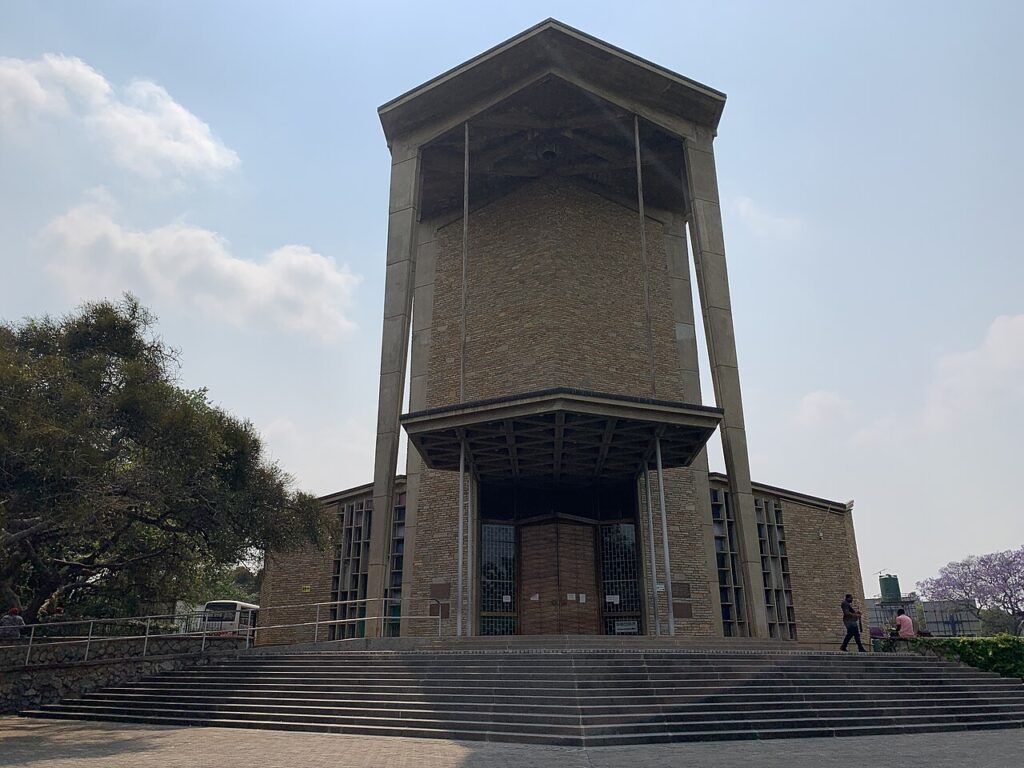
The concrete cathedral of independence-era Zambia – consecrated as the colonial flag came down, the national church of state funerals and jubilees.
At a glance
- Type
- Anglican cathedral
- Period
- 1957-1962
- Style
- Tropical Modernism
- Location
- Cathedral Hill, Lusaka, Zambia
- Coordinates
- -15.4205, 28.3097
- Architect
- Richard Nickson
Overview
The Anglican Cathedral of the Holy Cross stands on Cathedral Hill beside Zambia’s parliament and courts – a long nave of raw concrete and brick whose simple monumental forms mark the passage from colonial Northern Rhodesia to independent Zambia. Begun in 1957 and consecrated in 1962, two years before independence, it became the ceremonial church of the new nation.
History
The cathedral’s foundation stone was laid by Queen Elizabeth the Queen Mother; by its consecration the federation it was built under was dissolving, and Kenneth Kaunda’s independent Zambia adopted the building for state occasions – presidential funerals, independence jubilees, and the national prayers that punctuate Zambian public life. The interior holds memorials of the freedom struggle alongside colonial-era plaques, a reconciliation in stone.
Architecture and Design
Nickson’s design strips Gothic to its diagram: a tall parabolic-arched nave in board-marked concrete, brick infill, and full-height glazing at the west end flooding the sanctuary with highveld light. The free-standing campanile and the copper-clad roofline give the hill its silhouette; engaged artists added Zambian woodcarving and the great tapestry behind the altar.
Cultural significance
The cathedral is Zambia’s Westminster Abbey – the church of state mourning and national thanksgiving – and one of southern Africa’s notable modernist religious buildings, documenting the optimistic concrete idiom of the independence decade.
Visiting today
Open daily with a welcoming congregation; Sunday services mix English and Zambian languages and music. The national assembly and the freedom statue stand nearby on the ridge.
Getting there
Cathedral Hill adjoins Independence Avenue in central Lusaka; taxis and ride-hailing reach it from anywhere in the city in minutes.
Lusaka could not be granted city status without a cathedral, so the colonial government gave the site in 1951; the first independence thanksgiving service was held here on 24 October 1964, and the flag from that service still hangs inside.
Sources and resources
Find it on the map
See this place and what’s around it →Record researched and written by Luigi De Marchi for Cultural Heritage Online, 2026.
At auction this weekArt Deco glass, lighting and furniture are sold at auction every weekPieces from the 1920s and 1930s are open for bidding today on Catawiki, where an expert checks each lot before it goes live.See what is open on Catawiki →
Advertisement. Pictured, from the Cleveland Museum of Art (CC0) and not for sale: three pieces of Lalique glass, 1920 to 1931. How we handle this
📷 Become a Cultural Heritage Online photographer
Share your photos of places: they stay published under your name as the author. The more they're seen, the more you get noticed — and soon a contest will reward the most appreciated photos.
Log in or sign up free to add a photoIs this page about you?
This page is read by travellers and heritage enthusiasts who find it on Google. Tell us how you are connected to this place and we will take it from there.
This entry stays online and free either way — and a free account lets you add to it yourself.