
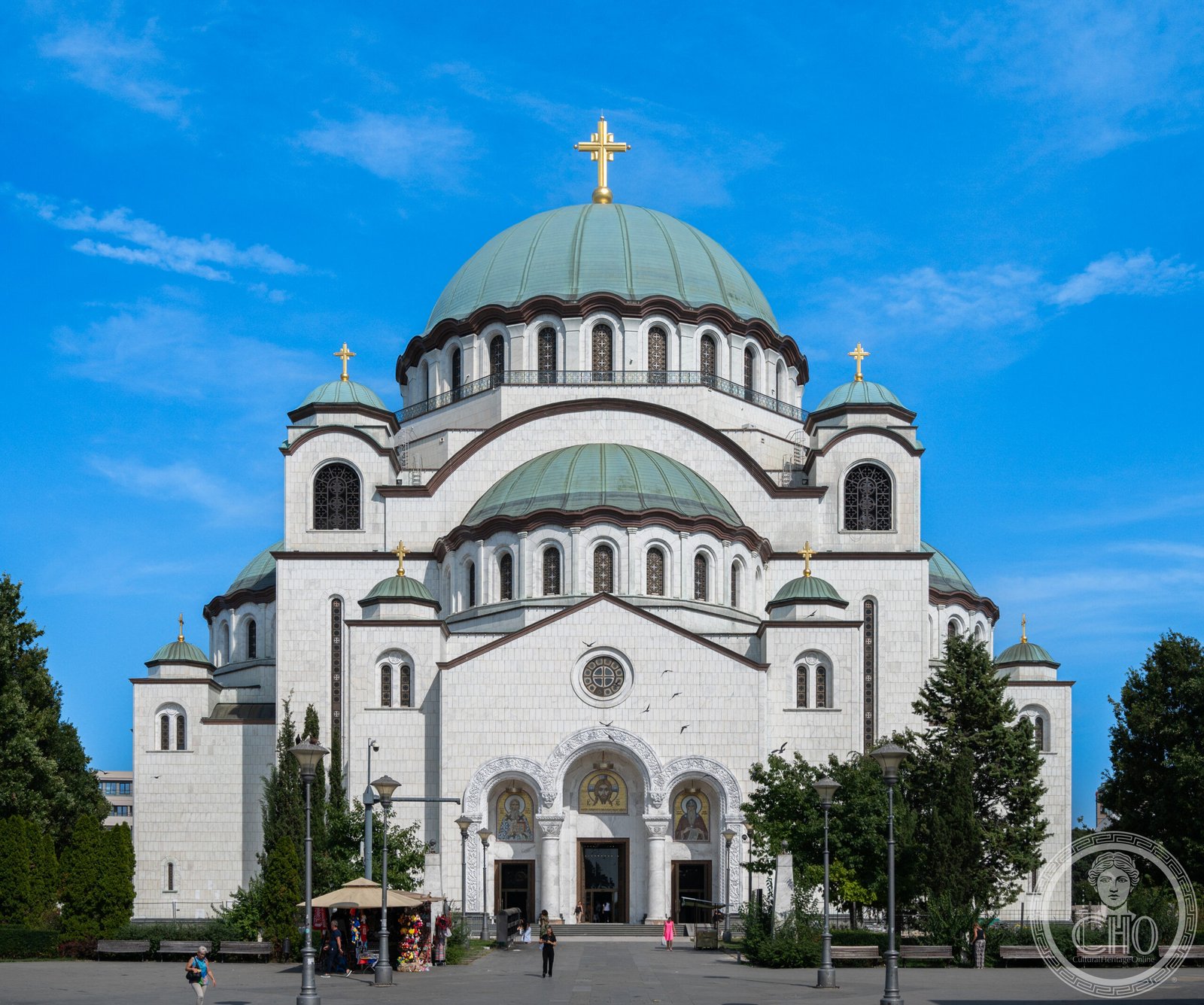
One of the largest Orthodox churches in the world and a building whose construction history mirrors the entire arc of twentieth-century Serbian experience. The project to honour Saint Sava — the medieval monk who organised the Serbian Orthodox Church and became the country’s patron saint — was approved in 1894. Ground was broken on Vračar Hill in 1935, on the very spot where the Ottoman governor Koca Sinan Pasha had ordered the burning of Saint Sava’s remains in 1595 to prevent them becoming a site of Serbian resistance. Construction halted in 1941 during the German invasion, halted again under communist rule, resumed in 1985 and continued through the NATO bombing of Belgrade in 1999. The exterior was completed that year; the interior was finished and the cathedral consecrated in 2020 — eighty-five years after ground-breaking, one of the longest construction projects of any building in the world. The main dome rises seventy metres and spans forty metres; the crypt mosaics cover 1,680 square metres of gilded Byzantine imagery.
At a glance
- Type
- Cathedral church
- Period
- Construction 1935–2020; consecrated 2020
- Style
- Serbian Byzantine Revival
- Location
- Vračar, Belgrade, Serbia
- Coordinates
- 44.7989° N, 20.4699° E
- Architect(s)
- Bogdan Nestorović and Aleksandar Deroko (original design 1926); Branko Pešić (resumed 1985)
Overview
The Cathedral of Saint Sava is the dominant landmark of Vračar, the Belgrade hill historically associated with Ottoman repression and Serbian resistance. Its scale is immense: total floor area 4,849 square metres, interior volume 170,000 cubic metres, capacity for 10,000 worshippers. The design draws on the medieval churches of Raška and Morava — the two great schools of Serbian Byzantine architecture — scaled to the ambitions of a modern national church. The building is the seat of the Serbian Orthodox Church and a major pilgrimage destination. The surrounding plateau has been developed as a cultural park with the Patriarchate Library and the Museum of the Serbian Orthodox Church adjacent.
History
In 1595 Koca Sinan Pasha, Ottoman governor of the Rumelia Eyalet, had the relics of Saint Sava exhumed and burned on Vračar Hill to quell Serbian national sentiment. The site became sacred. A proposal to build a cathedral there was first made in 1859; King Milan Obrenović approved the project formally in 1895. An international design competition held in 1926 was won by Bogdan Nestorović and Aleksandar Deroko. Foundation stone was laid in 1935 and work began; the German invasion of April 1941 halted construction. The communist government regarded the project as nationalist provocation and forbade further work; the shell stood unfinished for forty years. Construction resumed in 1985 as Yugoslavia began relaxing restrictions on religion. Work continued through the 1990s wars and the 1999 NATO campaign. The exterior was completed in 2004. Interior mosaics funded primarily by Russian donations were installed between 2016 and 2020. The cathedral was consecrated on 7 May 2020 by Patriarch Irinej.
Architecture & Design
Nestorović and Deroko’s design synthesises the Raška school of the twelfth and thirteenth centuries — which blends Romanesque structure with Byzantine decoration — and the Morava school of the late fourteenth century, known for elaborate stone carving. The plan is a Greek cross; the main dome is carried on four massive piers and rises to 70 metres with a diameter of 40 metres. Four subsidiary domes mark the arms of the cross; forty smaller domes articulate the drum and narthex. The exterior is clad in white Venčac marble from a quarry near Aranđelovac traditionally used for Serbian royal churches. The crypt contains the most ambitious mosaic programme completed in the Orthodox world since the Byzantine era: 1,680 square metres of gold-ground mosaic depicting the life of Saint Sava, designed by Russian artists and installed by Russian and Serbian craftsmen.
Cultural significance
The Cathedral of Saint Sava is not merely a religious building but a monument to Serbian continuity through Ottoman rule, partition, two world wars, communism and the dissolution of Yugoslavia. Its eighty-five-year construction is itself a narrative — a refusal to abandon a national project whatever the political circumstances. For the Serbian Orthodox Church the building represents the return of Saint Sava’s spiritual presence to the exact place where the Ottomans tried to extinguish it. For secular Serbs it is the country’s most recognisable landmark, equivalent in cultural weight to Notre-Dame in France or St Paul’s in England.
Visiting today
The cathedral is open daily throughout the year at no charge. The nave is open from early morning until evening; the crypt has its own entrance on the south side and the same hours. Photography is permitted in most areas except during services. Dress code applies: shoulders and knees must be covered. The surrounding terrace offers panoramic views across Belgrade. Audio guides are available at the entrance in several languages.
Getting there
The Cathedral is on Vračar, approximately 2 kilometres south of Belgrade’s city centre. Trolleybus 40 and buses 26 and 27 connect it directly to Knez Mihailova Street. Taxis from Belgrade Central Station take 10 minutes. Belgrade Nikola Tesla Airport (BEG) is 18 kilometres west of the city; shuttle buses reach the centre in 30–40 minutes. Street parking is available on the surrounding streets.
Sources & resources
Find it on the map
See this place and what’s around it →Record researched and written by Luigi De Marchi for Cultural Heritage Online, 2026.
📷 Become a Cultural Heritage Online photographer
Share your photos of places: they stay published under your name as the author. The more they're seen, the more you get noticed — and soon a contest will reward the most appreciated photos.
Log in or sign up free to add a photoIs this page about you?
This page is read by travellers and heritage enthusiasts who find it on Google. Tell us how you are connected to this place and we will take it from there.