
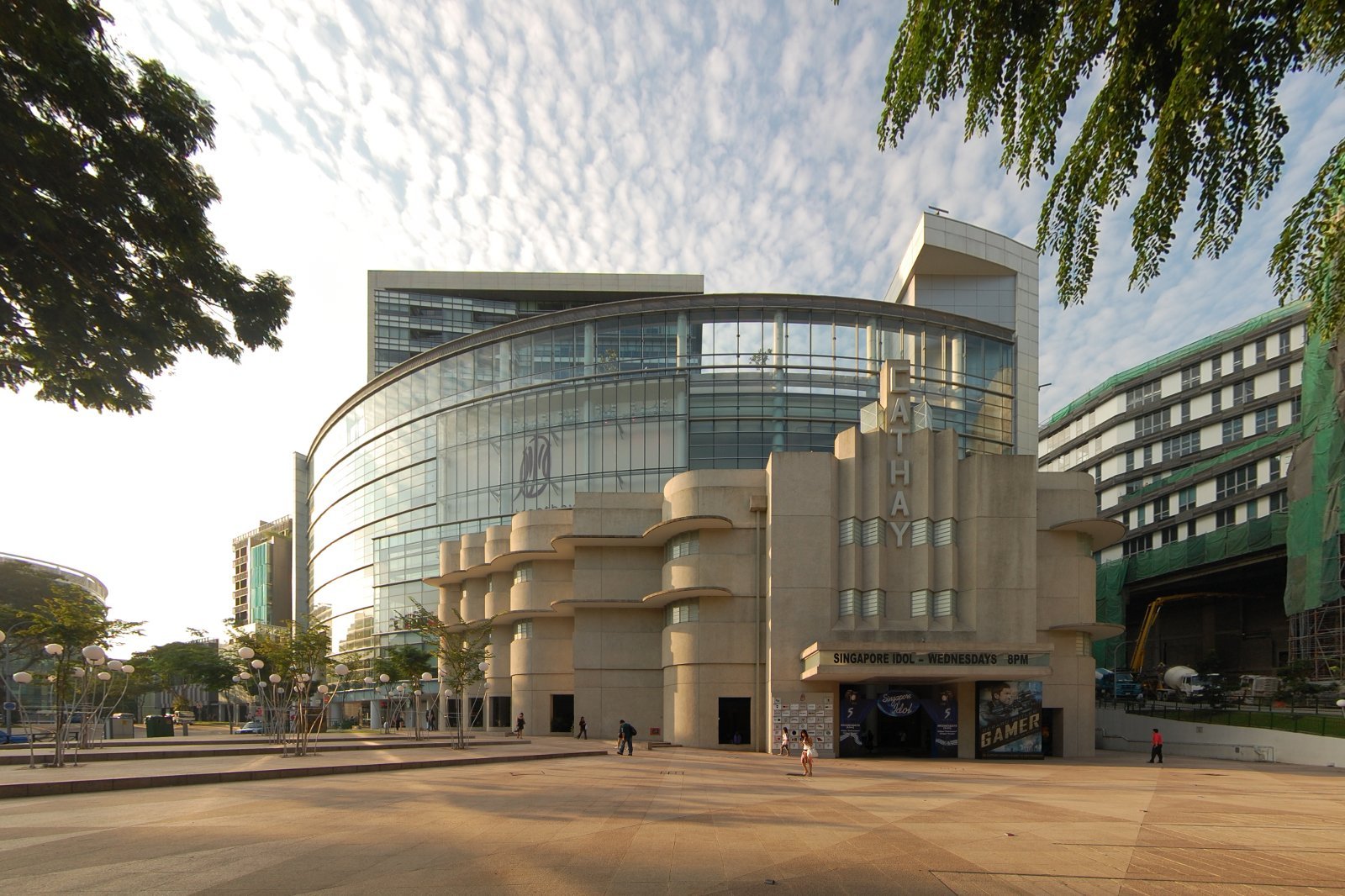
Singapore’s first skyscraper and a landmark Art Déco tower — opened in 1939, with the residential tower completed in 1941 — whose conserved facade on Handy Road remains one of the city-state’s most recognised monuments to colonial-era modernism.
At a glance
Completed in 1939 at the junction of Handy Road and Mount Sophia, Cathay Building rose as a conspicuous statement of modern ambition in pre-war Singapore. Its stepped Art Déco tower, clad in cream render, combined a commercial cinema with hotel rooms and retail space. The building’s original Art Déco facade is today gazetted as a national monument, preserved as the entrance to The Cathay mixed-use development that replaced the tower in 2006.
Key facts
- Address: 2 Handy Road, Singapore 229233
- Completed: 1939
- Style: Art Déco (Streamline Moderne)
- Architect: Frank W. Brewer
- Original use: Cinema, hotel, retail
- Conservation status: Original facade gazetted as a national monument
- Distinction: Singapore’s first skyscraper (tower completed 1941); first air-conditioned cinema in Singapore
- Current name: The Cathay (redeveloped 2006; cinema closed 2022, building revamped 2023–2025)
History
By the late 1930s Singapore was a prosperous entrepôt, and the Loke and Eu families—pillars of the Straits Chinese merchant class—had already established themselves in entertainment through Cathay Organisation. Their commission for a new headquarters on Handy Road, at the edge of the colonial civic quarter, was a calculated declaration of both wealth and modernity. The building opened in 1939, the same year Europe slid into war, and its sheer height made it the most prominent structure in the urban skyline at the time.
The tower became a focal point of the Pacific War almost immediately. When Japanese forces entered Singapore in February 1942, the upper floors of the Cathay Building served as the last British command post before the surrender. After the capitulation, the Japanese military occupied it for the duration of the occupation, using it for broadcasting and administrative purposes. The building’s height and visibility made it symbolically loaded for both sides throughout the conflict.
Post-war, Cathay returned to civilian use and its cinema became one of the city’s premier picture houses through the 1950s and 1960s, a period when Singapore’s film industry—centred on Shaw Brothers and Cathay Organisation—was producing Malay-language films for audiences across Southeast Asia. The Cathay cinema was the first air-conditioned cinema in Singapore, a distinction confirmed by the National Heritage Board (roots.gov.sg) and central to the building’s significance in local cultural history.
The tower was demolished and redeveloped in the early 2000s, but conservationists successfully argued for the retention of the original Art Déco street-level facade along Handy Road. That facade was gazetted as a national monument, and the new development—The Cathay—opened in 2006, designed to preserve the historic frontage while accommodating a modern retail and residential tower behind it. The Cathay Cineplex operated within the complex until June 2022, when it closed after more than eight decades of cinema history on the site. The building underwent a further revamp from mid-2023 and reopened in 2025.
What you see
The conserved facade presents the clearest legible remnant of the 1939 original: a symmetrical composition in cream render with the characteristic geometric ornament, pilasters and horizontal banding of late Art Déco—sometimes classified under the Streamline Moderne sub-current, with its emphasis on smooth surfaces and restrained decoration over the more exuberant motifs of earlier American Déco. The central bay retains its original proportions, and the name “Cathay” is set in period lettering above the entrance.
Behind the conserved facade, the tower that replaced the original structure is a contemporary glass-and-steel design by Tange Associates (Tokyo) with RDC Architects (Singapore), which rises above the low historical frontage. The contrast is deliberate and now accepted as a standard Singapore conservation approach: preserve the street-facing heritage skin, allow modern density above. Visitors approaching from Dhoby Ghaut MRT encounter the historic facade first, before the scale of the new tower becomes apparent.
Practical information
- Current use: The Cathay — mixed retail, food & beverage, residential (no operational cinema as of 2022)
- Opening hours: Mall generally open daily; individual tenants vary (typical 10:00–22:00)
- Nearest MRT: Dhoby Ghaut (North-South / Circle / North-East lines), approximately 5 minutes on foot
- Admission: Free to enter public areas
- Visit time: 20–30 minutes for exterior and ground-floor heritage elements
Getting there
From Dhoby Ghaut MRT station, exit towards Orchard Road and walk north along Handy Road for approximately 400 metres; the conserved facade of The Cathay is visible on the right. Buses stopping on Orchard Road (Somerset area) also bring visitors within a short walk. Street parking is available on Handy Road and in nearby car parks, but public transport is strongly recommended in this dense urban neighbourhood.
Nearby
- Dhoby Ghaut Green — small public park immediately south, marking the historic edge of the colonial civic quarter
- Fort Canning Park — hilltop heritage park with Raffles-era and WWII significance, 10 minutes on foot
- Singapore Art Museum (SAM) — converted 19th-century mission school on Bras Basah Road, 10–12 minutes on foot
- CHIJMES — converted Gothic-style chapel and convent complex, also along Bras Basah Road
Sources
- National Heritage Board Singapore — roots.gov.sg (architect Frank W. Brewer confirmed; first air-conditioned cinema in Singapore confirmed; first skyscraper confirmed)
- Wikipedia, “The Cathay” — en.wikipedia.org/wiki/The_Cathay (opening date 1939; facade gazetted national monument; redevelopment 2006)
- Urban Redevelopment Authority (URA) Singapore — conservation framework for Bras Basah / Bugis Planning Area
- National Library Board Singapore, Infopedia — eresources.nlb.gov.sg/infopedia/ (Cathay Organisation history)
- Nominatim / OpenStreetMap — GPS coordinates verified for 2 Handy Road, Singapore (1.2995, 103.8477)
- Wikimedia Commons — File:The_Cathay-day-2009-09-02.jpg (Nlannuzel, CC BY-SA 3.0)
Find it on the map
See this place and what’s around it →Record researched and written by Luigi De Marchi for Cultural Heritage Online, 2026.
📷 Become a Cultural Heritage Online photographer
Share your photos of places: they stay published under your name as the author. The more they're seen, the more you get noticed — and soon a contest will reward the most appreciated photos.
Log in or sign up free to add a photoIs this page about you?
This page is read by travellers and heritage enthusiasts who find it on Google. Tell us how you are connected to this place and we will take it from there.