
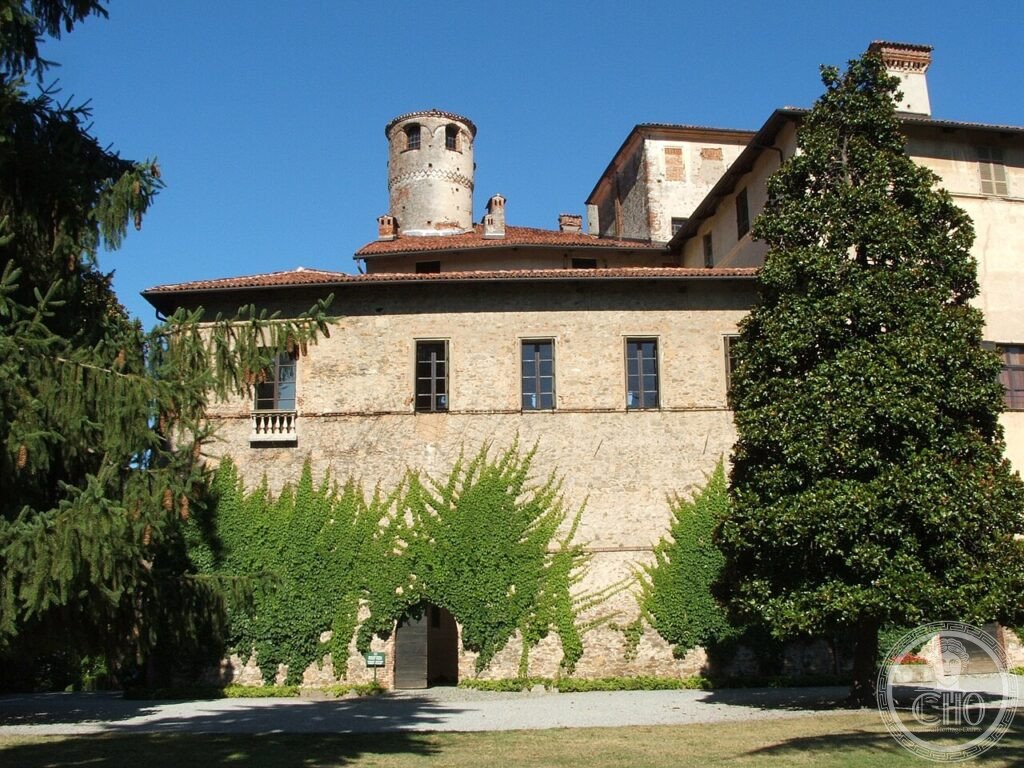
A Saluzzo marquisate stronghold perched above the Varaita valley, whose great hall preserves one of the most complete cycles of late-Gothic courtly fresco painting in northern Italy, the celebrated Ciclo degli Eroi e delle Eroine.
At a glance
Castello della Manta stands on a rocky spur above the village of Manta, about 6 kilometres south-west of Saluzzo in the Cuneo province. The fortress originated in the twelfth century as a Saluzzo dependency; it passed to the Vagnone family, became a marquisate seat in the fourteenth century, and received its defining character under Valerano di Saluzzo, who commissioned the extraordinary frescoes around 1420. The FAI acquired the castle from the Saluzzo di Manta family in 1985 and undertook a systematic restoration of the painted great hall, the garden terraces, and the medieval structure. It opened to the public in 1987 and remains one of the FAI’s flagship properties in Piedmont.
Key facts
- Origin: Twelfth century; restructured XIV–XV century
- Commissioner of frescoes: Valerano di Saluzzo, c. 1420
- Style: Late Gothic / International Gothic
- FAI acquisition: 1985
- Key feature: Ciclo degli Eroi e delle Eroine — 32 figures in cortly procession
- GPS: 44.5733, 7.4283 — Google Maps
History
The Saluzzo marquisate used Manta both as a military outpost guarding the Varaita valley pass into France and as a seasonal court residence. Valerano di Saluzzo, an illegitimate son of the marquis Thomas III, transformed the main tower and great hall around 1420, commissioning a decorative programme that drew directly on the Chevalier errant of his father — a chivalric poem listing the Nine Heroes and Nine Heroines of classical and medieval legend.
The resulting frescoes cover three walls of the sala baronale in a continuous procession: armoured knights and crowned queens marching in cortly dress beneath heraldic shields, each identified by a scroll. The painter — probably a workshop in the orbit of the Piedmontese court — worked in the International Gothic idiom, giving the figures an ornamental line quality and a love of textile pattern that aligns the cycle with the illuminated manuscripts of the same decade.
After centuries of Saluzzo family occupation and partial abandonment, the FAI restoration brought the frescoes back to legibility. A later sixteenth-century Annunciation fresco cycle in the chapel — tonally and stylistically removed from the great hall — was also consolidated.
What you see
The exterior presents a compact medieval tower block with later additions in Piedmontese baroque; the main entrance is through a rusticated portal into a courtyard from which garden terraces descend in three levels toward the valley. The view southwest toward the Monviso massif is the one element no restoration can replicate or improve.
The great hall sits on the piano nobile. Entering it from a dim anteroom, the frescoed walls arrive with sudden force: the Nine Heroes and Nine Heroines in their full-length procession occupy three sides of the room, each figure about 1.8 metres tall, separated by heraldic borders. The reds and deep blues, slightly muted by five centuries of temperature and humidity cycles, retain enough vibrancy to make the procession feel animated. The faces have the particular late-Gothic characteristic — half-portrait, half-type — that makes each figure seem both individual and symbolic simultaneously.
Gallery
Practical information
- Opening: Tuesday–Sunday 10:00–18:00 (last entry 17:30); closed Monday. Seasonal hours apply October–March.
- Admission: Full €10; FAI members free; reduced for students and seniors.
- Duration: 60–90 minutes for castle and gardens.
- Booking: Recommended for weekends and school holidays.
- Note: The great hall is cool even in summer; bring a light layer.
Getting there
Manta is 6 km south-west of Saluzzo on the SP589. By car from Cuneo: follow SS20 toward Saluzzo, then SP589 toward Manta village (45 min). No direct rail service; the nearest station is Saluzzo (Torino–Saluzzo line), served by infrequent trains from Turin Porta Nuova (1h30). Taxi from Saluzzo station: approximately 10 minutes. Limited parking in the village piazza below the castle; a short uphill walk reaches the entrance.
Nearby
- Saluzzo historic centre — medieval marquisate capital, 6 km; Casa Cavassa and Museo Civico within walking distance
- Abbazia di Staffarda — Cistercian abbey, 14 km northeast
- Monviso — highest peak of the Cottian Alps, 40 km southwest; visibility on clear days from the castle terraces
Sources
- FAI – Fondo Ambiente Italiano: fondoambiente.it/luoghi/castello-della-manta
- Wikipedia EN: Castle of Manta
- Frugoni, Chiara: Il Castello della Manta, Turin, 1992
- Tournier, Michel (ed.): Gothic International — Court Art of the 14th and 15th Centuries, Paris, 2007
Find it on the map
See this place and what’s around it →📷 Become a Cultural Heritage Online photographer
Share your photos of places: they stay published under your name as the author. The more they're seen, the more you get noticed — and soon a contest will reward the most appreciated photos.
Log in or sign up free to add a photoIs this page about you?
This page is read by travellers and heritage enthusiasts who find it on Google. Tell us how you are connected to this place and we will take it from there.