
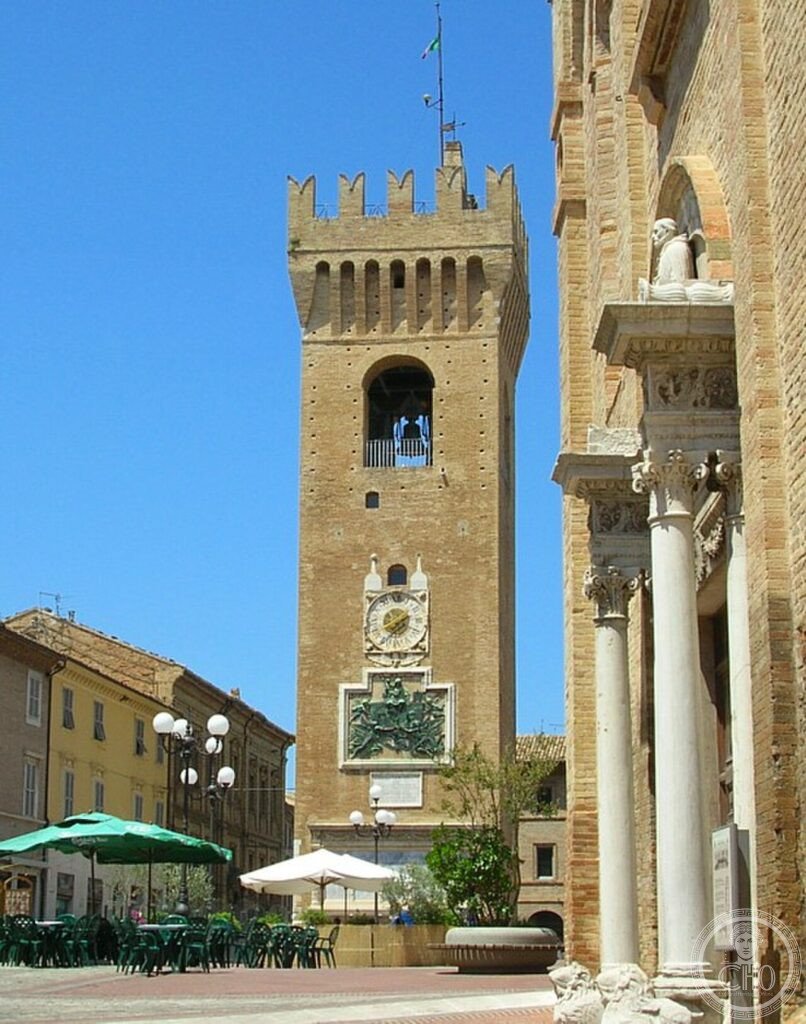
The hillside garden behind the Leopardi family home in Recanati where, in 1819, Giacomo Leopardi wrote L’infinito — a fourteen-line idyll that would become one of the most translated poems in Italian literary history.
At a glance
The Orto sul Colle dell’Infinito is a terraced garden on a promontory above Recanati, enclosed on its west side by an ancient hedge of holm oak that blocks the view of the valley and — as Leopardi describes in the poem — forces the imagination to conjure infinite spaces beyond it. The garden has been in Leopardi family ownership for centuries; the FAI acquired a conservation easement and management rights in 2012, restoring the terraces and paths and opening the site to visitors. It is the only FAI property dedicated to a poet rather than a building, and the commission to landscape architect Marco Bay (2012–2014) deliberately avoided any literal interpretation: the hedge, the gravel paths, and the view east toward the Adriatic are the garden’s entire content.
Key facts
- Associated poet: Giacomo Leopardi (1798–1837)
- Key work: L’infinito, composed here 1819, published 1826 in Idilli
- FAI management: From 2012
- Landscape architect: Marco Bay (restoration 2012–2014)
- Setting: Terraced garden on limestone spur, 296 m above sea level
- GPS: 43.4025, 13.5515 — Google Maps
History
Giacomo Leopardi was born in Recanati in 1798 into a family of provincial nobility whose library — one of the largest private libraries in the Papal States — shaped his formation as a classicist and philosopher before he was fourteen. The family palazzo on the Piazza Sabato del Villaggio adjoins the garden; the hedge that closes the western terrace had been in place for decades when Leopardi walked there in the autumn of 1819, aged twenty-one, and wrote the fourteen endecasyllables that would become L’infinito.
The poem turns on a paradox: it is the hedge — an obstacle, a limit — that generates the sensation of the infinite. Leopardi uses ermo (solitary) for the hill and soave (gentle) for the shipwreck in the last line, a tonal balance that translates poorly but registers immediately in the Italian. The poem was published in the Idilli of 1826 and has been in continuous circulation since; it is arguably the most anthologised short poem in Italian.
The FAI restoration of 2012–2014 chose to add almost nothing: paths were consolidated, the hedge repaired, the eastern panorama cleared of secondary growth. The restraint is deliberate — the garden is a literary site, not a botanical collection.
What you see
The site consists of three elements: the approach path from the Palazzo Leopardi courtyard, the terraced garden (roughly 40 × 20 metres), and the holm-oak hedge that screens the western valley. The hedge is the poem’s protagonist — taller than a person, dense enough to block all sight lines, old enough to have the character of a wall. Standing before it, the valley below becomes entirely conceptual.
Turn east: the garden opens onto a panorama of rolling Marchigian hills that, on clear days, ends at the Adriatic. Leopardi called it the sea of hills (mar del colle); the phrase works equally in Italian and English. The simplicity of the garden — gravel, old stone edging, the hedge, the view — means that everything narrows to the experience of standing on the edge between enclosure and expansion that is the poem’s subject.
Gallery
Practical information
- Opening: Tuesday–Sunday, hours vary seasonally; consult FAI website before visiting.
- Admission: Combined ticket with Palazzo Leopardi available; check FAI for current pricing.
- Duration: 20–40 minutes for the garden; allow additional time for Casa Leopardi and Palazzo.
- Best time: Late afternoon in autumn, when the low light angles across the hedge and the sea is faintly visible on the horizon.
Getting there
Recanati is 25 km south-west of Ancona and 27 km north of Civitanova Marche. By car from Ancona: A14 motorway to Porto Recanati exit, then SP3 toward Recanati (35 min). The garden entrance is adjacent to Palazzo Leopardi on Piazza Sabato del Villaggio in the historic centre. Parking: Via della Conciliazione or Piazza Giacomo Leopardi (5 min walk). No rail service to Recanati; nearest station is Porto Recanati (Adriatica line), with bus connections (Contram, 30 min).
Nearby
- Palazzo Leopardi — family palazzo and library open to the public, adjacent
- Museo Nazionale Recanati — Lotto altarpiece and Leopardi manuscripts, 5 min walk
- Loreto — Basilica della Santa Casa UNESCO candidate site, 15 km southeast
Sources
- FAI – Fondo Ambiente Italiano: fondoambiente.it/luoghi/orto-sul-colle-dell-infinito
- Wikipedia EN: L’infinito — Wikipedia
- Leopardi, Giacomo: Canti, ed. Francesco Flora, Milan, Mondadori, 1956
- De Sanctis, Francesco: Giacomo Leopardi, Naples, 1885
Find it on the map
See this place and what’s around it →📷 Become a Cultural Heritage Online photographer
Share your photos of places: they stay published under your name as the author. The more they're seen, the more you get noticed — and soon a contest will reward the most appreciated photos.
Log in or sign up free to add a photo