
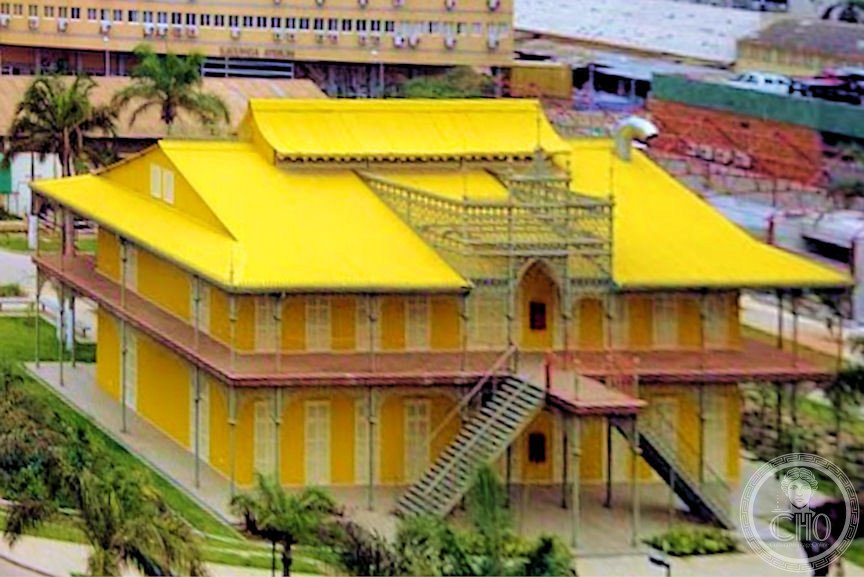
Shipped bolt by bolt from France in 1892 and attributed to the workshop of Gustave Eiffel, this elegantly impractical iron house baked its would-be governors in the Angolan heat and survived to become one of the most distinctive 19th-century heritage buildings in Africa.
At a glance
- Type
- Historic Prefabricated Iron Residence
- Period
- 1892
- Style
- Victorian Prefabricated Iron Architecture
- Location
- Luanda, Angola
- Coordinates
- -8.8368, 13.2343
- Architect
- Attributed to the workshop of Gustave Eiffel (attribution debated)
Overview
The Casa de Ferro — the Iron House or Iron Palace — is one of the most unusual heritage buildings in Africa: a fully prefabricated iron structure, every panel and bolt designed, manufactured, and shipped from France in 1892, then reassembled in Luanda as an intended residence for the Governor of Angola. The elegant Victorian iron construction, with decorative ironwork balconies and painted white, was attributed to the workshop of Gustave Eiffel, though this attribution remains debated by architectural historians. The design proved immediately and catastrophically unsuitable for the Angolan climate: iron walls in the tropical sun turned the interior into an oven, making the building effectively uninhabitable. It was never permanently used as a residence and served various administrative and cultural functions over the following decades.
History
The Casa de Ferro arrived in Luanda only three years after the completion of the Eiffel Tower in Paris (1889), at a moment when prefabricated iron construction was being tested across European colonial territories as a solution to the problem of building durable, prestigious structures in climates where traditional materials and skilled labor were scarce. The Portuguese colonial government ordered the building as a governor's residence, apparently without full consideration of how iron behaves in an equatorial climate. Once assembled and occupied, the thermal problem was immediately apparent. The building was quietly abandoned as a residence and repurposed. Over the following century it changed functions repeatedly. Today it is one of only a small number of prefabricated iron buildings surviving in sub-Saharan Africa and is recognized internationally as a unique specimen of 19th-century architectural history.
Architecture and Design
The building exemplifies the prefabricated iron architecture that became fashionable in the second half of the 19th century, when improvements in industrial iron production and the global reach of steamship trade made it practical to manufacture entire buildings in European workshops and ship them in component form to distant destinations. The Luanda Casa de Ferro follows a conventional Victorian residential form: a raised ground floor, symmetrical facade, and decorative cast-iron balconies and railings in the ornate style of the period. The structural system relies on bolted iron panels rather than timber framing, making it structurally robust but thermally disastrous in tropical conditions. The attribution to the Eiffel workshop, if accurate, would connect it to the most celebrated iron engineer of the 19th century.
Cultural significance
The Casa de Ferro occupies a curious position in the heritage landscape of Luanda and of Africa more broadly. It represents both the hubris of European colonial technological ambition — the assumption that industrial solutions developed in temperate Europe could simply be transplanted to the tropics — and the ingenuity of prefabricated construction as a practical response to colonial building challenges. Its survival is largely accidental, but it has come to be recognized as a rare specimen of a building type that was once more common across colonial Africa and Asia, most examples having been demolished or destroyed. For Angolan heritage authorities and the international architectural community, it is an important physical document of 19th-century industrial history.
Visiting today
The Casa de Ferro is a recognized heritage building in Luanda. Access and opening hours should be verified locally, as conditions may change. The building is located in central Luanda and is most effectively visited as part of a broader exploration of the city's colonial architectural heritage, which includes the historic Baixa district and the Museu Nacional de Angola. Visitors to Angola should consult current entry requirements and local conditions before travel.
Getting there
Luanda is served by Quatro de Fevereiro International Airport (LAD), with connections to Lisbon, Dubai, Johannesburg, and other African capitals. Within Luanda, taxis and ride-shares provide the most practical transport for heritage sites in the city center. The Casa de Ferro is in central Luanda and can be included in a walking or driving tour of the historic Baixa district. Road conditions and traffic in Luanda vary significantly; local guidance on timing and routes is advisable.
Sources and resources
Find it on the map
See this place and what’s around it →📷 Become a Cultural Heritage Online photographer
Share your photos of places: they stay published under your name as the author. The more they're seen, the more you get noticed — and soon a contest will reward the most appreciated photos.
Log in or sign up free to add a photoIs this page about you?
This page is read by travellers and heritage enthusiasts who find it on Google. Tell us how you are connected to this place and we will take it from there.