
Once a Phoenician trading empire that rivaled Rome itself, Carthage rose from the shores of Tunisia to dominate the ancient Mediterranean before its legendary destruction and rebirth as a Roman provincial capital.
At a glance
Carthage was founded on the eastern shore of the Lake of Tunis as a Phoenician colony and evolved into one of the ancient world’s wealthiest and most influential cities. The archaeological remains span millennia—from Punic temples and harbors to Roman theaters and Byzantine basilicas—now protected as a UNESCO World Heritage Site.
History
Legend credits Queen Elissa (also called Alyssa or Dido), originally from Tyre, as Carthage’s founder, though her historicity remains debated. According to myth, she negotiated land with a local tribe by cutting an oxhide into strips to outline the city’s perimeter.
From its Phoenician origins, Carthage transformed into the capital of a vast Punic empire dominating the southwestern Mediterranean during the first millennium BC. It became a major trading hub and rival of Rome itself, until the nearly three-year siege during the Third Punic War in 146 BC brought its destruction.
Roman forces rebuilt the city a century later. Roman Carthage flourished as the empire’s major provincial capital in Africa. The site remained significant through the Byzantine period, until Umayyad forces destroyed it after the Battle of Carthage in 698 to prevent Byzantine reconquest. Later occupied by Muslims and briefly by Crusaders during the Eighth Crusade, Carthage eventually declined as power shifted inland to Kairouan and Tunis. Modern development began in the early 20th century, and the municipality was formally established in 1919.
What you see
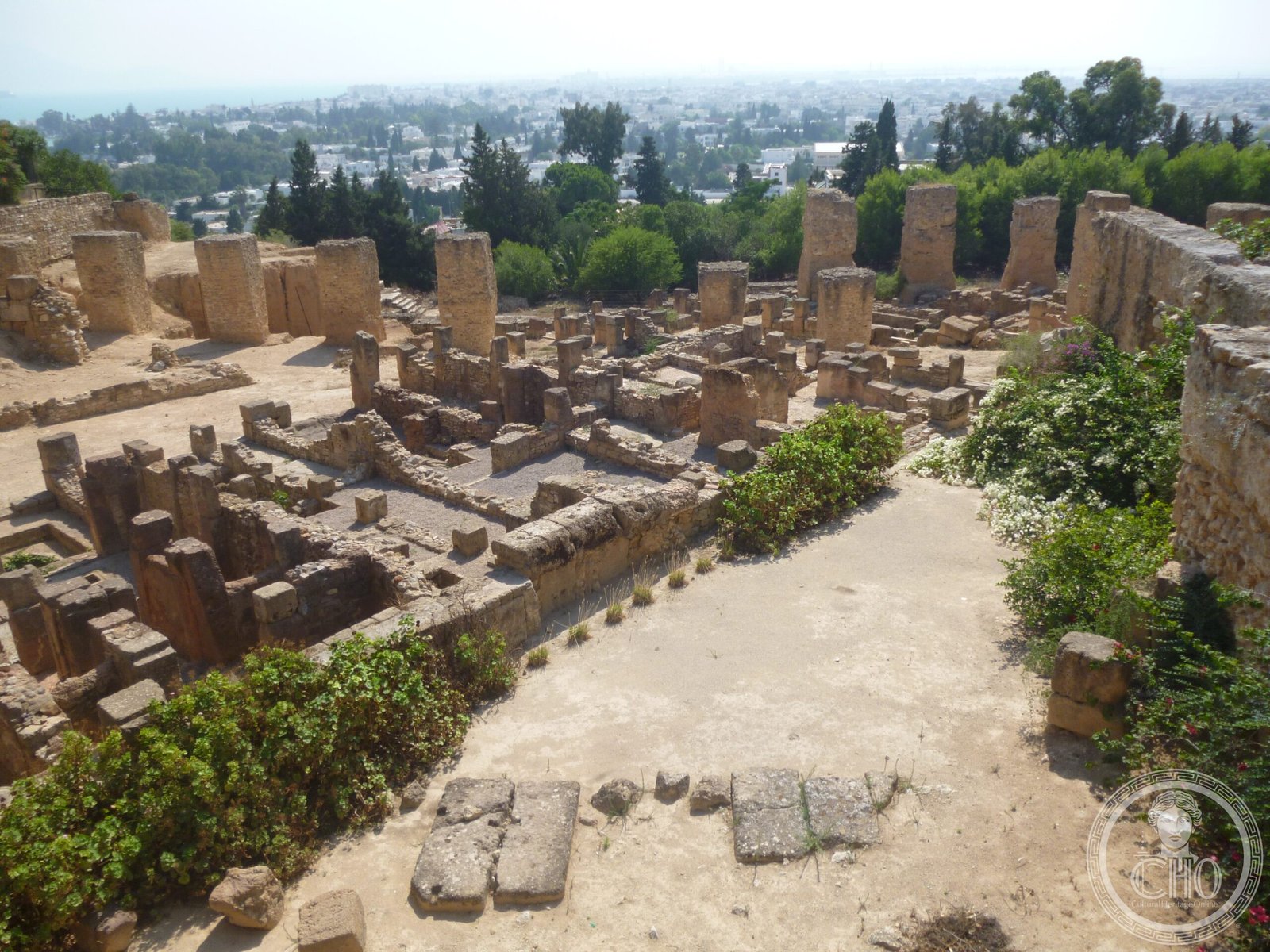
The archaeological site encompasses ruins spanning multiple civilizations. Visitors encounter remains of Punic temples, harbors, and domestic structures; Roman theaters, villas, and public buildings; and Byzantine basilicas and early Christian monuments. The Carthage National Museum, founded in 1875 by Cardinal Charles Lavigerie, displays artifacts from systematic excavations begun in the 19th century by Charles Ernest Beulé and Alfred Louis Delattre. The open-air Carthage Paleo-Christian Museum exhibits materials excavated under UNESCO supervision from 1975 to 1984.
Cultural significance
Carthage’s story encompasses triumph, catastrophe, and resilience. The city shaped Mediterranean trade and politics for centuries and remains central to understanding ancient commerce, naval power, and the clash between civilizations. Ongoing scholarly debate about contested practices—particularly whether child sacrifice was performed—continues to fuel historical and philosophical discussions.
Key facts
- Location: Carthage, Tunisia
- Coordinates: 36.852558°N, 10.323461°E
- UNESCO World Heritage Site
- Founded: Traditionally 9th century BC (Phoenician colony)
- Destroyed: 146 BC (Third Punic War); rebuilt as Roman city; destroyed again 698 AD
Practical information & getting there
The archaeological site lies within Carthage municipality, a suburb of Tunis. Multiple museums on-site provide context for the ruins. The site’s first modern survey occurred in 1830 by Danish consul Christian Tuxen Falbe. Ongoing scholarship and excavations continue to reveal new understanding of this multilayered settlement.
Sources & resources
Find it on the map
See this place and what’s around it →📷 Become a Cultural Heritage Online photographer
Share your photos of places: they stay published under your name as the author. The more they're seen, the more you get noticed — and soon a contest will reward the most appreciated photos.
Log in or sign up free to add a photo