

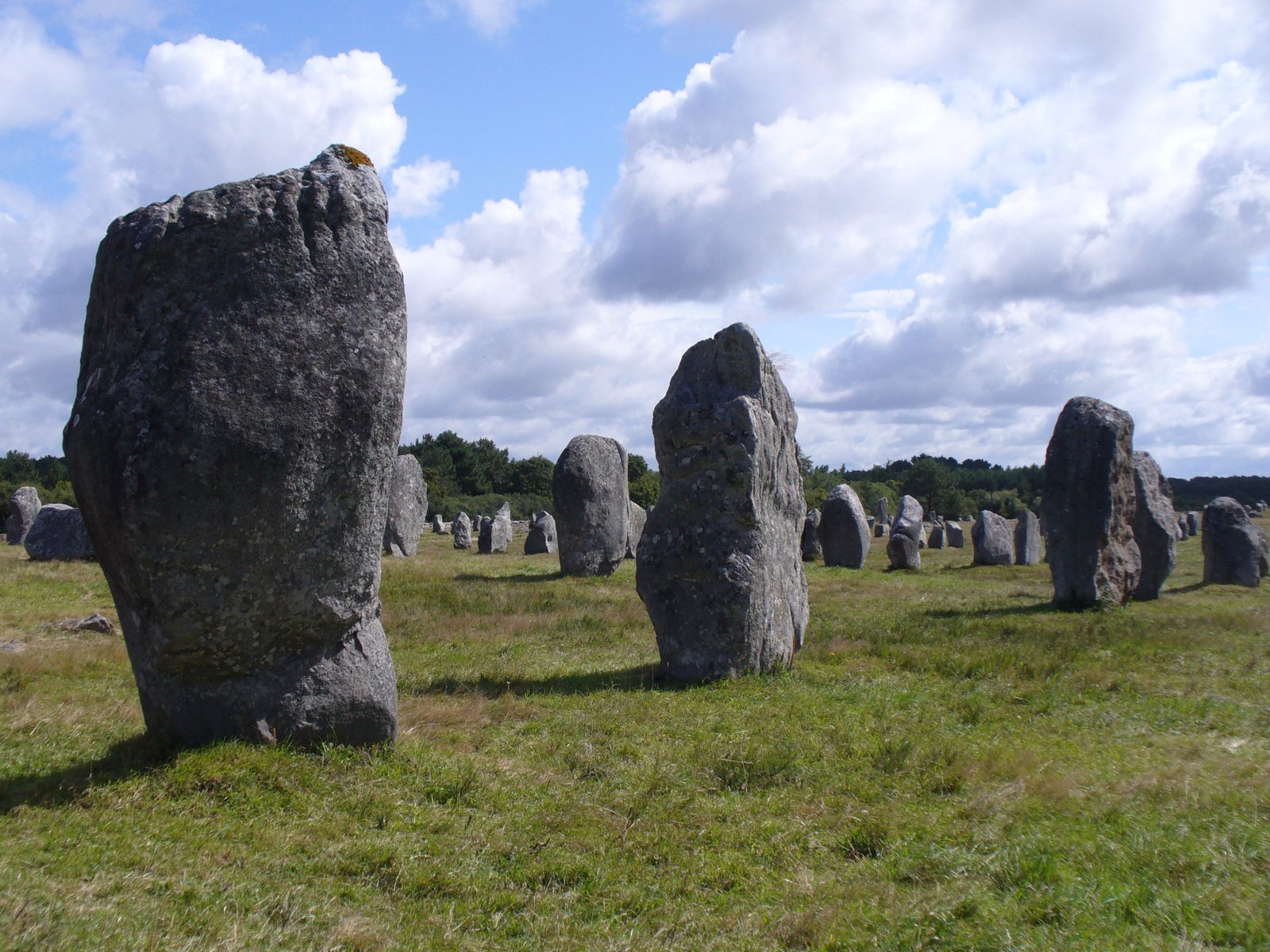
The World’s Largest Stone Alignment
Walk among the Carnac alignments at dusk, when the last light turns 4,000-year-old granite the colour of iron, and the silence between the rows seems almost intentional. You are standing inside the largest megalithic monument ever created — a landscape of more than 3,000 standing stones arranged in disciplined parallel rows across 4 kilometres of Breton farmland. Nothing else like this exists on Earth.
The three main alignments — Ménec, Kermario, and Kerlescan — run roughly east-west across the Morbihan plateau, constructed between 4500 and 2500 BC by Neolithic communities who pre-date Stonehenge by two millennia. The Ménec alignment alone extends 1.2 kilometres with 1,099 stones arranged in eleven rows; Kermario runs parallel with 1,029 stones in ten rows; Kerlescan, at the eastern end, has 540 stones in thirteen rows. The stones themselves are not uniform: at the western ends they can reach 4 metres in height, diminishing gradually toward the east where many are barely knee-high.
The Grand Menhir Brisé — Ambitions Carved in Stone
Some 4 kilometres east of the main alignments, near Locmariaquer, lies the most audacious stone ever raised by human hands. The Grand Menhir Brisé — the Great Broken Menhir, also called Er Grah — originally stood 20 metres tall and weighed approximately 330 tonnes. It is the largest menhir ever erected. It now lies in four pieces, having toppled at some point in prehistory, perhaps during an earthquake. When it stood, it would have been visible for many kilometres across the flat Breton peninsula — a navigational beacon, a territorial marker, or a cosmological axis, depending on whose interpretation you accept.
The menhir’s granite was quarried at Locmariaquer, on the shores of the Gulf of Morbihan. Moving 330 tonnes of stone across coastal terrain with Neolithic technology — wooden sledges, ropes, rollers, organised collective labour — was an undertaking of civilisational ambition. The why remains open.
Astronomical Theories and Ongoing Debate
In the 1970s, Scottish engineer Alexander Thom proposed that the alignments functioned as a sophisticated astronomical calendar — that specific rows marked the rising and setting of the sun at solstices and equinoxes, and that the Grand Menhir Brisé served as a lunar foresight visible from multiple backsight stations across the region. His measurements were meticulous; his conclusions remain contested. Archaeoastronomers continue to argue over whether the alignments encode intentional celestial geometry or whether apparent alignments are the product of the sheer density of stones.
The alternative — or complementary — reading sees the alignments as a ritual processional landscape: a place where communities gathered for ceremonies, perhaps seasonal, perhaps funerary, moving through the stone corridors as through a sacred passage. Carnac is also surrounded by dolmens, cairns, and tumuli — burial monuments of the same culture, reinforcing the interpretation that this was a landscape of the dead as much as the living.
Dolmens, Tumuli, and the Broader Neolithic Complex
The alignments are the most dramatic element of a much larger prehistoric complex. The Table des Marchands at Locmariaquer is a passage grave whose capstone — 23 tonnes, 6.7 metres long — was carved from the same giant menhir as pieces found in the dolmens of Gavrinis and Er Grah. This means that sometime around 3500 BC, a single enormous menhir was deliberately broken into pieces and distributed among at least three separate monuments across a 7-kilometre radius. Whether this was destruction, redistribution of sacred material, or both, archaeologists cannot say with certainty.
The Tumulus Saint-Michel, just northeast of Carnac village, is a Neolithic cairn 125 metres long and 10 metres high — one of the largest in Europe — containing a central chamber that yielded axes, beads, and animal bones when excavated in 1862.
Excavation History and Archaeological Research
Systematic study of the Carnac alignments begins with James Miln, a Scottish antiquarian who excavated at Carnac from 1874 to 1881 and established the first museum of Breton prehistory in the town. His collections were continued by Zacharie Le Rouzic, a local archaeologist who spent four decades re-erecting fallen stones (some critics later noted that re-erection introduced interpretive choices) and expanded the museum that still bears Miln’s name.
Modern research has shifted from excavation to non-invasive survey: ground-penetrating radar, LiDAR mapping, and geophysical prospection have revealed that the stone rows are not isolated but part of a layered palimpsest — some rows appear to have been repositioned, some stones re-used from earlier structures, and the chronology of construction may span more than 2,000 years rather than a single Neolithic episode.
Access, Enclosure, and Visitor Reality
Since 1991, the Ménec and Kermario alignments have been enclosed with fencing to allow vegetation recovery and reduce erosion caused by visitor foot traffic. Free independent access within the fenced areas is permitted in low season (October to April); during high season, access is by guided tour only. The Kerlescan alignment, smaller and less visited, remains open for unguided walking year-round. Guided tours in French and English are operated by the Centre de Recherche Archéologique at Carnac.
The Carnac Stones are not a UNESCO World Heritage Site — a perennial anomaly for one of Europe’s most important prehistoric landscapes. A nomination has been under discussion for decades; the complex land ownership (private fields, communal paths, state-protected zones) has complicated the process. As of 2025, France’s nomination dossier remains incomplete.
Location and Getting There
Carnac is in the Morbihan department of southern Brittany, 30 kilometres southwest of Vannes. The nearest railway station is Auray (10km north), served by TGV from Paris Montparnasse (approximately 3 hours). From Auray, buses run to Carnac in season; taxis and car rental are available year-round. The alignments are spread across a 4-kilometre corridor west of Carnac village; the Ménec alignment is the closest to the village centre, approximately 1 kilometre north on the D119. A dedicated museum — the Musée de Préhistoire de Carnac — is located in the town centre and provides essential context before visiting the stones.
Essential Facts
- Period
- c. 4500–2500 BC (Neolithic)
- Main alignments
- Ménec (1,099 stones), Kermario (1,029 stones), Kerlescan (540 stones)
- Total stones
- Over 3,000 menhirs across the complex
- Location
- Carnac, Morbihan, Brittany, France
- GPS
- 47.5985°N, 3.0664°W
- UNESCO status
- Not inscribed (nomination in progress)
- Visitor access
- Fenced in high season (guided tours); open low season (Oct–Apr)
Find it on the map
See this place and what’s around it →📷 Become a Cultural Heritage Online photographer
Share your photos of places: they stay published under your name as the author. The more they're seen, the more you get noticed — and soon a contest will reward the most appreciated photos.
Log in or sign up free to add a photo