

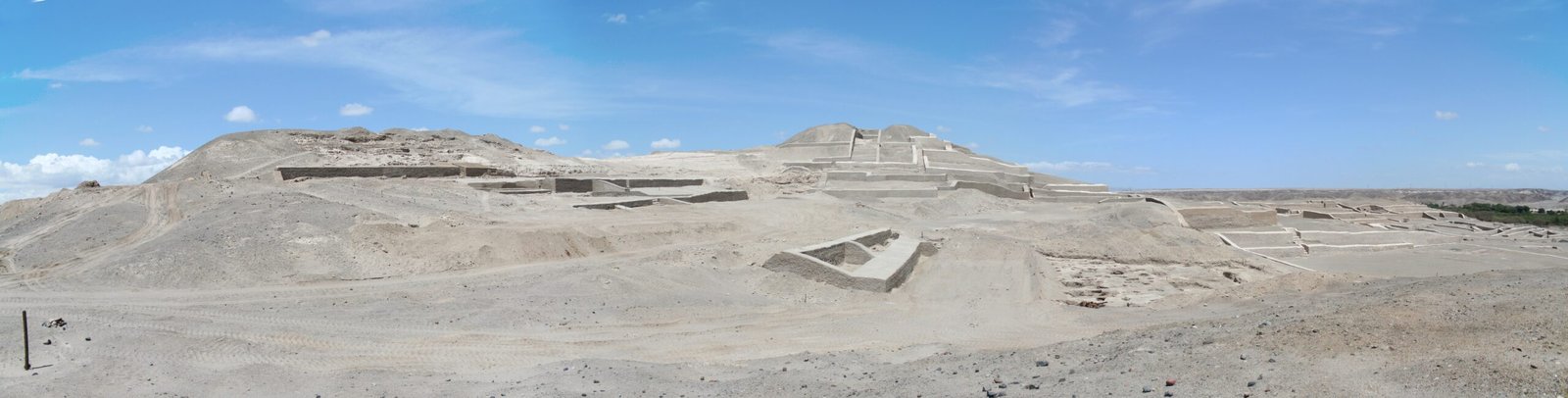
The primary ceremonial centre of the Nasca culture — the people who created the Nasca Lines — a 24 km² complex of 40 adobe pyramid mounds in the driest desert in the Americas, used not as a city but as a seasonal ritual gathering place for communities across a vast region.
At a glance
In the desert pampa approximately 28 km west of the city of Nasca in southern Peru, near the Nasca River in one of the driest valleys on Earth, Cahuachi was the heart of Nasca culture during the Early Intermediate Period (c. 1–500 AD). The site extends over approximately 24 km² and contains approximately 40 adobe pyramid mounds, the largest of which rises 28 metres above the desert floor. It was not a conventional city: excavations led by Italian archaeologist Giuseppe Orefici since 1982 have shown it was a “vacant ceremonial centre” — visited seasonally by communities from across a wide region to participate in rituals, deposit offerings, and conduct burials. The famous Nasca Lines appear to converge on Cahuachi from across the pampa, suggesting they were processional routes to the ceremonial centre.
Key facts
- Location: 28 km west of Nasca city, Ica Region, southern Peru, near the Nasca River
- Culture: Nasca (Early Intermediate Period, Andean archaeology)
- Active period: c. 1–500 AD (approximately 500 years of use)
- Area: approximately 24 km²; approximately 40 adobe pyramid mounds
- Largest structure: Gran Piramide (Great Temple), approximately 28 metres high
- Primary excavator: Giuseppe Orefici (Italian Archaeological Mission to Cahuachi), since 1982
- Estimated excavation: approximately 40% of site excavated; remainder contains intact deposits
History
Cahuachi developed as the principal ceremonial focus of the Nasca culture during the Early Intermediate Period, a phase of Andean prehistory (approximately 200 BC–600 AD) characterised across the Andes by the emergence of regional polities with elaborate ceremonial centres but without the large urban populations associated with later horizon states. The Nasca culture occupied a series of valleys in the coastal desert of southern Peru — among the most arid environments in the world — sustained by underground water channels called puquios that tapped aquifers in the alluvial fans of the Andean foothills. Cahuachi was located at the edge of the desert pampa, near the Nasca River, in a position that placed it at the intersection of the irrigated valley floor and the open desert where the famous geoglyphs were created.
The site was constructed and rebuilt over several centuries through successive phases of platform mounding, the addition of plazas and enclosures, and the construction of the Great Temple on a natural hill that was progressively enlarged. Unlike urban centres, Cahuachi shows little evidence of permanent residential occupation: domestic refuse is sparse, food storage facilities are limited, and the majority of structures appear to have been ceremonial or funerary in function. The interpretation developed by Orefici and supported by subsequent researchers is that Cahuachi functioned as a pilgrimage centre — a place where communities from a wide catchment area, united by Nasca cultural identity, converged periodically to participate in ceremonies, exchange goods, deposit offerings, and bury their dead. The site was eventually abandoned around 400–500 AD, possibly following major flooding events or shifts in the regional political order.
The connection between Cahuachi and the Nasca Lines has been a central question in the archaeology of the region since Paul Kosok first identified the geoglyphs from the air in 1939. Analysis of the Lines’ geometry shows that many of the long straight lines radiating across the pampa converge on or point toward Cahuachi, strongly suggesting they functioned as ceremonial pathways leading communities through the desert toward the ritual centre. This interpretation positions the Nasca Lines not as astronomical markers or extraterrestrial signals (popular misconceptions) but as the physical expression of processional routes across a sacred landscape.
What you see today
Cahuachi is one of the largest adobe monuments in the Americas, but its scale is not immediately legible from ground level: the mounds have been partially eroded by wind, and some of the smaller structures have been reduced to low rises in the desert floor. The most imposing visible feature is the Great Temple (Gran Piramide), a stepped platform of adobe brick and fill rising from a natural hill that was reshaped by Nasca builders into a monumental pyramid. Its terraced profile and the ramps that once provided access are partially preserved. Around the Great Temple, a series of lower platform mounds of varying sizes define plazas and enclosures that formed the ceremonial heart of the complex. The adobe construction is distinctive: Nasca builders used a technique of moulded adobe cones packed together into solid masses rather than the rectangular mud-brick common elsewhere in the Andes, a construction method that created structures of great density and durability.
Excavated areas contain extraordinary finds: ceramic vessels decorated with trophy heads, animals, and geometric patterns in the polychrome Nasca style; textiles of exceptional quality in the Nasca woven tradition; musical instruments including panpipes and drums; and human burials showing evidence of ritual head modification. The site museum (on-site or in Nasca city) displays selected finds. Approximately 60% of the site remains unexcavated, and active fieldwork by the Italian Archaeological Mission continues to produce new discoveries.
Practical information
- Access: by car or taxi from Nasca city (approximately 30 minutes on dirt road); no public transport to the site itself
- On-site: limited facilities; bring water; sun protection essential in the coastal desert
- Combined visit: best combined with Nasca Lines overflight from Nasca airport (10 minutes from city) and the Maria Reiche Museum
- Best season: May–October (dry season); flooding risk November–April after highland rains
- Guides: local guides available in Nasca; recommended for context
Getting there
Nasca is accessible by bus from Lima (approximately 7–8 hours on the Panamericana Sur highway) or from Ica (approximately 2 hours). Cruz del Sur and other operators run frequent long-distance buses from Lima. From Nasca city, the site of Cahuachi is approximately 28 km west on unpaved desert roads; a taxi or organised tour from Nasca is the practical option. The Nasca Lines viewpoint (Mirador) and the Maria Reiche Museum are on or near the Panamericana highway north of Nasca and can be visited on the same day.
Nearby
- Nasca Lines — overflights from Nasca airport; the geoglyphs that Cahuachi likely served as the ritual destination of
- Maria Reiche Museum — near the Lines viewpoint; dedicated to the German mathematician who mapped the geoglyphs
- Chauchilla Cemetery — 30 km south of Nasca; remarkable open-air Nasca burial ground with preserved mummies in situ
- Ica — 140 km north; regional capital with an outstanding archaeological museum (Museo Regional de Ica)
Sources
- Orefici, Giuseppe, Cahuachi: Capital Teocrática Nasca, Universidad de San Martin de Porres, 2012 — the primary excavation monograph
- Silverman, Helaine, “Cahuachi: Non-Urban Cultural Complexity on the South Coast of Peru,” Journal of Field Archaeology, Vol. 15, No. 4 (1988)
- Schreiber, Katharina, and Lancho Rojas, Josue, Irrigation and Society in the Peruvian Desert, Lexington Books, 2003
- Aveni, Anthony F., Between the Lines: The Mystery of the Giant Ground Drawings of Ancient Nasca, Peru, University of Texas Press, 2000
- Wikipedia, “Cahuachi” — consulted June 2026
Find it on the map
See this place and what’s around it →📷 Become a Cultural Heritage Online photographer
Share your photos of places: they stay published under your name as the author. The more they're seen, the more you get noticed — and soon a contest will reward the most appreciated photos.
Log in or sign up free to add a photo