

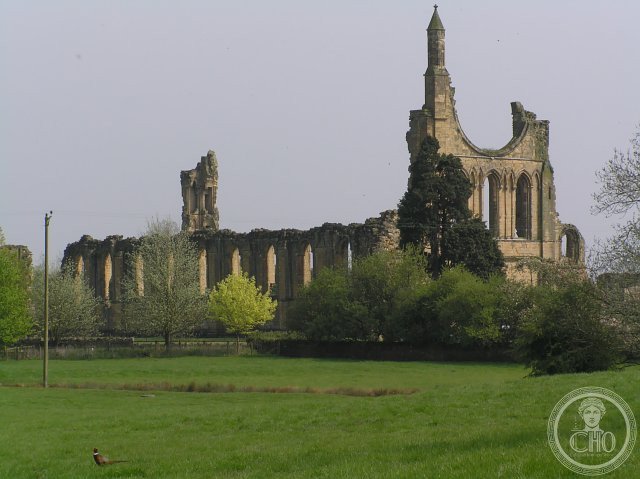
Among the hills of the North York Moors, the ruins of Byland Abbey still hold an enormous Gothic rose window in fragments and tiled floors of the thirteenth century: what remains of the largest Cistercian church ever built in Britain.
At a glance
Byland Abbey stands in the North York Moors near the village of Coxwold, its roofless nave and shattered west front still tracing the outline of what was, on completion around 1200, the largest Cistercian church built in Britain. The community began in 1135 as a Savigniac foundation that moved through five temporary sites before settling permanently here in 1177; it was absorbed into the Cistercian order in 1147 and grew into a major landholder across the North York Moors. The ruined west front once held a rose window nearly 8 metres across, an early and influential example of large-scale Gothic tracery in England, echoed shortly afterwards in the south transept of York Minster. Suppressed in 1538, the site is now in the care of English Heritage.
Key facts
- Founded: 1135 as a Savigniac house; absorbed into the Cistercian order in 1147; the monks settled permanently at this site in 1177 after five earlier moves
- Scale: a twelve-bay nave and lantern tower, described by historians as grander than any earlier Cistercian building in Britain
- Rose window: the ruined west front held one of England’s earliest large Gothic rose windows, a design echoed soon after at York Minster
- Floor tiles: extensive glazed mosaic-pattern pavements from the 1230s survive in situ, in yellow and green geometric patterns
- Chapter house: retains the base of a stone lectern, recorded as the only surviving example of its kind in Britain
- Dissolved: November 1538, with around 25 monks still in the community at closure
- Status: Grade I listed building and Scheduled Monument (Historic England entries 1315790 and 1013403), in the care of English Heritage
History
Byland’s monks began as a Savigniac community founded in January 1135, but spent decades without a permanent home, relocating five times in search of suitable land before finally settling on this site in the Rye valley in 1177. The order merged with the Cistercians in 1147, and once established at Byland the abbey grew rapidly into one of Yorkshire’s largest religious houses, drawing on extensive sheep-farming estates across the North York Moors and engineering a substantial water-management system to serve the precinct, earthworks of which still survive and are recognised by Historic England as a rare and important survival.
The great church that rose here in the following decades was, by the account of contemporary and later historians, grander than anything the Cistercian order had previously built in Britain: a twelve-bay nave beneath a lantern tower, closed at the west end by a rose window of nearly 8 metres in diameter. Glazed and mosaic-pattern floor tiles were laid through the church and chapter house in the 1230s, and the chapter house itself held a stone lectern base without known parallel elsewhere in the country. The abbey’s precinct also witnessed history directly: in October 1322, King Edward II was staying nearby when Scottish forces under Robert the Bruce routed his army at the Battle of Old Byland, forcing the king’s hurried retreat. In the following century, a monk of the house recorded a now well-known collection of twelve ghost stories connected to the abbey and its surroundings.
Byland was surrendered in November 1538 during the dissolution of the monasteries, its community by then reduced to about 25 monks. The site passed to Sir William Pickering in 1539 and later to the Wombwell family, gradually falling into the picturesque ruin drawn and photographed by generations of visitors. It has been in state guardianship since 1921 and is today maintained by English Heritage as a scheduled ancient monument open to the public.
What you see
The west front is the most arresting survival: two stair-turrets flank the shattered springing of the great rose window, whose surrounding masonry gives a sense of the scale of a window that once dominated the whole facade. Walking east along the nave, worn column bases mark out the twelve bays of the arcade, with the crossing and transept walls rising highest where the lantern tower once stood. In the chapter house, off the east range of the cloister, the base of the stone lectern survives roughly in position, a detail unique among English monastic remains of its kind.
The abbey’s most vivid surprise is underfoot: substantial stretches of the 1230s tile pavement remain in their original locations in the south transept and elsewhere, laid in yellow-and-green geometric and heraldic patterns that give a rare, direct sense of how vividly coloured a Cistercian interior could be, against the order’s reputation for architectural austerity. Because the tiles are fragile, English Heritage covers them with protective matting through the winter and early spring, so visitors hoping to see the pavement uncovered should plan a visit between roughly late spring and autumn.
Practical information
- Opening hours: abbey grounds open daily during daylight hours; free entry
- Museum and shop: open April to October, Friday to Monday, 12:00-16:00, run by volunteers
- Guided tours: free, Saturdays and Sundays at 14:00, about one hour, no booking required
- Time needed: 45-60 minutes
- Note: the 1230s tile pavement is covered with protective matting from autumn through spring
Getting there
Byland Abbey lies beside the village of Coxwold in North Yorkshire (address: Byland, Coxwold, YO61 4BD), within the North York Moors National Park. The nearest railway station is Thirsk, about 10 miles away on the York-Middlesbrough line; York itself is roughly 20 miles south. By car, the abbey is reached via minor roads off the A170 and A19, with a small on-site car park holding about nine spaces. GPS: 54.2032° N, -1.1590° E.
Nearby
- Rievaulx Abbey — about 8 miles away; another major Cistercian ruin in a wooded valley, among the best-preserved in England
- Helmsley Castle — a medieval fortress in the market town of Helmsley, a short drive from Byland
- North York Moors National Park — the surrounding moorland and dale landscape, popular for walking and cycling routes that link the area’s abbey ruins
Sources
- English Heritage — “Byland Abbey” visitor and history pages (english-heritage.org.uk)
- Historic England — National Heritage List for England, list entries 1315790 and 1013403
- Wikipedia — “Byland Abbey” (en.wikipedia.org)
Find it on the map
See this place and what’s around it →📷 Become a Cultural Heritage Online photographer
Share your photos of places: they stay published under your name as the author. The more they're seen, the more you get noticed — and soon a contest will reward the most appreciated photos.
Log in or sign up free to add a photoIs this page about you?
This page is read by travellers and heritage enthusiasts who find it on Google. Tell us how you are connected to this place and we will take it from there.