
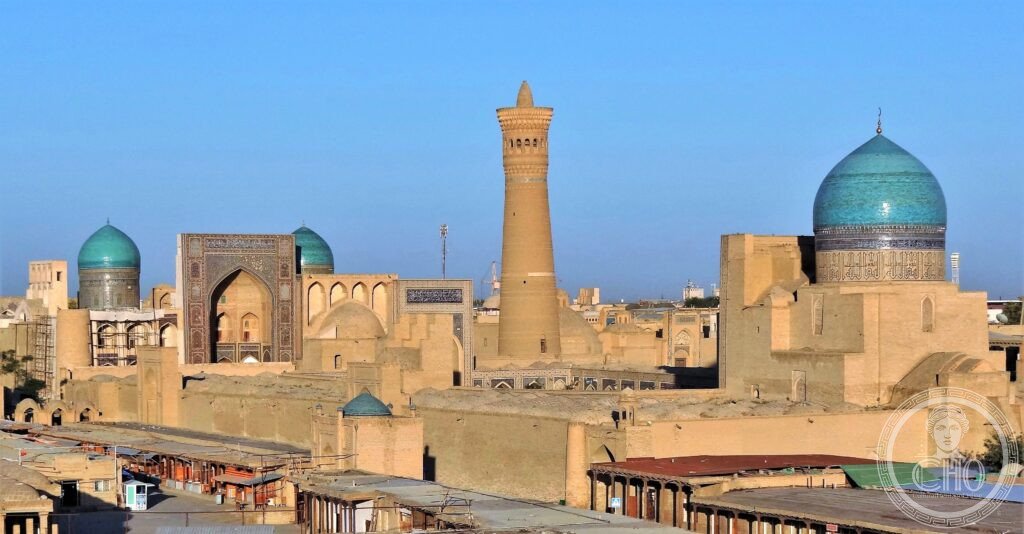
Bukhara is the Silk Road city that still works as a city: its bazaars, bathhouses and madrasas surround the Kalon Minaret much as they did a thousand years ago, in a historic centre inhabited continuously for roughly 2,500 years and inscribed by UNESCO in 1993.
At a glance
Bukhara has been settled for around 2,500 years and was one of the great intellectual centres of the medieval Islamic world. What sets it apart from other Silk Road cities is that its old town remains genuinely lived in: people still occupy the historic mahallas, the bazaars still trade, and the teahouses still stand where they have stood for centuries.
The skyline is dominated by the Kalon Minaret, a brick tower said to have so impressed Genghis Khan in 1220 that he spared it from the destruction he ordered for the rest of the city. Nearby stands the Ismail Samani Mausoleum, built between 892 and 943, regarded as the oldest intact Islamic building in Central Asia, and the Ark Fortress, the old citadel occupied from the 4th century until 1920.
Key facts
- Historic significance: continuously inhabited for approximately 2,500 years, with the Samanid-era old town largely intact
- Kalon Minaret: a 47-metre brick minaret built in 1127 by the Qarakhanid ruler Arslan Khan, decorated with fourteen distinct bands of brick pattern
- Ismail Samani Mausoleum: built 892–943 for the founder of the Samanid Dynasty; considered the oldest intact Islamic monument in Central Asia
- UNESCO status: inscribed as a World Heritage Site in 1993
- Coordinates: 39.7742° N, 64.4158° E
History
Known to the Achaemenid Persians as Numijkath around 500 BCE, Bukhara passed under Alexander the Great in 329 BCE and became a Silk Road trading hub under the Kushans in the early centuries CE. Its golden age came under the Samanid Dynasty, roughly 875 to 999, when the city was the intellectual capital of the Persian-speaking world. Ibn Sina, the physician known in Europe as Avicenna, was educated at the Samanid court library in Bukhara, and the poet Rudaki, regarded as the founder of classical Persian poetry, worked there until his death in 941.
In 1220 Genghis Khan besieged the city, tortured its merchant elite for their wealth, and burned it to the ground. Tradition holds that the Kalon Minaret alone was spared: the Mongol leader is said to have removed his helmet and bowed before it. The Kalon Mosque was rebuilt under the Shaybanid ruler Muhammad Shaybani Khan in 1514, and the Mir-i-Arab Madrasa followed in 1536.
Russian forces under General Kaufman took Bukhara in 1866, reducing the emirate to a vassal state, and in 1920 the Red Army under Mikhail Frunze ended the emirate altogether, bombarding the Ark Fortress in the process. Under Soviet rule, the Mir-i-Arab Madrasa remained the only functioning Islamic school in Central Asia while other religious institutions were closed.
What you see
The Kalon ensemble sits at the heart of the old city: the minaret, the mosque and the Mir-i-Arab Madrasa stand together, their cobalt-blue Timurid domes visible across the rooftops. Walking the base of the minaret reveals its fourteen bands of brickwork, each laid in a different geometric pattern, with the lower six dating to the Qarakhanid period and the upper bands the result of later restoration. The Kalon Mosque’s covered prayer hall is carried on 280 columns, and its open courtyard is large enough to hold thousands of worshippers. The Mir-i-Arab Madrasa continues to function as a religious school and holds the tomb of Khoja Ahrar.
A short walk northwest brings visitors to the Ismail Samani Mausoleum, its entire surface, dome included, covered in patterned baked brick whose diagonal shadows are most pronounced in the late afternoon light. Elsewhere in the old town the trading domes survive in use: Tim Abdullah Khan still sells silk, embroidery and suzani textiles, while the Toqi-Sarrofon and Toki-Tilpak-Furushon domes once housed money-changers and headwear traders respectively. The Ark Fortress, the former citadel, houses a museum on the history of the city and its old throne room.
Practical information
- Getting around: the historic centre is compact and best explored on foot, linking the Kalon ensemble, the bazaars and the Ark Fortress
- When to visit the mausoleum: the brickwork of the Ismail Samani Mausoleum is best seen in late afternoon, when the shadow pattern is most defined
- Official information: current opening arrangements and any entry conditions are best checked through the relevant Uzbek tourism or heritage authority before travelling
Getting there
Bukhara is served by its own international airport, a short distance east of the historic centre, with connections to regional hubs including Istanbul, Moscow and Tashkent. The Afrosiyob high-speed train also links Bukhara with Samarkand. Timetables, fares and current routings should be confirmed with the airlines or Uzbekistan Railways directly.
Nearby
- Ismail Samani Mausoleum — roughly one kilometre northwest of the Kalon ensemble, within the old city
- Ark Fortress — within the historic centre, the former citadel and seat of the emirs
- Chor Minor — a smaller monument within the old town, built in 1807
- Tim Abdullah Khan and the trading domes — clustered around the Kalon ensemble in the old bazaar quarter
Sources
- UNESCO
Find it on the map
See this place and what’s around it →📷 Become a Cultural Heritage Online photographer
Share your photos of places: they stay published under your name as the author. The more they're seen, the more you get noticed — and soon a contest will reward the most appreciated photos.
Log in or sign up free to add a photoIs this page about you?
This page is read by travellers and heritage enthusiasts who find it on Google. Tell us how you are connected to this place and we will take it from there.