
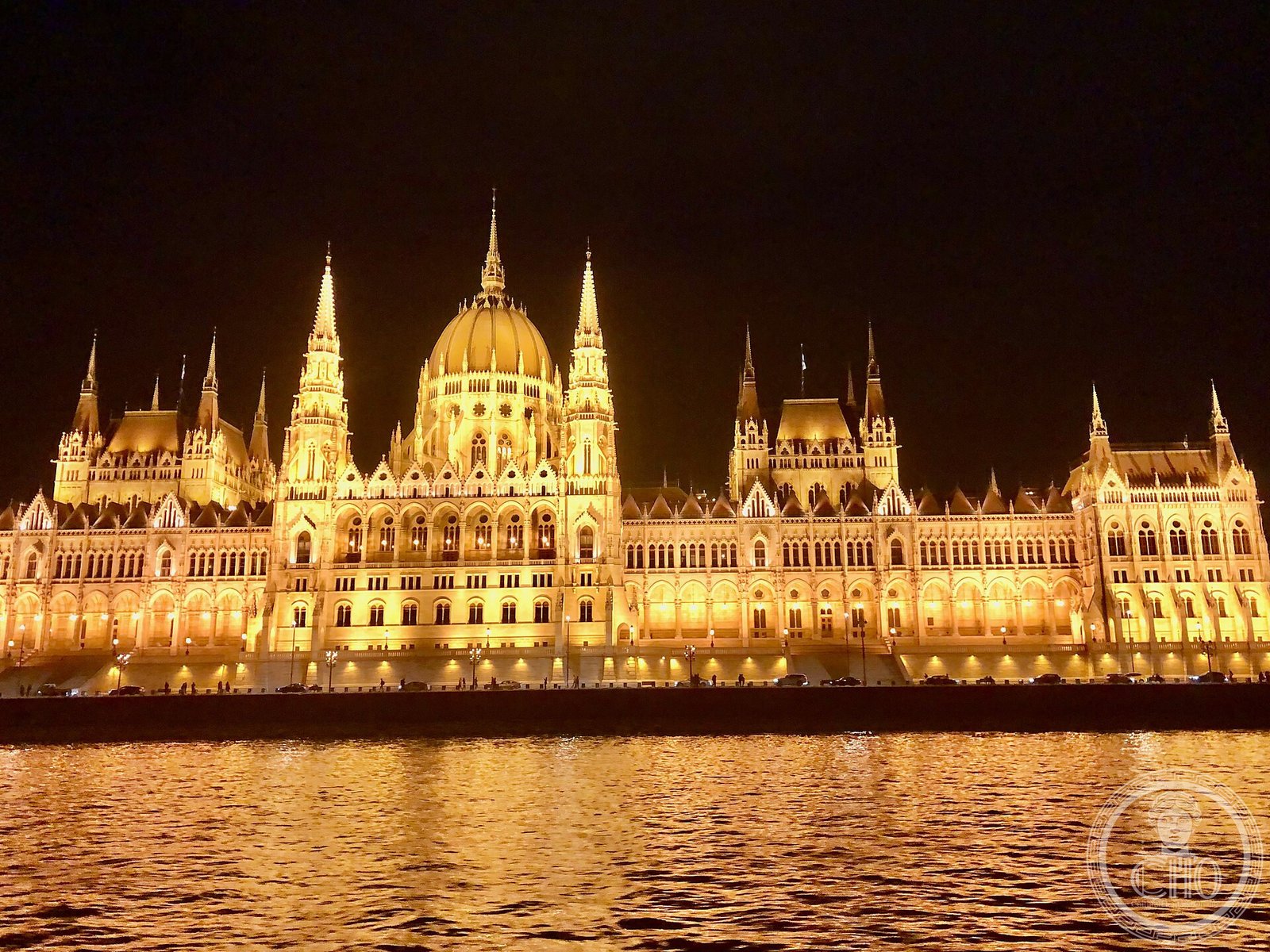
The Hungarian Parliament Building (Országház) is a monumental Gothic Revival legislative palace on the eastern bank of the Danube in Budapest, designed by Imre Steindl and built between 1885 and 1904. At 268 metres in length and with a central dome rising 96 metres — mirroring the height of St. Stephen’s Basilica across the river in a deliberate architectural parity — it is the largest building in Hungary and the third largest parliament building in the world by floor area. The building houses the National Assembly of Hungary, the office of the President of the Republic, and the Hungarian Crown Jewels.
At a glance
- Type
- National parliament building and state monument
- Period
- Designed 1882; constructed 1885–1904; officially opened 1902
- Style
- Gothic Revival with Renaissance and Baroque elements; Historicist
- Location
- Kossuth Lajos tér 1–3, Budapest V, Hungary (47.5071° N, 19.0435° E)
Overview
The Parliament is Budapest’s most recognisable landmark and the dominant feature of the Danube riverside panorama that forms part of the UNESCO World Heritage Site “Banks of the Danube, the Buda Castle Quarter and Andrássy Avenue,” inscribed in 1987. Its construction coincided with Hungary’s millennium celebrations of 1896 — the 1,000th anniversary of the Magyar conquest of the Carpathian Basin — and was intended to express the power and cultural ambition of the Kingdom of Hungary within the Austro-Hungarian Empire. Approximately 40 million bricks, 40 kg of gold, and half a million decorative stones were used in its construction.
History
The decision to build a permanent home for the Hungarian National Assembly was taken in 1880; an international competition was won by Imre Steindl, a professor at Budapest’s Technical University. Construction began in 1885 with a workforce of up to 1,000 labourers and employed some of Hungary’s foremost sculptors and painters for the interior decoration. The building was inaugurated for the millennial celebrations of 1896, though full completion came in 1904. During the 20th century the building survived both World Wars largely intact, though its exterior stonework required extensive restoration in the 1990s and 2000s after decades of atmospheric damage. Since 2000, the Hungarian Holy Crown — the crown of St. Stephen, symbol of Hungarian statehood since the 11th century — has been displayed in the central domed hall.
What you see
The facade features 365 pinnacles, 88 sculptures of Hungarian rulers and military figures, and two symmetrical main wings flanking the central domed section. Inside, guided tours access the Grand Staircase — decorated with ceiling frescoes by Károly Lotz — the Congress Hall, and the domed rotunda where the Hungarian Holy Crown, orb, and sceptre are displayed under armed guard. The debating chamber of the National Assembly is accessible only when parliament is not in session. The Danube-facing terrace and Lion Gate are focal points for public gathering and national ceremonies.
Cultural significance
The Parliament building is inseparable from the identity of Budapest and of Hungary as a nation-state. It anchors the UNESCO-designated Danube panorama alongside the Buda Castle complex and the Chain Bridge. The presence of the Holy Crown of St. Stephen in the rotunda since 2000 has reinforced the building’s role as Hungary’s symbolic heart as well as its legislative centre.
Practical information
- Address
- Kossuth Lajos tér 1–3, 1055 Budapest, Hungary
- Hours
- Guided tours daily when parliament is not in session; check the official website for schedules
- Admission
- Paid guided tours; EU citizens free with valid ID — check parliament.hu for current details
- Website
- parlament.hu/en
Getting there
Take Metro Line 2 (red) to Kossuth Lajos tér station; the Parliament entrance for visitors is on the Danube side of the square, a 3-minute walk from the metro exit. Tram line 2 runs along the Danube embankment and stops directly in front of the building. From Buda, bus 16 and the Chain Bridge (Széchenyi lánchíd) provide easy walking access from the Buda side of the river.
Sources & resources
Find it on the map
See this place and what’s around it →📷 Become a Cultural Heritage Online photographer
Share your photos of places: they stay published under your name as the author. The more they're seen, the more you get noticed — and soon a contest will reward the most appreciated photos.
Log in or sign up free to add a photoIs this page about you?
This page is read by travellers and heritage enthusiasts who find it on Google. Tell us how you are connected to this place and we will take it from there.