

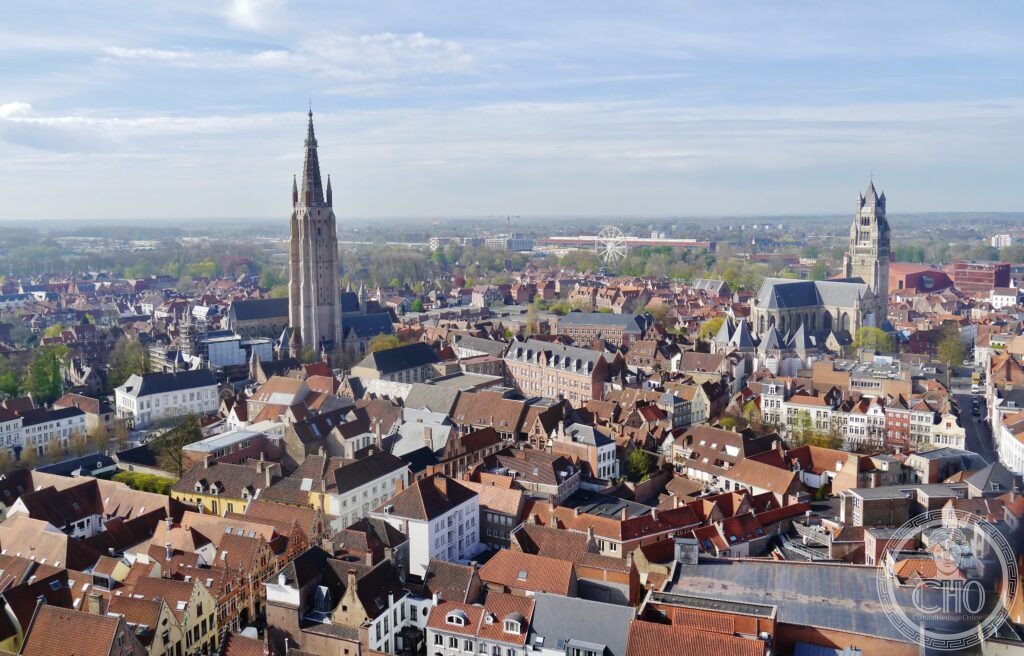
The most perfectly preserved medieval city in northern Europe and the former commercial capital of the known world. Bruges (Brugge in Flemish), founded on a cluster of islands linked by bridges in the Flemish tidal plain, was the most important trading city in northern Europe between the 13th and 15th centuries, handling the commerce of the Hanseatic League and the wool trade between England and the Mediterranean, and preserving today the canals, guild-houses, belfry, and church towers of that mercantile golden age largely unchanged.
At a glance
The Historic Centre of Bruges, UNESCO WHS 2000, is a World Heritage Area covering the old city inside the oval ring canal — the Coupure, the Damse Vaart and the waterways that join them. Approximately 120,000 people live in the wider municipality and approximately 20,000 in the centre itself, and the decisive fact of its history is an absence: from the 16th century, when the silting of the Zwin inlet cut the city off from the sea and Antwerp took its place as the dominant port, Bruges was largely abandoned, and stayed so until British and French Romantic painters and writers “discovered” it in the late 19th century. The abandonment of the city for 400 years meant it was never modernised, which is the most fortunate bankruptcy in European urban history. The canals earned the city the name “Venice of the North”, which the Bruges Tourist Office officially objects to: Bruges claims the title, several other cities claim it too, and it is the most contested piece of tourist branding in European heritage. The boats leave from the Dijver and the Wollestraat for approximately 30 min, passing under low stone bridges, along the backs of medieval houses, by the Béguinage and the Minnewater, the Lake of Love. As an art city, Bruges was the centre of Flemish painting in the 15th century. The painters are called the “Flemish Primitives”, a term that refers to the primacy of the Flemish school in northern European painting and not to any crudeness of technique. Jan van Eyck, about 1390–1441, was court painter to Philip the Good, Duke of Burgundy, and painted the Ghent Altarpiece in 1432 — the masterpiece is in Ghent, not here, and is the most important single altarpiece in northern European art. Hans Memling, about 1440–1494, was the most commercially successful painter in 15th-century Bruges, and his entire surviving corpus is still in the city: the finest single-city collection of works by any Flemish Primitive.
Key facts
- Bruges as the commercial capital of the medieval world: the most important trading city in northern Europe (1270–1480). Bruges stood at the centre of medieval European commerce. Here the wool trade between England, the producer, and Italy, the processor — Florence and Venice — crossed the fur trade from Russia, the spice trade from the eastern Mediterranean and the herring trade from Scandinavia. Its market was the most liquid commodity market in the world in the 14th century: the price of undyed English wool was set in Bruges, and that price determined the cost of cloth in Florence and the margin of every Florentine cloth merchant. The most extraordinary thing about the medieval city is that it housed permanent trading colonies from every major commercial power of Europe. The Hanseatic League, the German confederation, kept its Kontor here, the most important Hanseatic trading house outside the German-speaking world, with representatives from 60+ Hanseatic cities. Beside them came the Florentines, the Venetians, the Genoese, the Spanish and the English, which made Bruges the most internationally cosmopolitan city in northern Europe, and its annual fair the most important commercial event of the medieval north and the one most often named in European mercantile history. It also produced the Beurs, the first commodities exchange in the history of capitalism. Italian merchants met in the house of the Van der Beurze family to buy and sell futures on commodity prices, and from that family name come “beurs” in Dutch, “bourse” in French and “borsa” in Italian — every modern European word for stock exchange. No other Bruges family matters as much to world economic history.
- Jan van Eyck and the Flemish Primitives: the art of the most important school of northern European painting. The Groeninge is the most important museum in Bruges, and its masterpiece is the Madonna of Canon van der Paele, painted by Jan van Eyck in 1436. What makes these pictures what they are is technique: van Eyck laid on many thin transparent layers of oil, which gives the Flemish Primitives their luminosity and the sense of looking into a lit space rather than at a surface — the most important technical innovation in the history of Northern European painting. The same hand made the Arnolfini Portrait in 1434, now in the National Gallery in London and the most famous Flemish painting outside Belgium, with its convex mirror on the back wall reflecting the whole room and two further figures entering the door, one of whom may be van Eyck himself: the most studied single object inside any painting in the northern tradition. Memling is shown in the Sint-Janshospitaal Museum, the finest setting of any medieval collection in Europe — a working 12th-century hospital, the Oud Sint-Jan, turned into a gallery that holds his entire surviving Bruges corpus. Its most intricate object is the Shrine of St. Ursula of 1489, a wooden reliquary casket painted on every panel with her story, in such condition that the colours look as fresh as they did in 1489: the finest state of preservation of any 15th-century polychrome object in Europe.
- The Belfry of Bruges: the most important civic tower in the Low Countries. The Belfry rises 83 m and is the third to stand on this spot: the first burned in 1280, the second in 1493, and the present tower is largely 14th-century with an octagonal upper stage added in 1482. It is the most recognisable silhouette in Bruges. Its carillon has 47 bronze bells, the heaviest being the Salvator at 6 tonnes, the lowest-pitched in the Belgian carillon tradition and the most sonorous single bell in any tower in the city. The Bell Master, the official city carillonneur, has been a full-time civic appointment since 1528 — one of the oldest continuously occupied musical posts in Europe — and gives concerts on Wednesday and Saturday mornings and on summer evenings, the most accessible free concert in any medieval Flemish city. The octagonal observation platform can be reached only by the 366-step climb, the most rewarding staircase in the Low Countries. From the top you see the whole oval of the historic city below and the flat Flemish countryside running to the horizon on all four sides, with the towers of the churches among them — above all the Onze-Lieve-Vrouwekerk, the Church of Our Lady, the most important church in Bruges, whose tower reaches 122 m and is the second tallest brick structure in the world after the Ulm Minster.
- Heritage: UNESCO World Heritage Site, Historic Centre of Bruges, inscribed 2000.
- GPS: 51.2093° N, 3.2247° E.
History
The founding (the name Bruges derives from the Old Norse word “bryggia” (landing stage or bridge); Viking settlement at the site in the 9th century; the first castle of the Counts of Flanders (Baldwin I, “Baldwin Iron Arm”; c.862–879 CE; the first Count of Flanders; the most important early political figure in Flemish history)). The medieval rise (the 13th century; the Bruges cloth trade boom; the construction of the first belfry and the market halls; the most important civic buildings of the early Bruges urban identity). The golden age (c.1300–1480; the period when Bruges was the most important commercial city in northern Europe; the Dukes of Burgundy (Philip the Good (r. 1419–1467); Charles the Bold (r. 1467–1477); the most important patrons of the arts in the Low Countries; the Burgundian court at Bruges was the most sophisticated and culturally productive court in northern Europe; Jan van Eyck served as Philip the Good’s court painter and diplomatic agent)). The decline (the silting of the Zwin inlet (the 16th century; the progressive silting of the Zwin river connecting Bruges to the sea; the most consequential environmental change in Flemish urban history; the port activities moved to Antwerp; the city entered a 400-year economic stagnation that preserved its medieval character; the most fortunate urban disaster in European heritage history)). The Romantic rediscovery (the late 19th century; the Belgian writer Georges Rodenbach published his novel Bruges-la-Morte (1892; “the Dead Bruges”; the first novel set in Bruges; the most important single book for the tourism promotion of any Belgian city; the novel (a symbolist work about a widower who returns to the melancholy city of Bruges to mourn his dead wife; the city as character — the most important example of a city as narrative protagonist in Symbolist literature; the effect on tourism: the novel was immediately translated into French and English and introduced Bruges to the European art world as a melancholy medieval paradise — the most effective literary promotion of any city in Belgium)); UNESCO WHS 2000).
What you see
The essential walk begins in the Markt, the central square, with the Belfry, the Neo-Gothic Provincial Court and the guild-house facades. Then the Burg, the civic square, where the Stadhuis, the City Hall of 1376–1421, is the most beautiful Gothic civic building in Belgium: its Hall of the Aldermen is the finest Gothic interior of any town hall in the country, with a painted wooden vault carrying over 70 hanging boss carvings of the counts and countesses of Flanders and Brabant — the finest medieval painted vault in Belgium. On the same square the Holy Blood Basilica keeps, in its upper chapel, the most venerated reliquary in the country: the vial said to hold blood from the crucifixion wound of Christ, brought from the Holy Land in 1150 by Thierry of Alsace, Count of Flanders. From there the Dijver canal makes the main walk, under the linden trees, past the Groeninge Museum with its van Eycks and the Arentshuis. The Onze-Lieve-Vrouwekerk, the Church of Our Lady, raises a 122-m tower and holds the Madonna of Bruges, carved by Michelangelo in 1501–1504 — the only sculpture of his to leave Italy in his lifetime, bought by a Bruges merchant in 1501, 128 cm of white Carrara marble, the most important Italian Renaissance sculpture in Belgium and the most prized object in any Belgian church. The walk ends at the Béguinage, the Princely Béguinage Ten Wijngaerde of about 1245, a UNESCO WHS in its own right, the most peaceful space in the city, where the Benedictine nuns still wear traditional dress.
Practical information
- Getting there: Bruges railway station (the direct train from Brussels Midi (central Bruges; 1h; departures every 30 min (the most frequent international train connection to a Belgian historic city); from Brussels Midi (the Eurostar terminus from London St. Pancras International; 2h from London; the most comfortable and most environmentally responsible route from London to Bruges); from Paris Gare du Nord (change at Brussels Midi; total journey approximately 2h 30min); by car (Bruges is 15 min from the E40 motorway; parking inside the historic centre is expensive and limited; the Park and Ride system (free parking at the station; free bicycle hire (the most recommended transport in Bruges: the city is flat and the canal network creates natural cycling circuits; the most pleasant cycling environment of any city in Belgium))))).
- Belgian beer and chocolate: the two most important products of Belgian civilisation. Belgium has the most diverse beer culture in the world and more distinct styles per head than any other country. The most important are the Trappist beers, brewed at 6 Belgian abbeys: Chimay, Orval, Rochefort, Westmalle, Westvleteren and Achel. The most celebrated is Westvleteren XII, rated best beer in the world more often than any other on Beer Advocate and RateBeer, brewed only by the monks of the Sint-Sixtusabdij and sold only at the abbey gate — the most unusual retail model in the drinks industry, since you must telephone ahead to reserve your maximum allocation of 2 cases per car per visit. In Bruges itself there is De Halve Maan, the Half Moon Brewery, the only working brewery in the city centre, whose Bruges Zot, the most important Bruges-brewed beer, a blonde ale with orange peel, is the one to drink on a canal boat. The brewery tour is the most popular indoor attraction in town after the Groeninge Museum, and in 2016 the brewery finished a 3.2-km underground beer pipeline from the city centre to its bottling plant on the outskirts: the most unusual piece of food-production infrastructure in Belgian culinary history. As for chocolate, approximately 50 shops crowd the historic centre, the highest density per square kilometre of any city in the world. The most inventive chocolatier is Dominique Persoone of the Chocolate Line on Burg square, who designed the “chocolate sniffer” for a Rolling Stones party in 2007 — cocoa inhaled through the nose, and the most controversial luxury food product in Belgian gastronomy.
- Ghent: the essential complement to Bruges. Ghent, Gent, lies 45 km east of Bruges, 30 min by train on the most used inter-city line in Belgium. It holds the Ghent Altarpiece, the Adoration of the Mystic Lamb, completed by Jan van Eyck in 1432: the largest and most complex altarpiece in northern European art, 12 panels measuring 3.4 m × 4.4 m when open, and the most studied painting in any Belgian church. Its central image is the Lamb, the lamb of God on an altar amid angels and worshippers in a visionary meadow, the blood from its neck running into a golden chalice, with every flower in the foreground painted so precisely that each species can be identified botanically — the finest union of scientific observation and religious imagery in medieval northern European painting. It is also the most stolen painting in the world, taken, looted and ransomed more often than any other single work of art in history: 13 documented incidents, including thefts by Philip II of Spain, by Napoleon and by the Nazis, and the Belgian criminal who removed a single panel in 1934 and died without saying where it was. That panel came back anonymously in 1945, in the most extraordinary theft in Belgian art history.
Getting there
Train from Brussels Midi 1h (every 30min). Eurostar from London to Brussels Midi 2h, then 1h to Bruges. Flat city. Cycling recommended. GPS: 51.2093, 3.2247.
Nearby
- Ghent and the Ghent Altarpiece. 45 km east (30 min by train). The most important single altarpiece in northern European art. Described in the Practical section. The Ghent Historic City Centre (the Graslei and Korenlei (the most beautiful medieval guild-house quaysides in Belgium; the view from the Korenlei looking toward the towers of Sint-Baafskathedraal, Sint-Niklaaskerk, and the Belfry of Ghent — the most impressive three-tower view in Flemish civic architecture); the Gravensteen (the Castle of the Counts; the most complete medieval castle in Belgium; the torture museum (the most visited part of the castle; the collection of medieval torture instruments; the most uncomfortable 30 minutes in any Belgian cultural visit))).
- Ypres (Ieper) and the Flanders Fields memorial landscape. 50 km south-west of Bruges (1h by car). The most important WWI memorial landscape in Europe. Ypres (the British name for the Belgian city of Ieper; the scene of 3 Battles of Ypres (1914, 1915, 1917); the Menin Gate Memorial (the Great Arch of the Menin Gate; the memorial to 54,896 soldiers of the British Empire who died in the Ypres Salient and have no known grave; the Last Post (the bugle ceremony conducted every evening at 20:00 since 1928 (except for the German occupation 1940–1944; resumed 11 September 1944 on the day the Polish Armoured Division liberated Ypres) — the most consistent single daily memorial ceremony in Europe; the Tyne Cot Cemetery (the largest CWGC cemetery in the world; 11,956 graves; the most moving single site in the Flanders Fields memorial landscape)))).
- Antwerp (UNESCO WHS adjacent context). 90 km east of Bruges (1h by train). The diamond capital of the world and the home of Rubens. Antwerp replaced Bruges as the dominant commercial city of the Low Countries in the 16th century, when the Scheldt estuary opened and the Portuguese spice trade came through it. The Rubenshuis was the home and studio of Peter Paul Rubens, 1577–1640, the most important Flemish Baroque painter, who ran the most productive workshop in the history of Flemish art: up to 12 assistants, Anthony van Dyck among them, and approximately 1,400 paintings. The Onze-Lieve-Vrouwekathedraal, the Cathedral of Our Lady, is the most important Gothic church in Belgium and the tallest in the Low Countries at 123 m, and it holds four Rubens altarpieces, of which the Descent from the Cross of 1612–1614 in the north transept is the finest he painted and the most dramatic picture in any Belgian church. In the Diamantkwartier, the Diamond Quarter, pass 80% of the world’s rough diamonds and 50% of all cut stones: the most important trading place for a luxury commodity anywhere.
Sources
- Wikipedia, Bruges. Flemish Primitives. Belfry of Bruges. Jan van Eyck, accessed June 2026.
- UNESCO, Historic Centre of Bruges, WHS reference 996, inscribed 2000.
- Luc Devliegher, De Huizen te Brugge, Lannoo, 1975.
Find it on the map
See this place and what’s around it →📷 Become a Cultural Heritage Online photographer
Share your photos of places: they stay published under your name as the author. The more they're seen, the more you get noticed — and soon a contest will reward the most appreciated photos.
Log in or sign up free to add a photo