
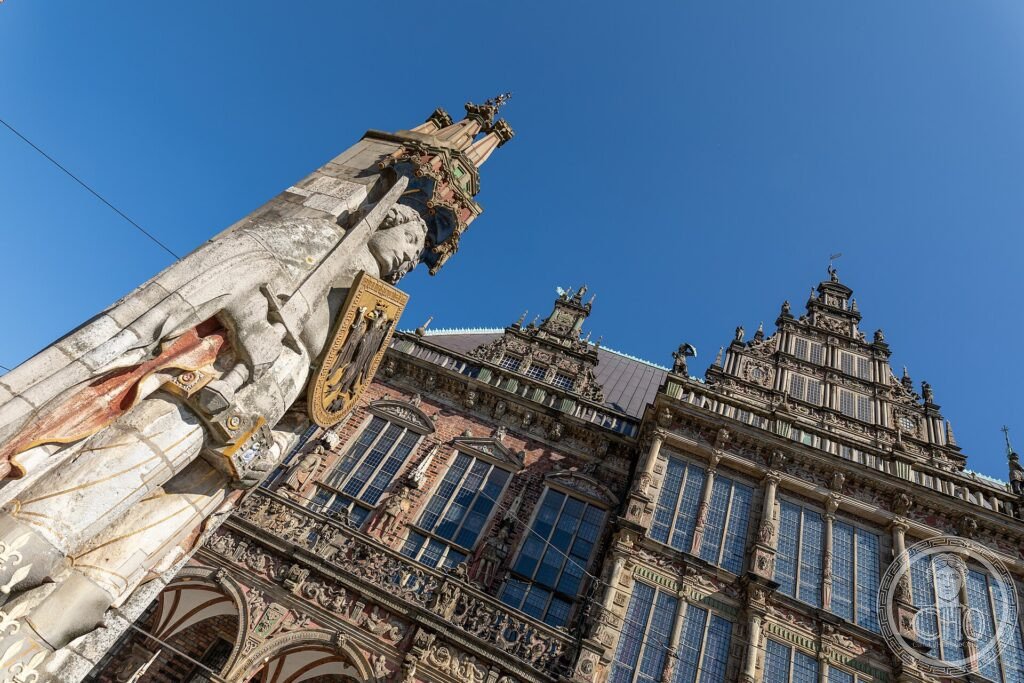
For over six centuries the Roland has stood watch before the town hall: more than five metres of stone proclaiming the rights and freedom of the merchant city. Behind him, the Renaissance facade of the Rathaus tells the pride of a Hanseatic republic never bowed to a prince.
At a glance
The Town Hall of Bremen and the statue of Roland that stands before it form a single UNESCO monument, inscribed in 2004 as an outstanding ensemble representing civic autonomy and the free market town in the Holy Roman Empire. The Gothic town hall of 1405–1410 received a magnificent Weser Renaissance façade in 1595–1612. The Roland, erected in 1404, is the largest free-standing statue of the German Middle Ages and a symbol of the city’s rights and independence. Both survived the Second World War.
Key facts
- UNESCO: World Heritage since 2004
- Town Hall: built 1405–1410 in Gothic style
- Weser Renaissance façade: added 1595–1612 by Lüder von Bentheim
- Roland statue: erected 1404, about 5.5 m tall, a symbol of civic freedom and market rights
- Survival: both monuments came through WWII largely undamaged
- Function: the Rathaus is still the seat of Bremen’s government
History
Bremen grew rich as a member of the Hanseatic League, trading across the North Sea and the Baltic. In 1404 the citizens raised a great stone Roland in the market square — a figure drawn from the legend of Charlemagne’s paladin — as a public declaration of the town’s liberties and its right to hold a market. The following years saw the building of a Gothic town hall to match this civic confidence.
At the turn of the 17th century the plain Gothic front was transformed: between 1595 and 1612 the city architect Lüder von Bentheim clad it in an ornate Weser Renaissance façade, with arcades, gables and sculpture. The ensemble has remained the symbolic heart of Bremen ever since, surviving the wars that flattened so many German city centres.
What you see
The Roland faces the cathedral, sword drawn and shield carved with the imperial eagle, an embodiment of the city’s defiance. Behind, the town hall’s façade is a screen of arcades, oriels and ornamented gables. Inside, the Upper Hall (Obere Rathaushalle) runs the length of the building, hung with models of sailing ships and lit by tall windows.
In a corner of the square stands the bronze of the Town Musicians of Bremen — donkey, dog, cat and cockerel — recalling the Grimm fairy tale.
Practical information
- Town Hall: interiors visitable on guided tours; the square and Roland are open at all times
- Town Musicians: the bronze statue stands on the western side of the Rathaus
- Time needed: 1–2 hours for the square and a hall tour
- Note: tours may be suspended during civic functions
Getting there
Bremen is a major city in north-west Germany, well connected by rail to Hamburg and Hanover. From the central station it is about a 15-minute walk, or a short tram ride, to the market square. GPS: 53.0759° N, 8.8072° E.
Nearby
- Schnoor quarter — Bremen’s oldest district, a maze of tiny lanes
- Böttcherstrasse — an Expressionist brick street of the 1920s
- St Peter’s Cathedral — facing the town hall across the square
Sources
- UNESCO World Heritage Centre — “Town Hall and Roland on the Marketplace of Bremen” (ref. 1087)
- Freie Hansestadt Bremen — official city authority
- Encyclopaedia Britannica — Bremen
Find it on the map
See this place and what’s around it →📷 Become a Cultural Heritage Online photographer
Share your photos of places: they stay published under your name as the author. The more they're seen, the more you get noticed — and soon a contest will reward the most appreciated photos.
Log in or sign up free to add a photoIs this page about you?
This page is read by travellers and heritage enthusiasts who find it on Google. Tell us how you are connected to this place and we will take it from there.