
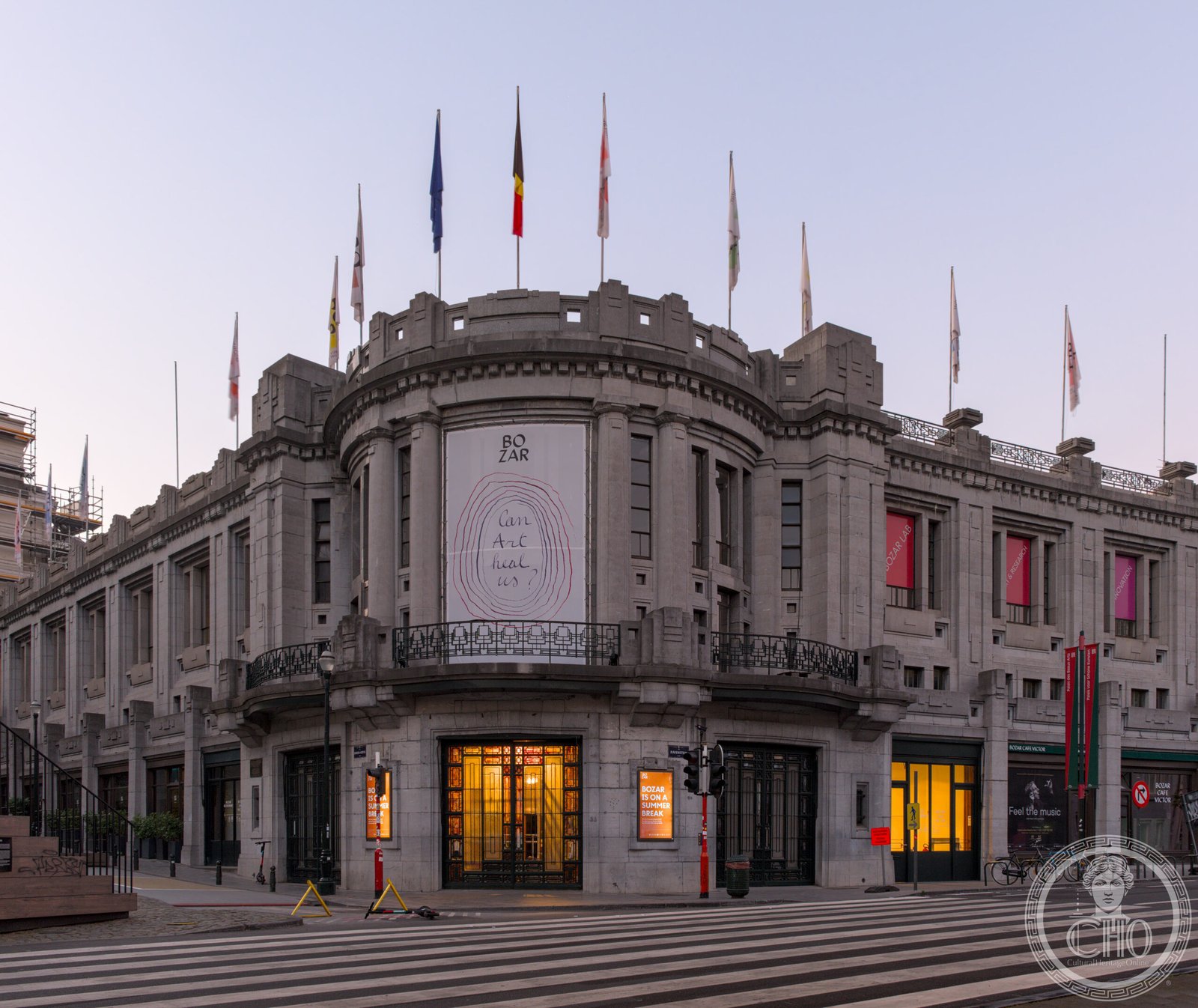
Bozar is Victor Horta’s late masterpiece — and one of the most quietly surprising buildings in Europe. Horta had electrified the world in the 1890s with the sinuous organic interiors of Art Nouveau: the Hôtel Tassel, the Maison du Peuple, the Hôtel Solvay. When the Belgian state commissioned him in 1922 to design a multi-purpose cultural venue in the Royal Quarter, he adopted an entirely different language: the restrained, geometric clarity of Art Déco, as though he were personally bridging the passage between two eras. The resulting Palais des Beaux-Arts — known today as Bozar — occupies an entire city block on the sloping Rue Ravenstein. Because the street drops sharply, the entrance is at pavement level but the concert hall is largely underground, an architectural sleight that gives the building its peculiar sense of compressed space suddenly released. The Henry Le Bœuf Hall, seating 2,150, is regarded as one of the finest concert acoustics in Europe and has hosted every major performer of the twentieth century. Bozar was listed as a National Heritage Monument in 2018 and is the only building by Horta to contain a concert hall.
At a glance
- Type
- Multi-purpose cultural centre
- Period
- 1922–1928
- Style
- Art Déco
- Location
- Rue Ravenstein 23, Brussels, Belgium
- Coordinates
- 50.8436° N, 4.3597° E
- Architect(s)
- Victor Horta
Overview
The Centre for Fine Arts in Brussels — universally known by its Flemish nickname Bozar — is Belgium’s premier multidisciplinary cultural institution. Under a single roof it presents classical music concerts, temporary art exhibitions, theatre, dance, literature events, cinema, and architecture shows. The building occupies a complete urban block between the upper and lower cities of Brussels, connected internally by staircases and galleries that reveal the topographic drop. Its main hall is a benchmark of acoustic engineering; its galleries have hosted landmark exhibitions from Magritte retrospectives to contemporary international biennials. The programming reaches across disciplines and languages in a city that is itself the capital of European multilingualism.
History
The project originated in 1922 when the Belgian state sought a permanent venue to replace the provisional spaces used for major cultural events in Brussels. Victor Horta, then in his sixties and long past his Art Nouveau peak, was selected after a competition. He designed a building that would integrate a concert hall, exhibition galleries, cinema, theatre, and artists’ studios in a single block — an ambition without precedent in Belgian public architecture. Construction ran from 1922 to 1928. The building was inaugurated in 1928 as the Palais des Beaux-Arts. Throughout the mid-century it became the cultural heart of Brussels, a neutral space where Flemish and Francophone Belgium could meet on equal terms. In the 1990s it was rebranded as Bozar to reflect its fully bilingual and international identity. A major restoration and extension project was completed in 2002 by architects Samyn and Partners.
Architecture & Design
Horta’s design is a study in controlled complexity. The building must navigate a substantial level change across the Rue Ravenstein block — the upper city entrance on the Rue Royale side sits some ten metres above the lower entrance on Rue Ravenstein. Horta resolved this by burying the concert hall below street level and using the height difference to create a sequence of interior promenades. The façade on Rue Ravenstein is deliberately understated — a long, low horizontal band of stone that gives no hint of the scale of the spaces within. The Henry Le Bœuf Hall has a horseshoe plan with shallow balconies; its acoustic properties derive from the geometry and the extensive use of wood panelling. The interior detailing — ironwork, lighting fixtures, door handles — shows Horta’s craft at its most precise, stripped of ornament but never cold.
Cultural significance
Bozar holds a unique place in European cultural geography as a genuinely neutral ground in a politically divided country. It is the principal institution where Belgium’s linguistic communities — Flemish, Francophone, and German-speaking — share a common cultural space. For architectural history, it represents Horta’s conscious self-reinvention: the inventor of Art Nouveau demonstrating that he could master and transcend its successor style. The Henry Le Bœuf Hall’s acoustic reputation has drawn every major orchestral ensemble and soloist of the past century. The building’s 2018 listing as a National Heritage Monument recognised its twin significance as architecture and as an institution.
Visiting today
Bozar is open year-round with a varied programme of concerts, exhibitions, theatre, and cinema. The building itself can be visited during events and on guided architectural tours organised periodically. Exhibition galleries have separate admission; concert tickets vary by programme. The bookshop and café are open to all visitors. The Henry Le Bœuf Hall concert season runs from September to June. The building is wheelchair accessible via the Rue Ravenstein entrance.
Getting there
Bozar is located on Rue Ravenstein in central Brussels, a three-minute walk from Gare Centrale station, which is served by national rail, metro lines 1 and 5, and several bus lines. Tram line 92 stops on Rue Royale adjacent to the upper entrance. By metro, Gare Centrale and Parc stations are both within five minutes on foot. Parking is extremely limited in the area; public transport is the recommended option.
Sources & resources
Find it on the map
See this place and what’s around it →📷 Become a Cultural Heritage Online photographer
Share your photos of places: they stay published under your name as the author. The more they're seen, the more you get noticed — and soon a contest will reward the most appreciated photos.
Log in or sign up free to add a photoDo you manage this place?
This page is read by travellers and heritage enthusiasts who find it on Google. Keep it accurate — and make it work for you. Free for non-profit heritage institutions.