
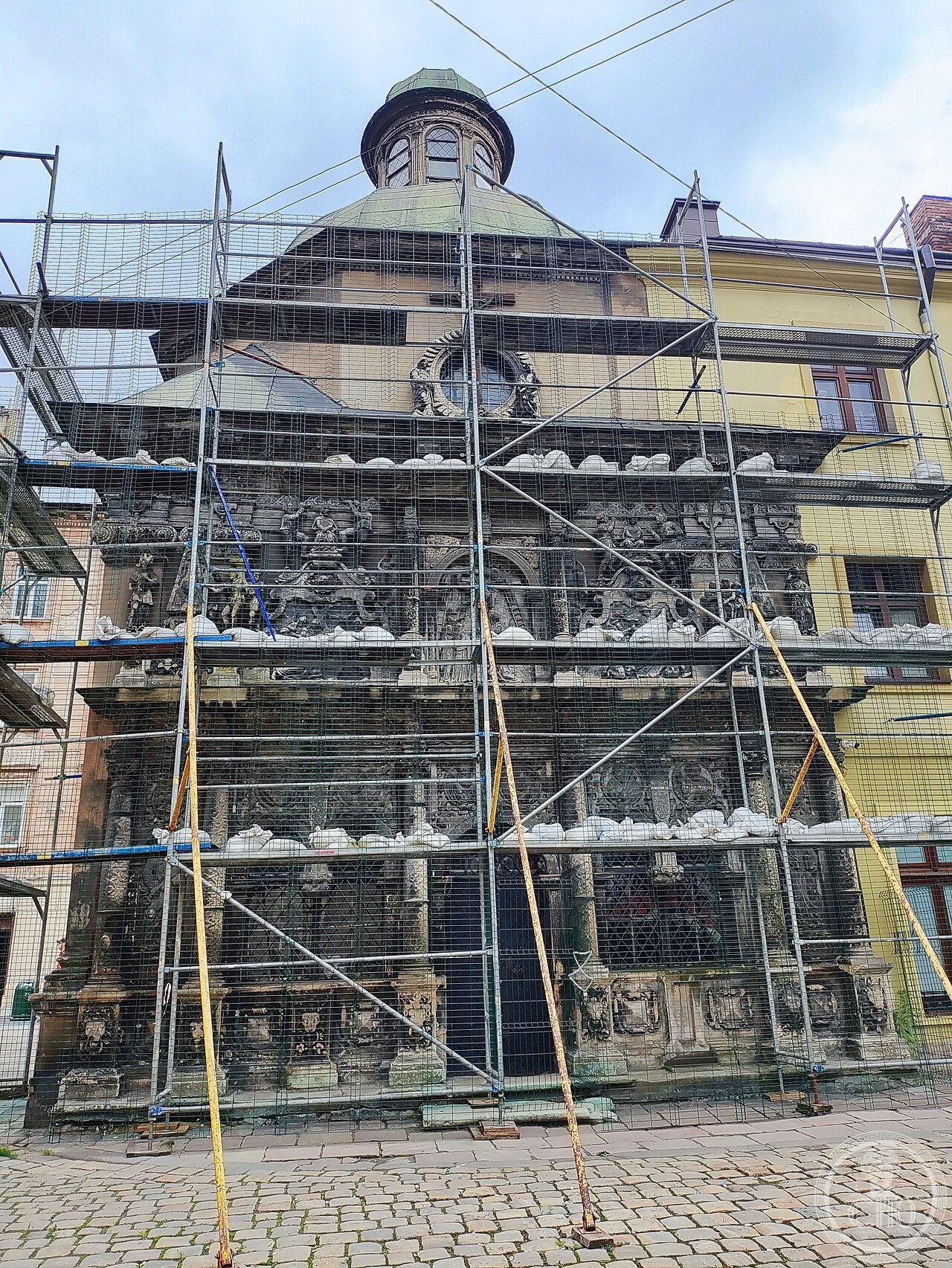
In Lviv, Ukraine, the Boim Chapel was built between 1609 and 1615, on the initiative of the wealthy cloth merchant Jerzy Boim, of Hungarian origin, who had settled in Lviv and married Jadwiga Niżniowska in 1590. The work was completed by his son Paweł Boim. The chapel was raised on a city cemetery then in use, next to the Latin Cathedral, in what is today Cathedral Square. The architect is commonly given as Andrzej Bemer, who is said to have followed a simplified version of the Sigismund Chapel in Wawel Cathedral in Kraków, with additions of Italian taste. That attribution comes mainly from tourist and Wikipedia sources and should ideally be checked against a scholarly source before being taken as settled. The sculptor Jan Scholtz directed a second phase of the work, while Hans Ficher carried out most of the interior sculptural decoration. The building, square in plan and on a single level, is crowned by a dome on an octagonal drum with a lantern, with a crypt below. The main façade, facing west, is entirely covered with reliefs carved in stone showing scenes of the Passion of Christ and biblical and allegorical figures, held to be among the richest Mannerist and late Renaissance sculptural ensembles in this part of Europe. The interior has stucco decoration, four stone figures of prophets by the altar and a coffered dome, according to some sources made of 36 panels, as well as mural portraits of Jerzy Boim and his wife Jadwiga, dated 1617 and attributed to Jan Gianni. The chapel served as the private funerary mausoleum of the Boim family, which buried there, according to the sources, fourteen of its members, with later burials afterwards moved to the general cemeteries of the city. Several tourist sources report that under Soviet rule the chapel lost its religious function and was used as a municipal store for cleaning materials, before becoming an exhibition space of the Lviv Art Gallery, although this detail comes from secondary, non-academic sources and should be treated with caution. Today the chapel no longer holds regular religious services and works as a museum, part of the Borys Voznytskyi Lviv National Art Gallery, open to visitors for a fee, within the historic centre of Lviv, a UNESCO World Heritage site.
About the Boim Chapel
In Lviv, Ukraine, the Boim Chapel was built between 1609 and 1615, at the initiative of the wealthy cloth merchant Jerzy Boim, of Hungarian origin, who had settled in Lviv and married Jadwiga Niżniowska in 1590; the work was completed by his son Paweł Boim. The chapel was built on a then-existing city cemetery adjoining the Latin Cathedral, in what is today Cathedral Square. The architect is commonly cited as Andrzej Bemer, who is said to have followed a simplified version of the Sigismund Chapel at Wawel Cathedral in Kraków with added Italian touches, though this attribution comes primarily from tourism and Wikipedia sources and would ideally be verified against a scholarly source before being treated as settled fact; sculptor Jan Scholtz directed a second phase of work, while Hans Ficher carried out most of the interior sculptural decoration. The building, square in plan and single-storey, is topped by a dome on an octagonal drum with a lantern, with a crypt below; the main west facade is entirely covered in carved stone reliefs depicting scenes from the Passion of Christ and biblical and allegorical figures, considered among the richest Mannerist and late-Renaissance sculptural ensembles in this part of Europe; the interior features stucco decoration, four stone prophet figures near the altar, and a coffered dome, according to some sources made up of 36 panels, along with mural portraits of Jerzy Boim and his wife Jadwiga, dated 1617 and attributed to Jan Gianni. The chapel served as the Boim family’s private funerary mausoleum, holding, according to sources, fourteen family burials, with later interments eventually moved to the city’s general cemeteries. Several tourism sources report that under Soviet rule the chapel lost its religious function and was reportedly used as a municipal storage depot for cleaning supplies, later becoming an exhibition space of the Lviv Art Gallery, though this detail comes from secondary, non-academic sources and should be treated with some caution. Today the chapel no longer holds regular religious services and functions as a museum, part of the Borys Voznytskyi Lviv National Art Gallery system, open to visitors for a fee, within Lviv’s historic centre, a UNESCO World Heritage Site.
Key facts
- 1609-1615: built as a private mausoleum for merchant Jerzy Boim’s family.
- A densely carved facade, among the finest Mannerist sculptural ensembles in Eastern Europe.
- Fourteen Boim family members reportedly buried in the chapel.
- 1617 mural portraits of Jerzy and Jadwiga Boim attributed to Jan Gianni.
- Soviet era: reportedly lost its religious function, according to tourism sources.
- Today a museum, part of the Lviv National Art Gallery system.
History
Commissioned by a single wealthy merchant family as a private funerary monument, the Boim Chapel packs an extraordinary density of Mannerist stone carving into a footprint far smaller than the grand cathedral it stands beside, a deliberate statement of status by a Hungarian-origin merchant family that had risen to prominence in Renaissance-era Lviv. Its transition from private mausoleum through reported Soviet-era secular use to its current status as a museum reflects the broader pattern of religious sites across the former Soviet sphere losing and later partially regaining public devotional or heritage significance.
What you see
Every inch of the chapel’s west facade is carved with Passion scenes and biblical figures in dense Mannerist relief, crowned by a lantern-topped dome on an octagonal drum. Inside, a coffered dome, stone prophet figures, and 1617 mural portraits of the Boim family surround the crypt where fourteen family members were once interred.
Practical information
- Opening hours: generally open daily as a museum, with an entrance fee; check current hours before visiting.
- Address: Katedralna Square 1, Lviv, Ukraine.
Getting there
The Boim Chapel stands beside the Latin Cathedral in Lviv’s historic centre, easily reached on foot. GPS: 49°50′26″N, 24°01′52″E.
Nearby
- Latin Cathedral — the large Roman Catholic cathedral directly adjoining the chapel.
- Armenian Cathedral — the medieval Armenian cathedral elsewhere in Lviv’s old town.
Sources
- Wikipedia — “Boim Chapel” (en.wikipedia.org).
- POLONIKA Institute — “Kaplica Boimów we Lwowie”
- lviv.travel — official Lviv tourism site, “Boim Chapel in Lviv”
Find it on the map
See this place and what’s around it →📷 Become a Cultural Heritage Online photographer
Share your photos of places: they stay published under your name as the author. The more they're seen, the more you get noticed — and soon a contest will reward the most appreciated photos.
Log in or sign up free to add a photo