
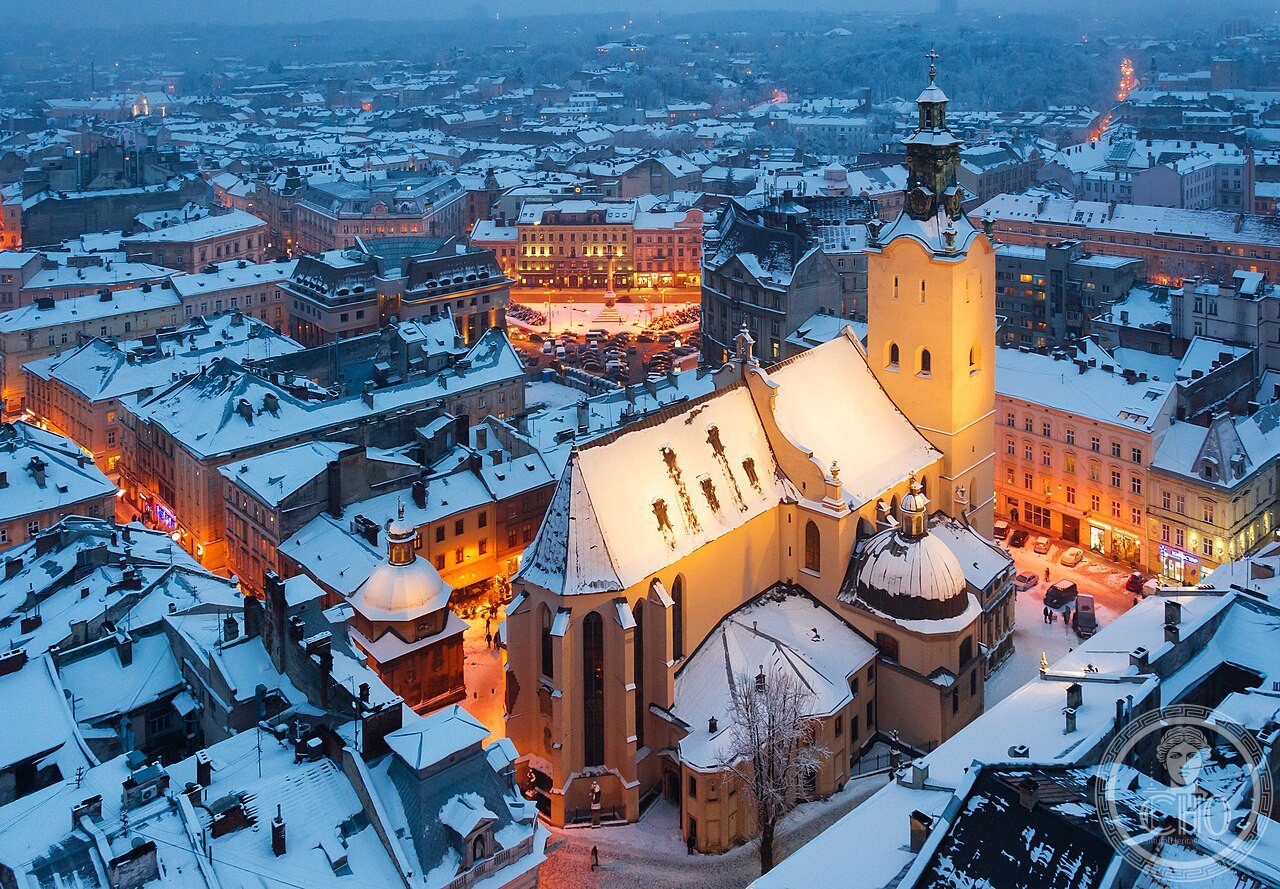
At Lviv, in Ukraine, building of the Archcathedral Basilica of the Assumption of the Blessed Virgin Mary began in 1360 at the order of King Casimir III the Great of Poland, replacing an earlier wooden church dedicated to the Holy Trinity, burned in 1344 barely six years after it was built. The chancel of the Gothic stone building was completed in 1404 and the church consecrated the following year, but the work went on until 1481, under the builders Joachim Grom and Ambroży Rabisch of Wrocław, coordinated by Jerzy Scheller of Lviv: a hundred and twenty-one years from the start of the work. Over the centuries several side chapels were added, among them the Kampian Chapel, of the late sixteenth to early seventeenth century, designed by P. Rymlianyn and V. Kapinos and restored between 1905 and 1907; the famous Boim Chapel, often associated with the cathedral, is in fact a separate, self-standing structure, built between 1609 and 1615 in Renaissance style for the family of the merchant Jerzy Boim on an adjoining former cemetery, with its own entrance and working today as an independent museum. Between 1760 and 1780, under Archbishop Wacław Hieronim Sierakowski, the cathedral was unified stylistically in Baroque, with a new bell tower added between 1761 and 1776; the chancel was then remodelled in Gothic Revival between 1892 and 1898, the period of the stained glass designed by Józef Mehoffer, Jan Matejko and Teodor Axentowicz. Inside, a sixteenth-century icon, “Our Lady of Graces”, attributed to Józef Szolc-Wolfowicz, is venerated, canonically crowned in 1776 and again by Pope John Paul II in 2001. The cathedral was the setting, in 1440, of a mass for Christian unity celebrated by Cardinal Isidore of Kyiv, and in 1656 of the famous “Oath of Lviv” spoken by King John II Casimir Vasa; Pope John Paul II came on 26 June 2001, on his apostolic journey to Ukraine, to crown the icon, though the great open-air masses of that visit were held separately at the Lviv hippodrome, not inside the cathedral. The cathedral remains today the metropolitan seat of the Roman Catholic Archdiocese of Lviv.
About the Latin Cathedral
In Lviv, Ukraine, construction of the Archcathedral Basilica of the Assumption of the Blessed Virgin Mary began in 1360 at the initiative of King Casimir III the Great of Poland, replacing an earlier wooden church dedicated to the Holy Trinity, which burned down in 1344, just six years after it was built. The presbytery of the stone Gothic building was finished in 1404 and the church consecrated the following year, but work continued until 1481, under builders Joachim Grom and Ambroży Rabisch of Wrocław, coordinated by Jerzy Scheller of Lviv: 121 years from the start of construction. Over the centuries several side chapels were added, including the Kampian Chapel, from the late 16th or early 17th century, designed by P. Rymlianyn and V. Kapinos and restored between 1905 and 1907; the famous Boim Chapel, often associated with the cathedral, is in fact a separate, freestanding structure, built between 1609 and 1615 in Renaissance style for the family of merchant Jerzy Boim on a former adjoining cemetery, with its own entrance and today functioning as an independent museum. Between 1760 and 1780, under Archbishop Wacław Hieronim Sierakowski, the cathedral was stylistically unified in Baroque form, with a new bell tower added between 1761 and 1776; the presbytery was later remodeled in Gothic Revival style between 1892 and 1898, the period from which the stained-glass windows designed by Józef Mehoffer, Jan Matejko and Teodor Axentowicz also date. Inside is venerated a 16th-century icon, “Our Lady of Grace,” attributed to Józef Szolc-Wolfowicz, canonically crowned in 1776 and again by Pope John Paul II in 2001. The cathedral was the setting, in 1440, for a Mass for Christian unity celebrated by Cardinal Isidore of Kyiv, and in 1656 for the famous “Lwów Oath” pronounced by King John II Casimir Vasa; Pope John Paul II visited on 26 June 2001, as part of his apostolic journey to Ukraine, to crown the icon, though the visit’s large outdoor Masses were held separately at the Lviv Hippodrome, not inside the cathedral itself. The cathedral remains today the metropolitan seat of the Roman Catholic Archdiocese of Lviv.
Key facts
- 1360-1481: built over 121 years, commissioned by King Casimir III the Great
- 1656: site of the “Lwów Oath” pronounced by King John II Casimir Vasa
- 1760-1780: stylistically unified in Baroque form under Archbishop Sierakowski
- The Boim Chapel, often thought part of the cathedral, is actually a separate freestanding structure
- 1892-1898: Gothic Revival remodeling and new stained glass by Mehoffer, Matejko and Axentowicz
- 2001: visited by Pope John Paul II, who crowned the “Our Lady of Grace” icon
History
Built across 121 years and then reshaped in Baroque unity three centuries after its Gothic completion, the Latin Cathedral’s layered architecture mirrors the successive political and artistic regimes that governed Lviv across more than six centuries. Its role hosting the 1656 Lwów Oath, a pivotal moment tying the cathedral to Polish royal history, and its 2001 papal visit place it at the intersection of both national and religious memory for the city.
What you see
A Gothic core, completed in 1481, was reshaped into Baroque unity between 1760 and 1780, then given a Gothic Revival presbytery and stained glass by leading Polish artists at the close of the 19th century. Just outside, the separate, freestanding Boim Chapel, a Renaissance-era family funerary chapel, is frequently mistaken for part of the cathedral itself despite its own distinct entrance and history.
Practical information
- Opening hours: generally open daily outside services; check current hours before visiting
- Address: Katedralna Square, Lviv, Ukraine
Getting there
The cathedral stands in Lviv’s historic centre, easily reached on foot within the old town. GPS: 49°50′27″N, 24°01′50″E.
Nearby
- Boim Chapel — the separate Renaissance family chapel just outside the cathedral
- Armenian Cathedral — the medieval Armenian cathedral elsewhere in Lviv’s old town
- Historic Centre of Lviv — the surrounding UNESCO World Heritage old town
Sources
- Wikipedia — “Cathedral Basilica of the Assumption, Lviv” (en.wikipedia.org)
- Lviv Interactive — “Cathedral of the Assumption of the Virgin Mary” (lia.lvivcenter.org)
- lviv.travel — official Lviv tourism site, “The Latin Cathedral”
Find it on the map
See this place and what’s around it →📷 Become a Cultural Heritage Online photographer
Share your photos of places: they stay published under your name as the author. The more they're seen, the more you get noticed — and soon a contest will reward the most appreciated photos.
Log in or sign up free to add a photo