
.JPG)
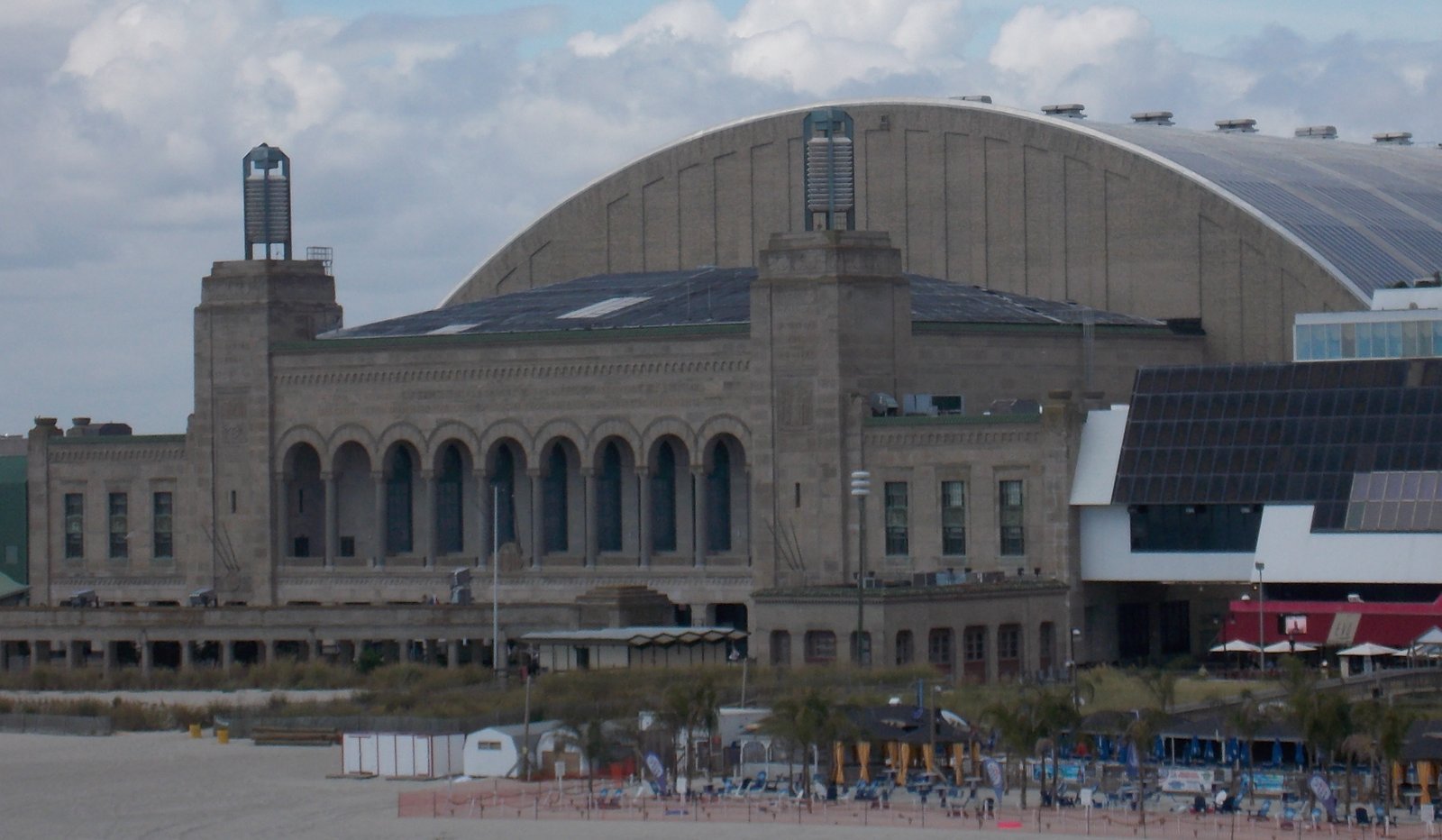
Built as a convention auditorium and completed in 1929, Boardwalk Hall contains the largest pipe organ in the world — 33,000 pipes installed by Midmer-Losh — housed in an Art Deco shell that once accommodated political conventions, ice shows, and the Miss America pageant.
At a glance
Boardwalk Hall stands at Mississippi Avenue and the Boardwalk in Atlantic City, its long horizontal facade facing the ocean promenade that has defined the city since the 1870s. Opened in May 1929 as the Atlantic City Convention Hall, it was the largest convention facility in the United States at the time and the largest room without interior columns — an engineering achievement that made it the preferred venue for heavyweight boxing championships, political conventions, and the Miss America pageant for much of the twentieth century.
Key facts
- Opened: May 1929 (original name: Atlantic City Convention Hall)
- Architects: Simon & Simon (Elmer and Martin Simon), Philadelphia
- Style: Art Deco
- Organ: Midmer-Losh — largest pipe organ in the world by number of pipes (33,000+)
- Main auditorium: capacity approx. 14,770 for concerts
- Address: 2301 Boardwalk, Atlantic City, NJ 08401
- National Historic Landmark: 1987
History
Atlantic City in the late 1920s was one of the busiest convention destinations in the United States. The city commissioned a hall that would exceed every competing venue in size and grandeur, and the Philadelphia architects Simon & Simon delivered a building whose main hall spans approximately 488 feet without a single interior column — a feat made possible by a steel arch roof of unprecedented span for the period. Construction took less than three years, and the hall opened in May 1929, just months before the stock market collapse that would reshape the city’s fortunes.
The Midmer-Losh organ, installed over several years beginning in the late 1920s, became the building’s defining feature. The Midmer-Losh firm of Merrick, New York, built the instrument to a specification that consumed more than three decades of work and produced an organ of 33,114 pipes — the largest in the world by that measure. The organ occupies chambers on both sides of the stage and has a console of exceptional size. It fell into disrepair in the second half of the twentieth century and has been the subject of ongoing restoration efforts.
The hall hosted the Democratic National Convention of 1964, where Lyndon B. Johnson was nominated; the Republican National Convention of 1940 (where Wendell Willkie won a contested nomination); numerous world heavyweight boxing championships; and, from its inception in 1921, the Miss America pageant for most of its history. The building was eventually renamed Boardwalk Hall and continues to operate as a performance and event venue.
What you see
The exterior on the Boardwalk presents a long, low Art Deco facade in limestone and brick — horizontal bands of carved ornament between large arched windows, a central entrance pavilion with more concentrated decorative detail, and the overall horizontal emphasis that characterises the building’s period and its function as a public assembly hall rather than a commercial tower. The ocean-facing length of the building is impressive in scale: nearly 500 feet of unbroken facade along one of the most famous promenades in the world.
Inside, the main auditorium is a single vast room with no columns obstructing any sightline. The ceiling arches over the space at a height that makes the room feel simultaneously enclosed and open; the Art Deco ornament of the original scheme has survived in substantial form, with painted panels, geometric metalwork, and the monumental organ facade — twin towers of pipes flanking the stage — providing the room’s primary visual identity. When the organ is played, the sound fills the space in a way that no electronic system can replicate.
Practical information
- Events: Boardwalk Hall operates year-round for concerts, sports events, and shows — check the current schedule online
- Organ tours: Periodic public organ demonstrations are scheduled; advance check recommended
- Allow: 1–2 hours if attending an event or organ demonstration; 20–30 minutes to view exterior and lobby
Getting there
Boardwalk Hall is at 2301 Boardwalk at the Mississippi Avenue intersection in Atlantic City. NJ Transit operates the Atlantic City Rail Line from Philadelphia 30th Street Station (approximately 1 hour). The casino shuttle circuit connects the hall to the major hotel-casinos on the Boardwalk. Philadelphia International Airport (PHL) is approximately 60 miles northwest.
Nearby
- The Boardwalk — the historic Atlantic City promenade extends from here in both directions along the ocean
- Atlantic City Aquarium — on the bay side of the island, 0.5 miles west
- Historic Atlantic City casinos — the steel-and-glass casino towers of the 1970s–1990s are a later chapter in the same story of Atlantic City reinvention
Sources
- National Park Service, National Historic Landmark nomination, Atlantic City Convention Hall (1987)
- Historic American Buildings Survey (HABS) documentation
- Midmer-Losh organ records, Organ Historical Society
- New Jersey Historic Preservation Office
Find it on the map
See this place and what’s around it →📷 Become a Cultural Heritage Online photographer
Share your photos of places: they stay published under your name as the author. The more they're seen, the more you get noticed — and soon a contest will reward the most appreciated photos.
Log in or sign up free to add a photoIs this page about you?
This page is read by travellers and heritage enthusiasts who find it on Google. Tell us how you are connected to this place and we will take it from there.