
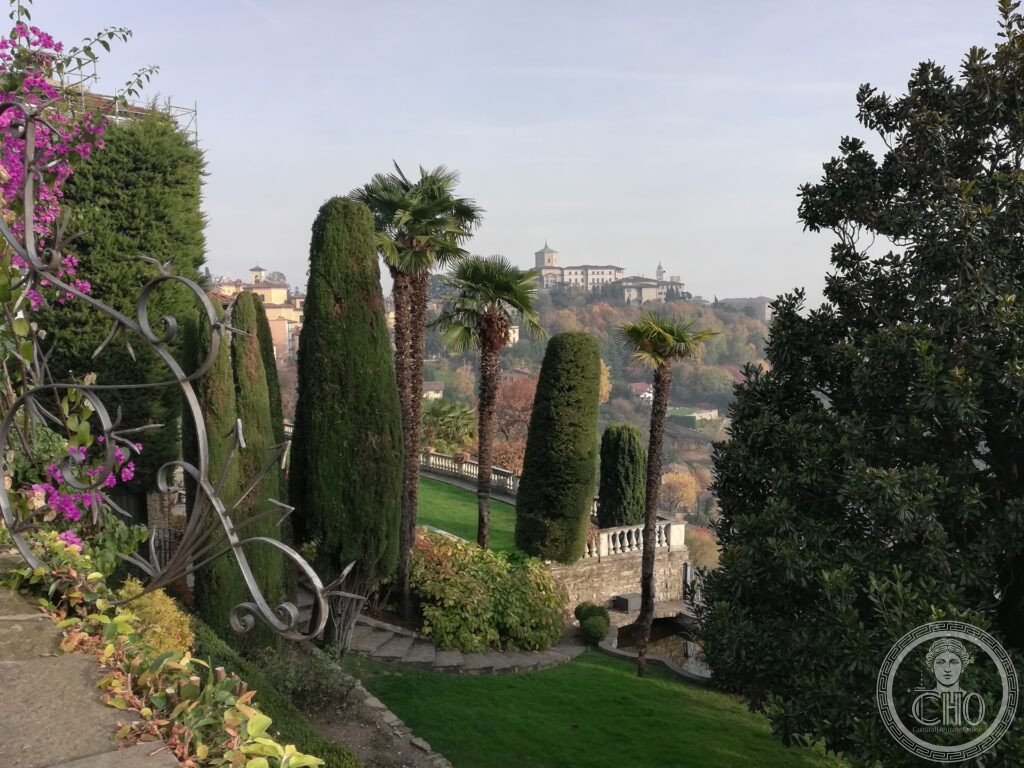
A medieval hilltop city enclosed within a sixteenth-century Venetian circuit of bastioned walls designed by Michele Sanmicheli — the finest intact example of Renaissance military architecture in northern Italy, inscribed UNESCO in 2017.
At a glance
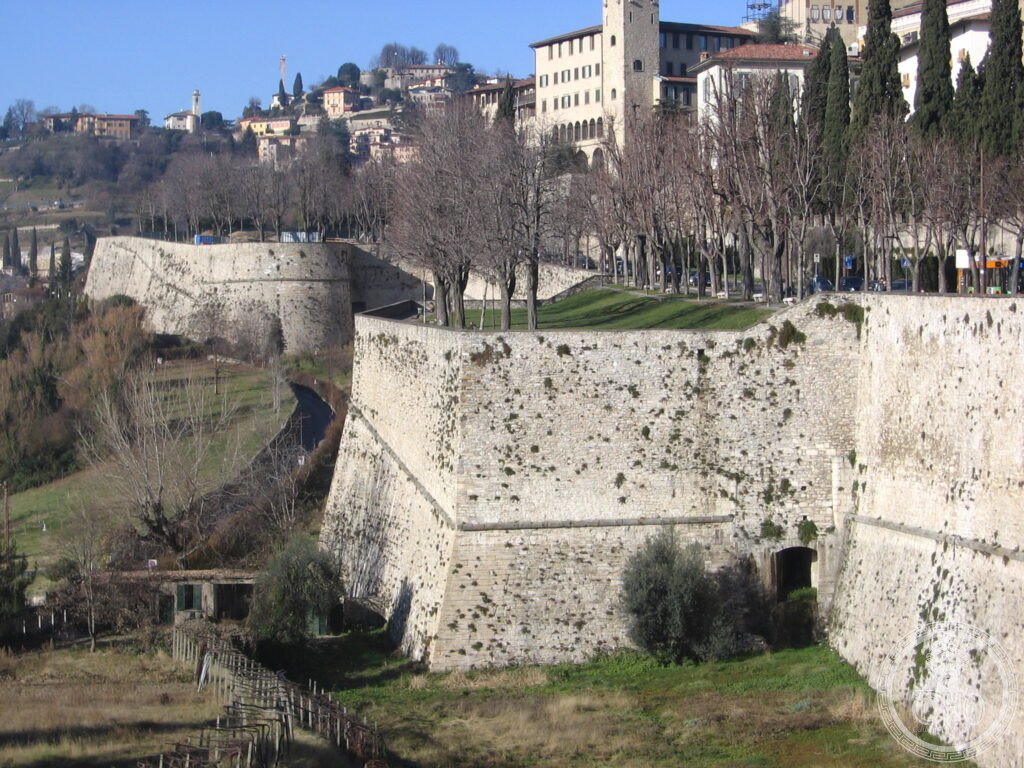
Bergamo Alta sits on a limestone promontory 350 metres above the Po plain, with the Città Bassa (modern Bergamo) spreading below it. The hill was settled in pre-Roman times and served as the administrative and episcopal centre through the medieval period. When the Venetian Republic took possession of the city in 1428, it inherited a medieval walled settlement; between 1561 and 1588, the Republic commissioned a complete circuit of new bastioned fortifications designed by the military engineer Michele Sanmicheli — the same architect who fortified Verona — enclosing both the medieval hilltop and its approaches in a continuous system of bastions, curtain walls, and four gates.
The walls were inscribed as UNESCO World Heritage in 2017 as part of the transnational “Venetian Works of Defence” inscription (ref. 1533), together with Palmanova and defensive works in Croatia and Montenegro. Approximately 6 km of wall circuit survive intact.
Key facts
- Fortification dates: 1561–1588
- Military architect: Michele Sanmicheli (1484–1559; design); works continued under supervision after his death
- Wall circuit: ~6 km; 14 bastions; 4 gates
- UNESCO inscription: 2017 — “Venetian Works of Defence”, ref. 1533
- Key spaces: Piazza Vecchia, Piazza del Duomo, Colleoni Chapel, Rocca di Bergamo
- GPS: 45.7051, 9.6627 — Google Maps
History
Bergamo Alta has been fortified since at least the Roman period, when it was Bergomum, a municipium on the road to the Alpine passes. The Lombards made it a duchy capital; Charlemagne’s Franks took it in 774 and established a comital seat. By the twelfth century, the commune of Bergamo was an independent city, with the hilltop serving as the religious and civic centre.
Venetian control from 1428 brought a prolonged period of architectural patronage: the Piazza Vecchia was regularised, the Palazzo della Ragione rebuilt, and Bartolomeo Colleoni — the great condottiere captain, born near Bergamo — commissioned Giovanni Antonio Amadeo to build the polychrome marble funerary chapel that still bears his name. The equestrian statue by Verrocchio in Venice was founded from his estate.
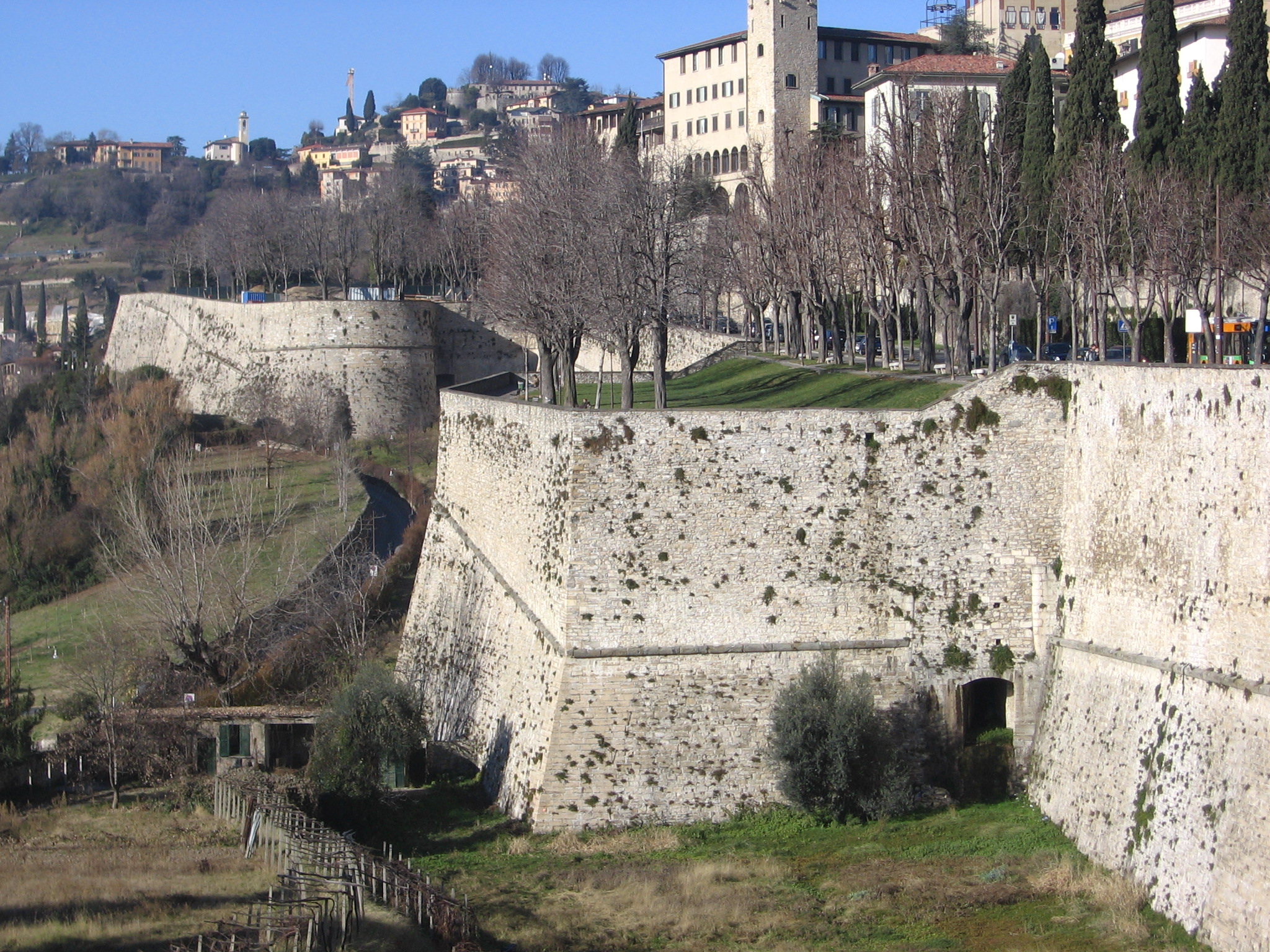
The Sanmicheli circuit was begun in 1561, after the Ottoman-Venetian War of 1537–1540 demonstrated the vulnerability of medieval walls to artillery. The new bastioned system — with angled faces designed to deflect cannonballs and low earth-backed walls that absorbed impact — followed the principles Sanmicheli had refined at Verona. The four original gates (Porta San Giacomo, Porta Sant’Agostino, Porta San Lorenzo, Porta Santa Maria) are among the best-preserved Renaissance city gates in Italy.
What you see
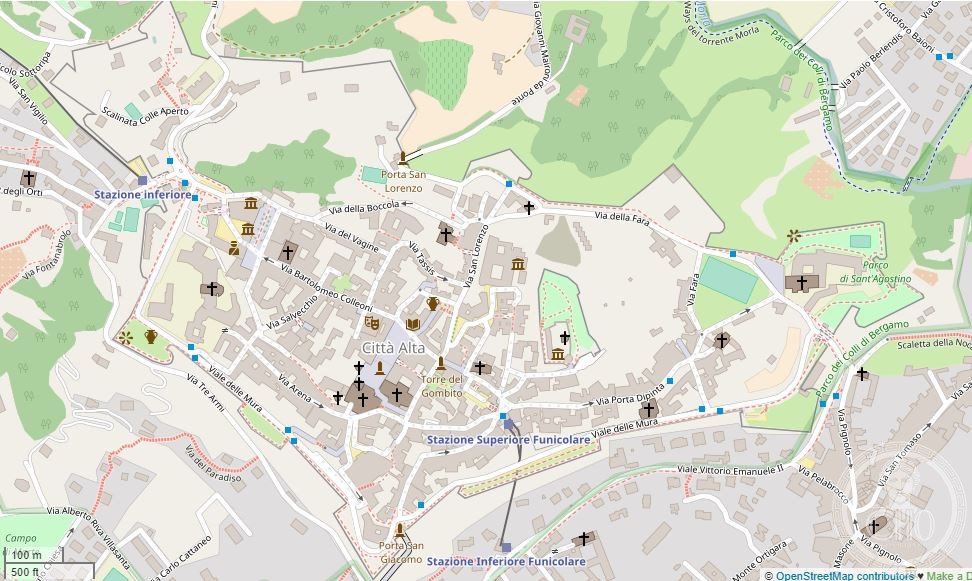
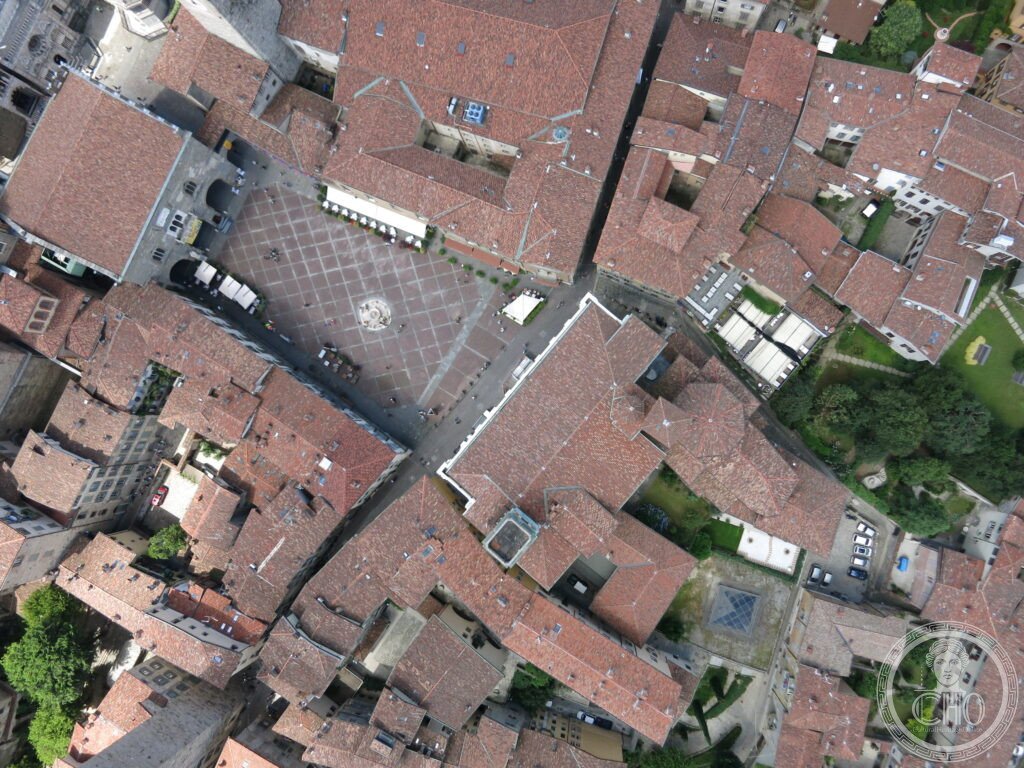
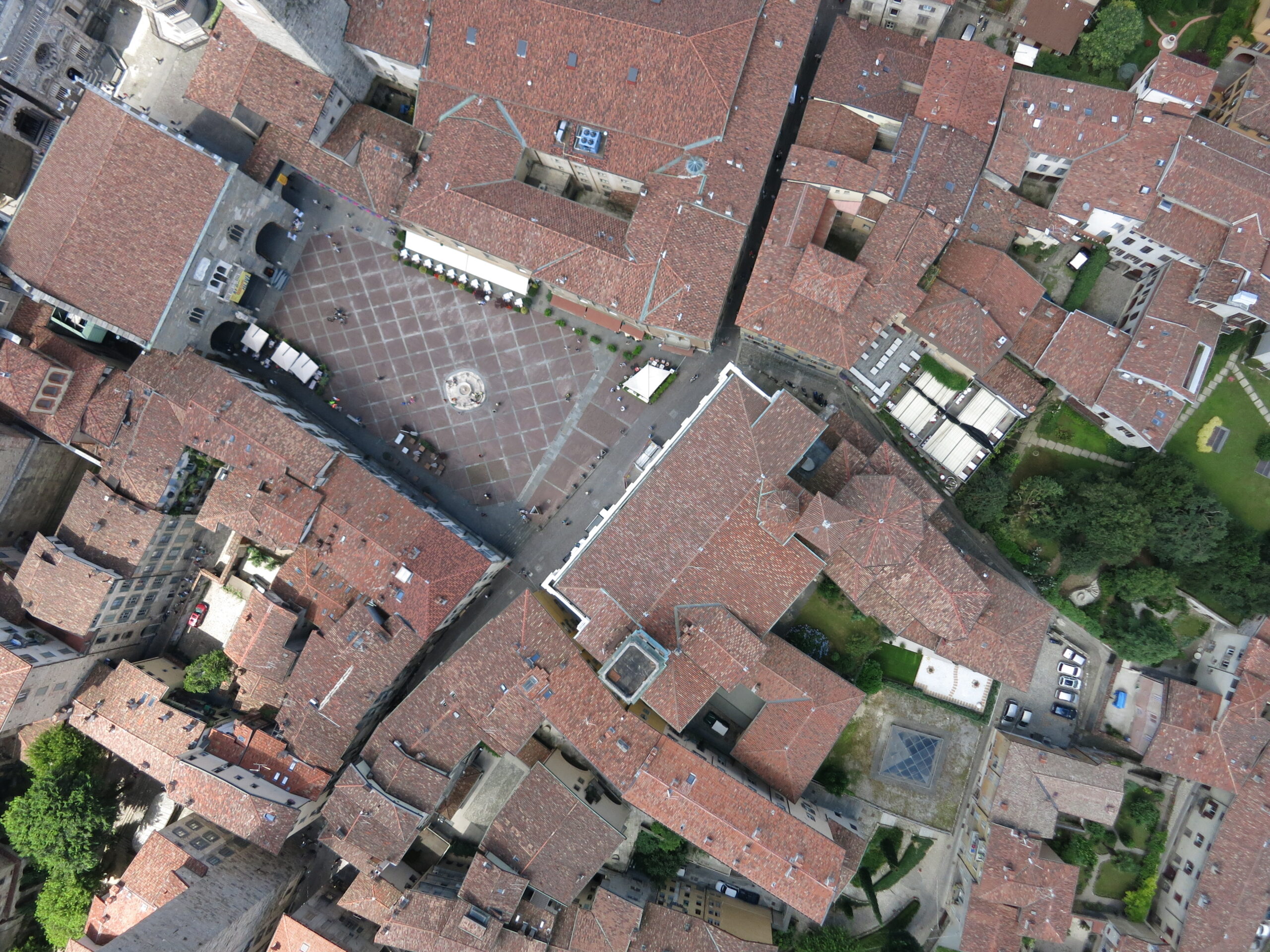
The main pedestrian route into Città Alta is through Porta Sant’Agostino, the eastern gate, its arch decorated with the Lion of Saint Mark carved in Istrian stone. From there, Via Porta Dipinta and Via Gombito climb through the medieval street grid to Piazza Vecchia — a composition that Stendhal called “the most beautiful piazza in the world.” The Palazzo della Ragione closes one end, the Torre Civica another; the Duomo and Colleoni Chapel are 50 metres away through a small square.
The Colleoni Chapel (1476–1483) is Bergamo’s architectural masterpiece: Amadeo’s polychrome marble façade assembles classical medallions, candelabra, and figure sculpture in a density that reads as concentrated excess, but with a precision of proportion that prevents it from collapsing. Inside, the gilded equestrian monument to Colleoni and his daughter Medea’s tomb are among the finest late-Gothic sculpture groups in northern Italy.
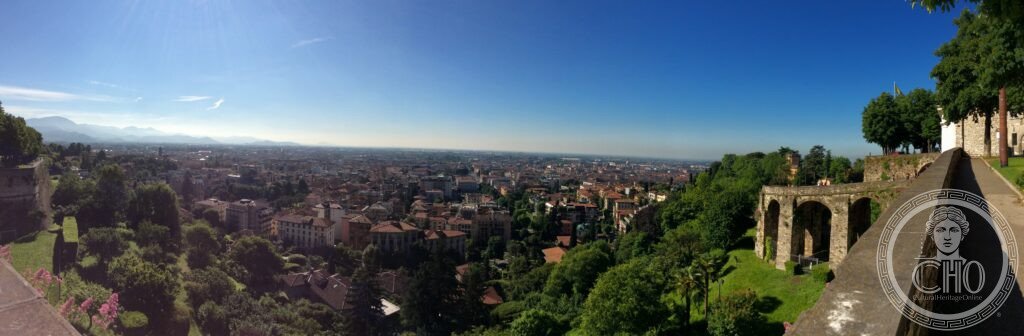
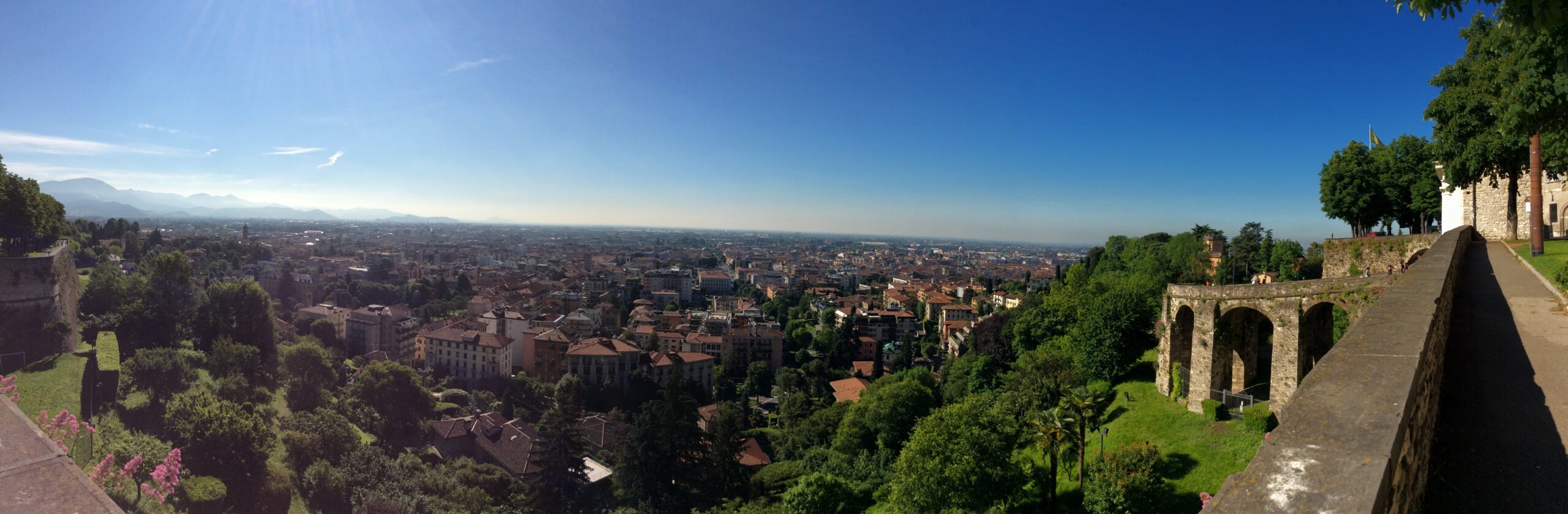
For the walls themselves, the best experience is the walk along the top of the curtain between Porta San Giacomo and the Rocca, looking south over the Città Bassa, the Po plain, and on clear days the Alps from the Matterhorn to Ortler.
Gallery
Practical information
- <
li>Funicolare: Funicular from Città Bassa (Viale Vittorio Emanuele II station) to Mercato delle Scarpe in Città Alta; every 15 minutes, €1.30.
- Colleoni Chapel: Open Tuesday–Sunday 9:00–12:30, 14:30–18:00; free.
- Wall walk: Public; best section Porta San Giacomo to Rocca (45 min). Open 24h.
- Duration: Half day minimum; full day for all major monuments.
- Note: Città Alta is ZTL — no private car access. Park at Porta Sant’Agostino (paying) or take bus or funicular from the lower city.
Getting there
Bergamo is 50 km north-east of Milan (35 min by train from Centrale, Trenord). From Bergamo train station (Città Bassa): funicular to Città Alta (Mercato delle Scarpe) or bus line 1A. By car from Milan: A4 motorway to Bergamo exit, then follow “Città Alta” signs to car parks near Porta Sant’Agostino or Sant’Alessandro. Ryanair and Wizz Air serve Bergamo Orio al Serio airport, 3 km from the station (bus or taxi, 15 min).
Nearby
- Accademia Carrara — one of the most important Italian painting collections outside Rome/Florence, 10 min walk from lower city; Lotto, Mantegna, Raffaello, Tiepolo
- Villa Panza (Varese) — contemporary art FAI collection, 50 km west
- Lago d’Iseo — lake with Monte Isola island, 25 km west
Sources
- UNESCO World Heritage Centre: whc.unesco.org/en/list/1533
- Wikipedia EN: Bergamo
- Arslan, Edoardo (ed.): Arte e Artisti dei Laghi Lombardi, Como, 1959
- Guidoni, Enrico: La Piazza, Florence, Sansoni, 1992
Gallery
Find it on the map
See this place and what’s around it →📷 Become a Cultural Heritage Online photographer
Share your photos of places: they stay published under your name as the author. The more they're seen, the more you get noticed — and soon a contest will reward the most appreciated photos.
Log in or sign up free to add a photo