

- Built
- c. 1100–1150 AD (Suryavarman II era)
- Style
- Angkor Wat period, Khmer Empire
- Distance
- 40 km east of the main Angkor temples
- Restoration
- None — deliberately left as found
- Location
- Siem Reap Province, Cambodia
- Coordinates
- 13.5788° N, 104.2253° E
The Temple That Was Never Restored
Beng Mealea was built roughly contemporaneously with Angkor Wat — around 1100 to 1150 AD — by artisans who used the same sandstone, the same carving vocabulary, and the same spatial logic. The outer moat, the concentric enclosures, the library pavilions, the causeway: the plan echoes Angkor Wat closely enough that some archaeologists believe the two temples shared the same design team.
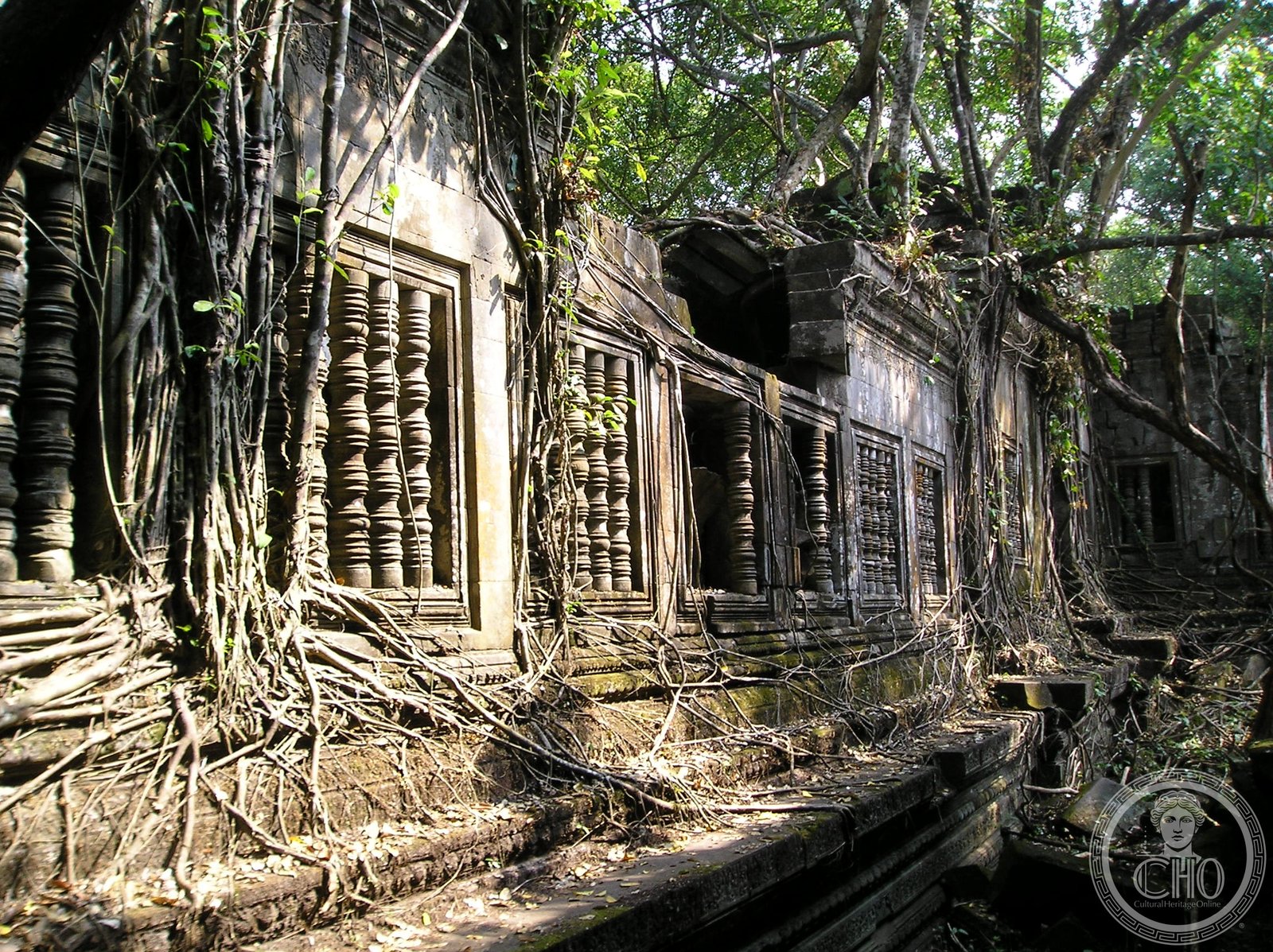
But where Angkor Wat has been restored, consolidated, and made safe for millions of visitors, Beng Mealea has been left almost entirely as the jungle found it. The difference this makes is radical. At Beng Mealea you see what stone temples actually become when the forest takes over: massive silk-cotton trees growing directly through gallery walls, strangler figs splitting tower foundations, entire roof sections collapsed into rubble fields that visitors cross on elevated wooden walkways.
What the Jungle Does to Stone
The process visible at Beng Mealea takes centuries to complete. First, seeds sprout in the cracks between carved sandstone blocks. The roots grow downward, following water. As the root systems thicken they exert outward pressure on the stone, gradually displacing individual blocks. When a root reaches full diameter it can be stronger than the mortar around it. At Beng Mealea several library pavilions have been displaced entirely from their foundations; one gallery has been lifted and tilted by root growth of approximately 30 cm over several decades.
The outer moat at Beng Mealea is still intact, its stone coping largely in place. Some of the gallery carvings survive beneath moss: devatas, apsaras, mythological battle scenes in the same style as the Angkor Wat galleries. They are harder to read than their Angkor counterparts — the stone is darker, the detail partially eroded — but they are there, in situ, unlifted and unreordered by any restoration programme.
An Honest Ruin vs. a Restored Monument
The decision to leave Beng Mealea unrestored was not an act of neglect. The Angkor Conservation Authority and EFEO (Ecole Francaise d’Extreme-Orient) have made a considered choice to maintain the site in what they call “romantic ruin” state: accessible to visitors, structurally monitored, but not reconstructed. Wooden walkways allow movement through the rubble without further damage. Undergrowth is trimmed back enough to prevent new root damage but not enough to reveal bare stone.
The contrast with Ta Prohm, which is often described as Angkor’s “jungle temple” but in fact has extensive consolidation and cleared access routes, is instructive. At Beng Mealea, the feeling is genuinely different: you are in the temple, not in a curated experience of the temple. The disorder is real. The weight of the collapsed stone is real. The silence broken by insects and occasional bird calls is what this place sounds like when no amplification system is present.
Two Brothers: When Film Found the Ruin
In 2003, director Jean-Jacques Annaud chose Beng Mealea as the principal filming location for Two Brothers (2004), starring Guy Pearce and featuring a young Freddie Highmore. The film opens with Highmore’s character discovering the temple — its collapsed towers, its overgrown courtyards — while tigers have made their home in the broken galleries. The production used Beng Mealea’s actual unrestored state rather than building sets: the falling walls, the wooden walkways over rubble, the moss-covered carvings are all real.
The film’s opening sequence remains one of cinema’s most striking uses of an archaeological site as primary location: not as backdrop but as active setting that drives the narrative logic of the story. A temple this complete in its ruination could not have been convincingly built on a studio backlot.
Getting There from Angkor
Beng Mealea is 40 km east of the main Angkor temple cluster, roughly an hour by tuk-tuk or motorbike on good road. It lies on the ancient Khmer royal highway that once connected Angkor to Preah Khan Kompong Svay. Most Angkor Archaeological Park passes do not cover Beng Mealea; a separate entrance fee is paid at the site. The site can be combined in a long day with Koh Ker (another largely unrestored temple complex, 60 km further north).
Practical Information
- Distance from Siem Reap: 68 km (approximately 1 hour 15 minutes by car).
- Entrance: Separate fee, not covered by standard Angkor Archaeological Park pass.
- Best time: November to March (dry season). The site can be muddy in wet season but the jungle is dramatically green.
- Guided vs. self-guided: A local guide is recommended for navigating the wooden walkways and finding the surviving carved panels.
- Combine with: Koh Ker (60 km north), or as a full day from Angkor.
Further Reading
Find it on the map
See this place and what’s around it →📷 Become a Cultural Heritage Online photographer
Share your photos of places: they stay published under your name as the author. The more they're seen, the more you get noticed — and soon a contest will reward the most appreciated photos.
Log in or sign up free to add a photo