

- Founded
- c. 1181 AD — King Jayavarman VII
- Empire
- Khmer Empire (Buddhist)
- Area
- 9 km² within moated walls
- UNESCO
- World Heritage Site, 1992 (Angkor complex)
- Location
- Siem Reap Province, Cambodia
- Coordinates
- 13.4413° N, 103.8566° E
The Last Great Capital of the Khmer Empire
Angkor Thom was built around 1181 AD by Jayavarman VII after Cham invaders had sacked and burned the previous Khmer capital. He responded with the most ambitious building programme in Southeast Asian history: a fortified royal city covering nine square kilometres, surrounded by an eight-metre-high stone wall and a moat 100 metres wide. At its peak, the city may have housed up to a million people, making it one of the largest pre-industrial urban settlements on earth.
Five ceremonial gates pierce the city walls, each approached by a dramatic causeway. The South Gate has a 54-deity and 54-demon lineup flanking the road, each set holding the body of a giant serpent in the mythological scene of the Churning of the Ocean of Milk. The effect is that of walking into a Hindu-Buddhist cosmological drama at monumental scale before you have even entered the city.
The Bayon: 216 Faces Looking in Every Direction
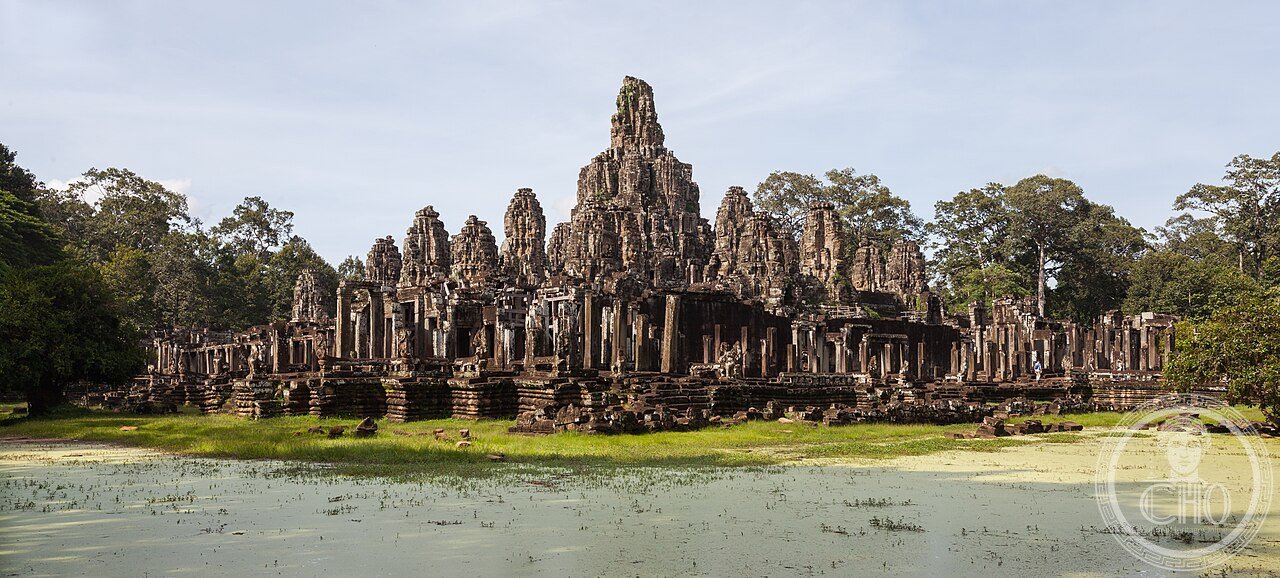
At the city centre stands the Bayon, Jayavarman’s state temple, built around 1190 AD. Fifty-four towers rise from its terraces, each bearing four enormous stone faces: some oriented to the cardinal directions, others angled diagonally. The total is 216 faces. The dominant interpretation is that they show the Buddhist bodhisattva Avalokiteshvara merged with the features of Jayavarman VII himself, so that the king’s gaze would watch over every road and every corner of his empire forever.
To enter the Bayon is to be surrounded simultaneously by all 216 faces looking down from above. The towers press close; the stone is warm in the Cambodian sun. Whether you read the faces as serene, smiling, or inscrutable depends on the hour and the angle of light, and every visitor comes away with a different answer.
The Bas-Reliefs: a Documentary of the 12th Century
Running for 1.2 kilometres around the interior galleries, the Bayon’s bas-relief panels are the most detailed surviving record of everyday Khmer life from the 12th century. They show not just gods and kings but cockfights, chess games, market stalls, women giving birth, and the kind of detail that history books never record: a fish jumping mid-naval battle, crocodiles gnawing at corpses, a man stealing chickens.
One long panel depicts a naval battle fought on Tonle Sap Lake between the Khmer and the Cham, with war boats, oarsmen, and the lake ecosystem rendered with the precision of a nature illustration. These carvings are the primary visual source historians use to reconstruct Khmer military organisation, trade, food culture, and dress of the period.
Beyond the Bayon: the Rest of Angkor Thom
The walled city contains far more than the Bayon. The Baphuon temple, an 11th-century pyramid predating Jayavarman’s construction, was dismantled for restoration in the 1960s, its stones carefully catalogued, and then the entire catalogue was lost during the Khmer Rouge years. French restorers spent decades reassembling it like a three-dimensional puzzle using only the stones as guides, completing the work in 2011. The Elephant Terrace, a 350-metre-long platform decorated with carved elephants, was used for royal audiences and ceremonies.
Henri Mouhot, the Khmer Rouge, and the Long Recovery
French naturalist Henri Mouhot brought Angkor to wide Western attention after his 1861 visit, though he was not its discoverer: the temples had never been abandoned by Cambodian monks and locals. In the 1970s the Khmer Rouge used the Angkor area as a base; some temples were damaged, and decades of French restoration records were destroyed or scattered. UNESCO designated the Angkor Archaeological Park a World Heritage Site in 1992. Today more than two million visitors arrive each year. Angkor Thom remains open, its towers intact, its 216 faces still watching.
Practical Information
- Access: Angkor Thom is within the Angkor Archaeological Park, 6 km north of Siem Reap. Park passes (1-day / 3-day / 7-day) are purchased at the main ticket gate.
- Best time: November to March. Arrive at the Bayon by 6:30 AM for sunrise sidelight on the stone faces.
- Combine with: Angkor Wat (2 km south), Ta Prohm (4 km east), Preah Khan (2 km north).
- Photography: Morning sidelight or overcast conditions are best; midday sun flattens the stone relief.
Further Reading
Find it on the map
See this place and what’s around it →📷 Become a Cultural Heritage Online photographer
Share your photos of places: they stay published under your name as the author. The more they're seen, the more you get noticed — and soon a contest will reward the most appreciated photos.
Log in or sign up free to add a photo