
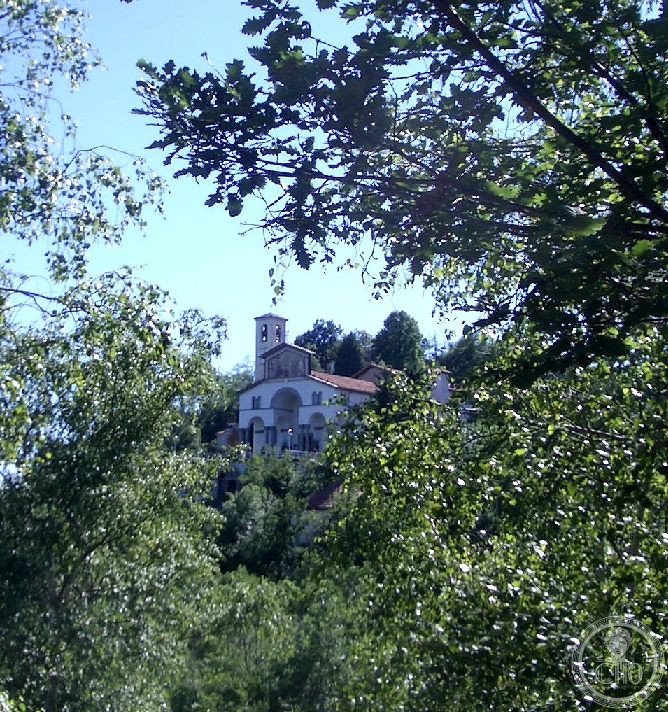
Above the rice fields and moraine hills of the Canavese, five small chapels and a Baroque sanctuary trace the Joyful Mysteries of the Rosary. The most recently founded and least visited of the nine Sacri Monti of Piedmont and Lombardy, Belmonte offers a quiet climb and a wide view towards the Gran Paradiso and the Torino skyline.
At a glance
The Sacro Monte di Belmonte stands on the Belmonte hill above Valperga, in the Canavese area of eastern Piedmont, between the Po plain and the Alps of the Valle d’Aosta. Founded in 1712, it is the youngest of the nine Sacri Monti inscribed by UNESCO and one of the two smallest, with only five chapels rather than the longer sequences found elsewhere.
Its devotional programme is dedicated to the five Joyful Mysteries of the Rosary, distinguishing it from Domodossola’s Via Crucis and Ghiffa’s Trinitarian theme. Only the Sacro Monte of Orta San Giulio shares the Joyful Mysteries subject, though there it extends across all twenty mysteries rather than five.
Key facts
- Founded: 1712, by the Barnabite friar Fra Desiderio Mosca
- Chapels: five, representing the Joyful Mysteries of the Rosary
- Altitude: the Belmonte hill rises to 554 metres, about 144 metres above Valperga
- Recognition: part of the UNESCO World Heritage Site ‘Sacri Monti of Piedmont and Lombardy’, inscribed in 2003 under reference 1068
- Setting: the Canavese, a historic sub-region of Piedmont known for its moraine hills, rice fields and views of the Gran Paradiso massif
History
The Belmonte hill was a site of Marian devotion long before the Sacro Monte was built. A will held at the Archivio Capitolare di Ivrea, dated 1371, records a donation to an oratory dedicated to the Madonna del Belmonte, and local oral tradition, later written down in seventeenth-century chronicles, tells of a shepherd said to have seen an apparition of the Madonna on the hill around 1290 and to have been cured of a wound.
The Sacro Monte itself was founded in 1712 by Fra Desiderio Mosca, a Barnabite friar from Torino who served as confessor to Vittorio Amedeo II, the Savoy duke who became King of Sardinia the following year. Vittorio Amedeo II funded the construction of the five chapels. The site was inscribed by UNESCO in 2003 as part of the wider Sacri Monti of Piedmont and Lombardy listing.
What you see
The path to the Sacro Monte begins at Valperga’s main square and climbs about 144 metres over roughly a kilometre, a walk of some half an hour. The first stretch is still paved with eighteenth-century cobbles before it continues on unsurfaced ground. The recommended route is to reach the Santuario at the summit first, then descend past the five chapels in reverse order, from the fifth to the first.
The Santuario della Beata Vergine di Belmonte, completed in 1712, has a façade in local limestone with a Baroque portal and paired columns. Inside is a fresco of the Madonna Incoronata, attributed to a painter associated with the Barnabites and dated to 1720, its crown rendered in gold leaf. From the terrace outside, the Canavese plain opens out on every side: the Gran Paradiso massif to the north, the moraine hills to the west, the Torino skyline to the south and the Lago di Viverone, the only natural lake among the Canavese hills, to the east.
Practical information
- Access: the Santuario’s interior generally opens for set hours during the day; the site’s own channels should be checked before visiting.
- Walking: the ascent from Valperga covers about 1.1 kilometres with a climb of 144 metres, taking around 25 to 35 minutes.
- Combine with: the Castello e Parco di Agliè nearby makes a natural pairing for a day out in the Canavese.
Getting there
Valperga can be reached by train from Torino to Rivarolo Canavese, followed by a short taxi ride or local bus, or directly by road via the SP2 from Ivrea. The Sacro Monte itself is reached on foot from the village along a signed path.
Nearby
- Castello e Parco di Agliè — about 5 km away, a former Savoy summer residence dating from the seventeenth and eighteenth centuries, with gardens and fountains.
- Ivrea — about 15 km away, home to the Città Industriale Olivetti, itself inscribed as a UNESCO World Heritage Site in 2018, and known for its Battaglia delle Arance carnival event in February.
Sources
- Wikipedia
- UNESCO
- Langé, Santino. I Sacri Monti piemontesi. Milano: Touring Club Italiano, 1967
Gallery
Find it on the map
See this place and what’s around it →📷 Become a Cultural Heritage Online photographer
Share your photos of places: they stay published under your name as the author. The more they're seen, the more you get noticed — and soon a contest will reward the most appreciated photos.
Log in or sign up free to add a photo