
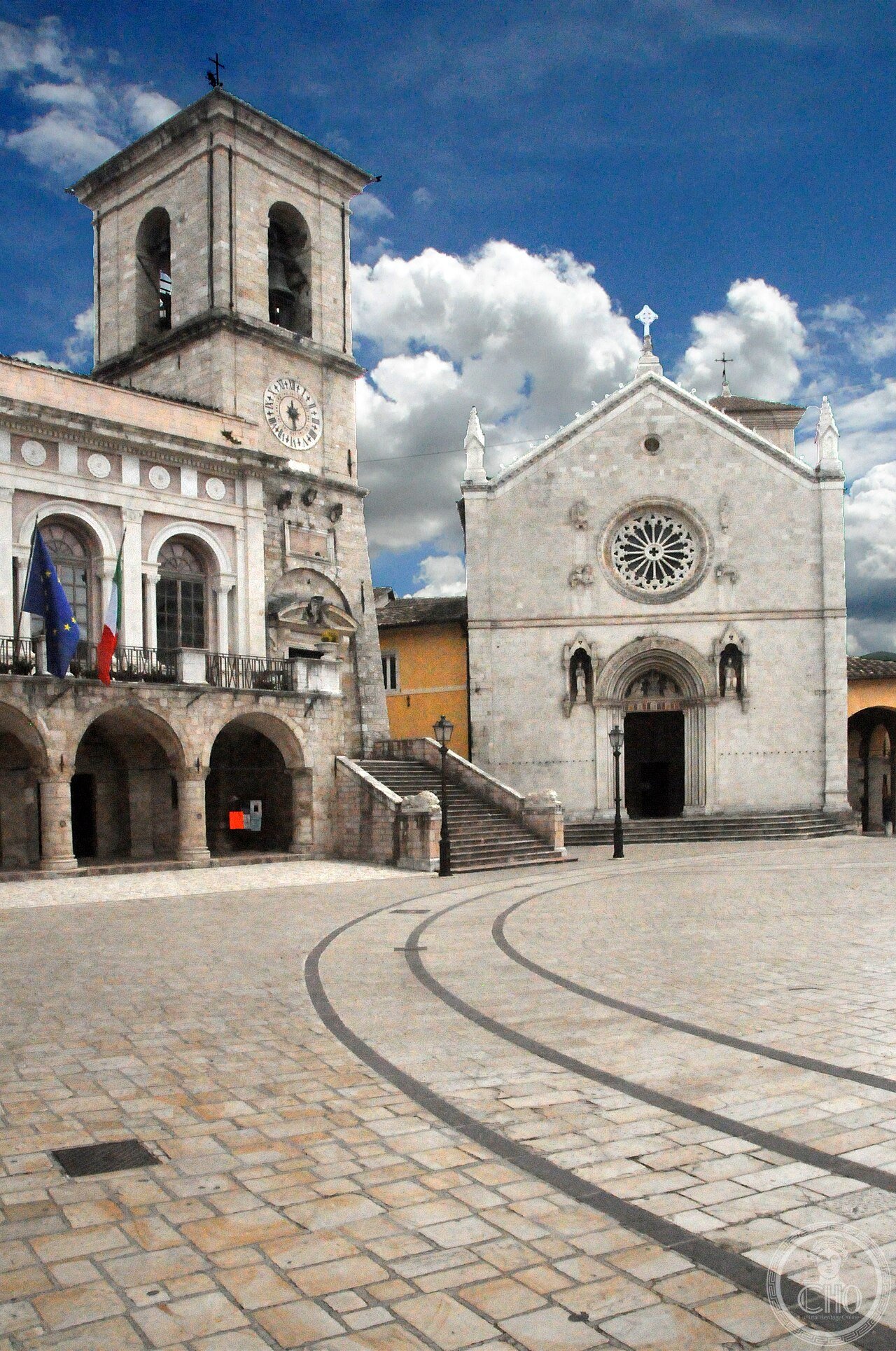
Built between 1290 and 1338 on the place traditionally identified as the birthplace of Saint Benedict and his sister Saint Scholastica, the basilica of Norcia was almost completely destroyed by the shock of 7.41 in the morning on 30 October 2016: the bell tower fell onto the church, bringing down much of the central body. But the facade stayed standing, almost intact, becoming the symbolic image of that earthquake. In October 2025, after nine years of work guided by the principle “as it was, where it was”, the basilica reopened.
About the Basilica of San Benedetto
The Basilica of San Benedetto stands on the site traditionally identified as the birthplace of Saints Benedict and Scholastica, twins born in Norcia in 480 AD into the noble gens Anicia, according to the account given by Pope Gregory the Great in his “Dialogues.” Benedict went on to compose the celebrated Rule of Saint Benedict, organised around the principle of “Ora et Labora” (“Pray and Work”), which profoundly shaped Western monasticism for centuries afterward, making Norcia’s basilica a foundational site for the entire subsequent history of European monastic life. The present basilica was built between 1290 and 1338 over an earlier crypt, itself constructed on the remains believed to mark the saints’ family home. On 30 October 2016, at 7:41 in the morning, a violent earthquake struck the region, and the basilica was almost completely destroyed: the massive bell tower collapsed directly onto the church, bringing down much of the central body of the structure. Remarkably, the facade, apse, and part of the side naves survived largely intact, and images of the basilica’s standing facade amid the surrounding rubble became one of the defining visual symbols of the 2016 central Italy earthquake sequence. Reconstruction and restoration work began in 2021 and was completed in October 2025, guided by the Italian Ministry of Culture’s principle of “com’era e dov’era” (“as it was and where it was”), an approach designed to restore the basilica as a place of worship and collective memory while fully respecting its layered historical fabric.
Key facts
- 480 AD: traditional birth year of Saints Benedict and Scholastica in Norcia
- 1290-1338: present basilica built over an earlier crypt
- 30 October 2016, 7:41 AM: earthquake destroys most of the basilica
- Survived intact: the facade, apse, and part of the naves
- 2021-2025: reconstruction under the “com’era e dov’era” principle
- October 2025: basilica reopens after nine years of restoration
- Legacy: Saint Benedict’s Rule shaped Western monasticism for centuries
History
The basilica’s status as the traditional birthplace of Saint Benedict, whose Rule became the foundational text for Western monasticism, gives Norcia an outsized spiritual significance relative to its modest size, connecting the small Umbrian town directly to the origins of the entire subsequent European monastic tradition, from Monte Cassino to the countless Benedictine houses established across the continent in the following fifteen centuries. The facade’s survival amid the near-total collapse of the 2016 earthquake became, almost immediately, a powerful symbol of resilience for the wider region devastated by that seismic sequence, its striking image of an intact medieval facade standing before a field of rubble circulated internationally as an emblem of both loss and endurance.
The nine-year reconstruction effort, completed only in October 2025 under the deliberately conservative “as it was, where it was” principle, reflects a broader Italian approach to post-disaster heritage restoration that prioritises historical authenticity and continuity of collective memory over faster but less faithful rebuilding methods — a decision that kept Norcia’s central religious monument out of use for nearly a decade in the name of preserving its historical integrity.
What you see
The basilica’s Gothic facade, the element that famously survived the 2016 earthquake, presents the church’s principal historic architectural face to Norcia’s main square. The crypt beneath the church, traditionally associated with the site of Benedict and Scholastica’s family home, preserves the oldest layer of the site’s sacred history, now reintegrated into the fully restored basilica following the completion of reconstruction work in 2025.
Practical information
- Opening hours: generally open daily with seasonal variation; check current hours before visiting; free admission
- Address: Piazza San Benedetto, 06046 Norcia, Italy
Getting there
The Basilica of San Benedetto is located in the main square of Norcia, in the Umbrian province of Perugia, easily reachable on foot. GPS: 42.7923° N, 13.0934° E.
Nearby
- Piazza San Benedetto — Norcia’s main square, surrounding the basilica
- Norcia historic centre — the town’s walled old town
- Monti Sibillini National Park — the mountain range surrounding Norcia
Sources
- Wikipedia — “Basilica di San Benedetto” (it.wikipedia.org)
- ACI Stampa — “La Basilica di San Benedetto a Norcia, dal terremoto alla ricostruzione” (acistampa.com)
- Ufficio del Soprintendente Speciale per le aree colpite dal sisma 2016 — “Norcia, Basilica di San Benedetto” (uss-sisma2016.cultura.gov.it)
Find it on the map
See this place and what’s around it →📷 Become a Cultural Heritage Online photographer
Share your photos of places: they stay published under your name as the author. The more they're seen, the more you get noticed — and soon a contest will reward the most appreciated photos.
Log in or sign up free to add a photo