
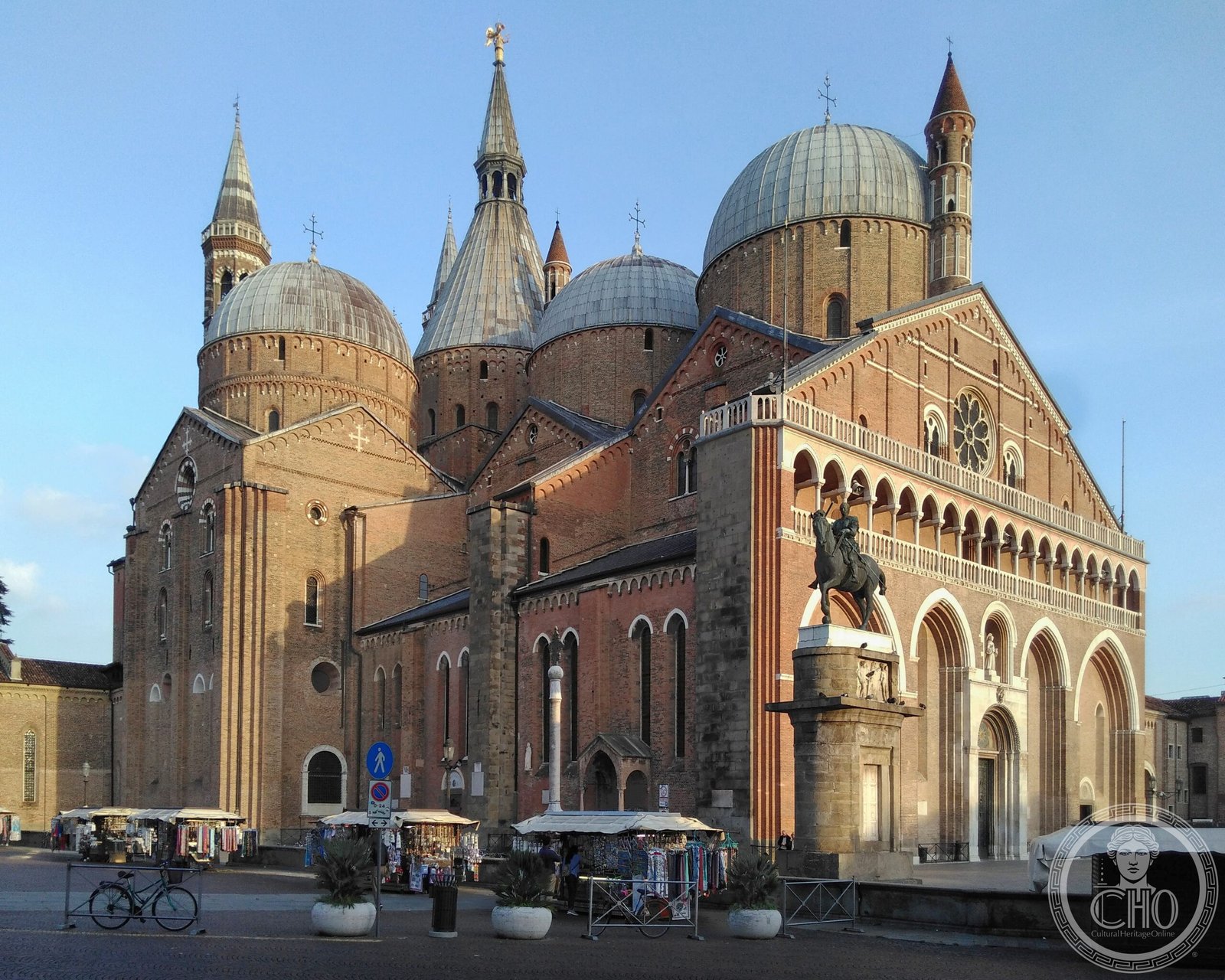
The Pontifical Basilica of Saint Anthony of Padua is one of the most visited pilgrimage sites in Christendom, standing in the heart of Padua in Veneto, northern Italy. Begun in 1232 and consecrated in 1310, this vast medieval complex blends Romanesque, Gothic, Byzantine, and Renaissance influences under eight distinctive domes. It houses the relics of Saint Anthony of Padua, a Franciscan friar canonised within a year of his death in 1231, and draws millions of devotees and cultural visitors each year.
At a glance
- Type
- Pontifical Basilica and Franciscan pilgrimage church
- Period
- Construction began 1232; consecrated 1310; additions through 16th century
- Style
- Romanesque-Gothic with Byzantine and Renaissance elements
- Location
- Piazza del Santo, 35123 Padova PD — 45.4019° N, 11.8806° E
Overview
The Pontifical Basilica of Saint Anthony of Padua is a Catholic church and minor basilica dedicated to Saint Anthony of Padua, one of the most popular saints in the Catholic world. It is designated a Basilica by the privilege of immemorial status and ranks as a Pontifical Basilica under the direct patronage of the Holy See. With millions of pilgrims and visitors annually, it is among the most attended religious sites in Italy and in Europe.
History
Construction of the basilica began in 1232, the year after the death of Saint Anthony, whose remains are enshrined here. The project united Romanesque building traditions of northern Italy with the pointed arches and ribbed vaults of Gothic architecture then spreading from France, resulting in an unusually syncretic structure. Works continued through the fourteenth and early fifteenth centuries, with the Cappella dell’Arca del Santo — the ornate reliquary chapel — reaching its definitive form in the sixteenth century through contributions by sculptors including Tullio Lombardo and Jacopo Sansovino. Donatello’s bronze high altar sculptures, cast between 1443 and 1450, represent a landmark moment in Italian Renaissance art produced for this church.
What you see
The exterior is dominated by eight domes — two large octagonal domes flanked by six smaller ones — and two bell towers that echo the silhouette of Byzantine churches, giving the building an unmistakably Eastern character rare in northern Italy. The vast interior preserves Donatello’s celebrated bronze Crucifix, six bronze relief panels depicting miracles of Saint Anthony, and the great equestrian statue of Gattamelata (1453) outside in the piazza, also by Donatello. The Cappella del Tesoro houses the saint’s relics including his chin and tongue, preserved as incorrupt by tradition, displayed for veneration in ornate reliquaries. The surrounding cloisters and convent buildings form a monastic campus still occupied by the Friars Minor Conventual.
Cultural significance
The Basilica di Sant’Antonio is a defining landmark of Padua’s identity and a key node in the pilgrimage routes of northeastern Italy, historically linked to the Camino de Santiago and Via Francigena networks. Its art collection — spanning Donatello bronzes, Mantegnesque frescoes, and Baroque chapel decorations — makes it as important for art history as for religious practice. The piazza it anchors, with Donatello’s Gattamelata as the first large freestanding equestrian bronze cast since antiquity, constitutes one of the most historically rich public squares in Europe.
Practical information
- Address
- Piazza del Santo 11, 35123 Padova PD, Italy
- Opening hours
- Basilica generally open daily 06:20–19:45; Cappella Reliquie hours vary — check official website
- Admission
- Free entry to basilica; treasury may require a ticket
- Website
- Check official website: santantonio.org
Getting there
The basilica is in the heart of Padua’s historic centre, reachable by tram (Line 1, stop Pontecorvo), by bus from Padova Centrale railway station (10-minute walk or bus lines 3, 12), or on foot from the train station in about 20 minutes. Padua is on the main Venice–Milan rail line with frequent high-speed connections; from Venice Santa Lucia the journey takes around 25 minutes.
Sources & resources
Find it on the map
See this place and what’s around it →📷 Become a Cultural Heritage Online photographer
Share your photos of places: they stay published under your name as the author. The more they're seen, the more you get noticed — and soon a contest will reward the most appreciated photos.
Log in or sign up free to add a photo