

On 3 September 301, at the point of death, the hermit and stonecutter Marinus spoke the words destined to become the founding motto of the republic that would take his name: “Relinquo vos liberos ab utroque homine” — “I leave you free from both men”, that is, from the emperor and from the pope. His relics, rediscovered in 1586, still rest beneath the high altar of the basilica dedicated to him.
About the Basilica di San Marino
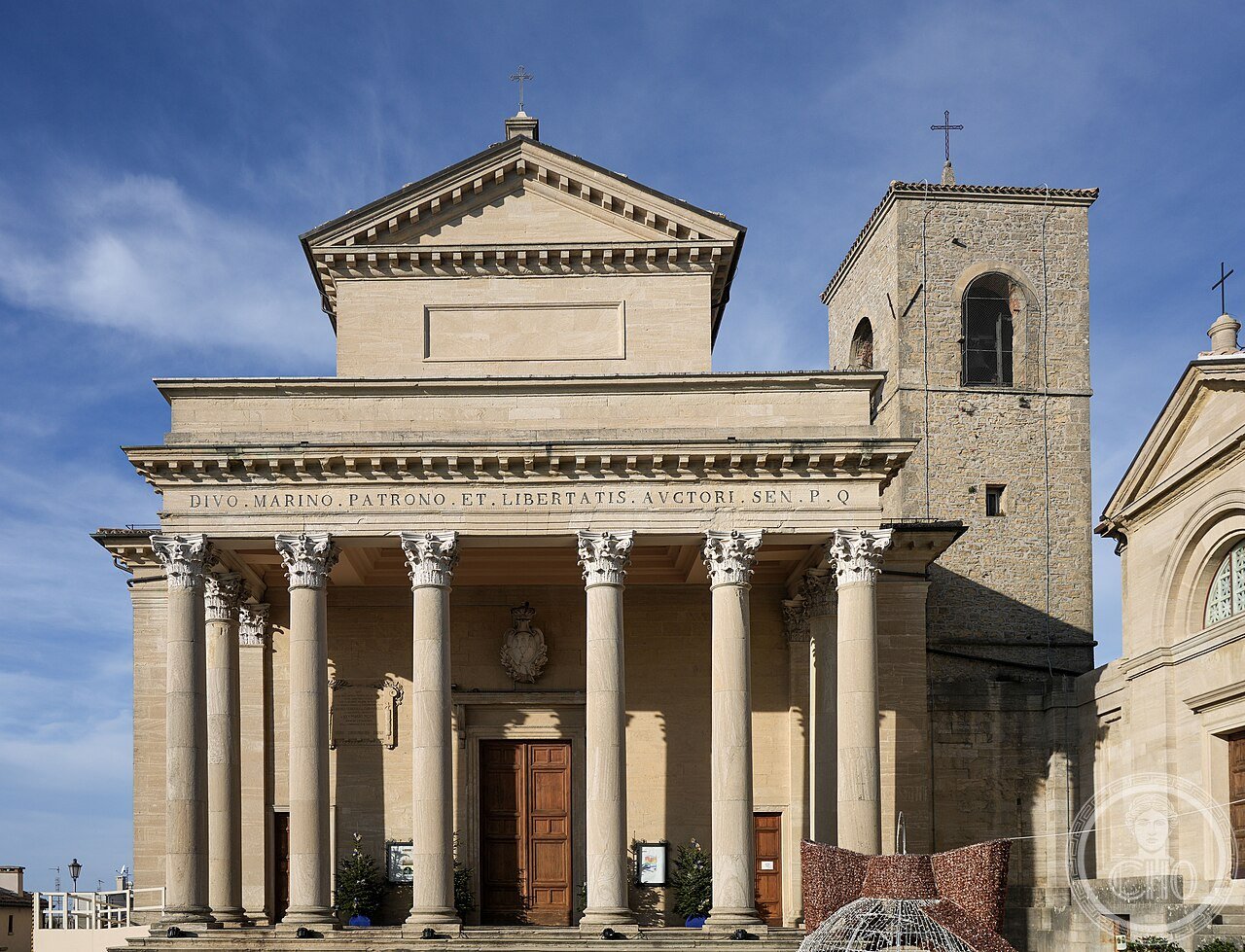
According to tradition, the Christian stonemason Marinus emigrated around 297 from the Dalmatian island of Rab, summoned to help rebuild the city walls of Rimini under a decree of Emperor Diocletian. Ordained a deacon by Gaudentius, Bishop of Rimini, Marinus was later falsely accused by a woman claiming to be his estranged wife, and fled to the isolation of Monte Titano, where he built a chapel and lived as a hermit, founding the small monastic community from which the future state of San Marino would grow. On 3 September 301, before his death, Marinus is said to have uttered the words that would become the republic’s founding motto: “Relinquo vos liberos ab utroque homine” — “I leave you free from both men,” meaning free from both emperor and pope. An earlier church dedicated to the saint was already standing on the site by the 4th century, and the first document directly referencing the Pieve di San Marino is dated 31 July 1113. The saint’s relics were rediscovered on 3 March 1586, and on 28 January 1595 some of these relics were formally donated to the island of Rab, Marinus’s birthplace, strengthening the historic bond between the republic and its founder’s homeland. The present basilica was built after the demolition of its predecessor in 1807: the council decided on 24 July 1825 to build a new church on the same site, construction began on 28 July 1826 under the Bolognese architect Achille Serra, and the building was completed and opened to the public on 5 February 1838, in a neoclassical style with a porch of eight Corinthian columns. On 21 July 1926, a century after construction began, Pope Pius XI raised the church to the rank of Minor Basilica. Beneath the high altar, a small urn holds the bones of Saint Marinus, while a marble monument to the right houses a silver reliquary containing the upper part of the saint’s skull, still venerated by pilgrims and visitors today.
Key facts
- c. 297-301: Marinus, a stonemason from Rab, flees to Monte Titano and founds a hermit community
- 3 September 301: Marinus dies, reportedly leaving the founding words “I leave you free from both men”
- 1113: earliest documented reference to the Pieve di San Marino
- 3 March 1586: the saint’s relics are rediscovered
- 28 January 1595: relics donated to the island of Rab, Marinus’s birthplace
- 1826-1838: present neoclassical basilica built by architect Achille Serra
- 21 July 1926: raised to Minor Basilica status by Pope Pius XI
History
Saint Marinus’s dying declaration of freedom “from both men” — explicitly naming both the secular emperor and the papal authority as powers his community should remain independent of — gives San Marino perhaps the clearest founding statement of political liberty attributed to any surviving European state, one still commemorated today in the republic that claims to be the world’s oldest continuously surviving one. The 1595 gift of relics to Rab, the saint’s Dalmatian birthplace across the Adriatic, formalised a devotional and historical connection between San Marino and Croatia that persists specifically through the shared veneration of a single founding figure, linking two distinct national and religious traditions across thirteen centuries of separation.
The century-long gap between the 1826 start of construction on the present basilica and its 1926 elevation to Minor Basilica status by Pope Pius XI — deliberately marked as occurring exactly one hundred years after groundbreaking — reflects a conscious institutional decision to tie the church’s formal ecclesiastical elevation to a symbolically resonant anniversary, reinforcing the basilica’s civic as well as religious significance to the republic it serves as spiritual centre.
What you see
The neoclassical facade, fronted by a porch of eight Corinthian columns, opens onto a three-nave interior supported by sixteen further Corinthian columns forming a large ambulatory around the semicircular apse. The pediment bears the inscription “Divo Marino Patrono et Lebertatis Auctori sen. p.q.,” commemorating the unbreakable bond between the founding saint and the republic’s liberty. Beneath the high altar, an urn holds the bones of Saint Marinus, while a separate marble monument houses the silver reliquary containing the upper part of his skull.
Practical information
- Opening hours: generally open daily; check current hours before visiting; free admission
- Address: Contrada Omagnano, Città di San Marino, 47890, San Marino
Getting there
The Basilica di San Marino is reachable on foot within the historic City of San Marino, atop Monte Titano. GPS: 43.9371° N, 12.4467° E.
Nearby
- Guaita Tower — the oldest of the three towers of Monte Titano, within walking distance
- Palazzo Pubblico — San Marino’s government palace, in the same historic centre
- City of San Marino — the UNESCO-listed historic centre surrounding the basilica
Sources
- Wikipedia — “Basilica di San Marino” and “Saint Marinus” (en.wikipedia.org)
- Visit San Marino — “Basilica of Saint Marinus” (visitsanmarino.com)
- San Marino Experience — “The Legend: the Foundation of the Republic” (sanmarinoexperience.com)
Find it on the map
See this place and what’s around it →📷 Become a Cultural Heritage Online photographer
Share your photos of places: they stay published under your name as the author. The more they're seen, the more you get noticed — and soon a contest will reward the most appreciated photos.
Log in or sign up free to add a photo