

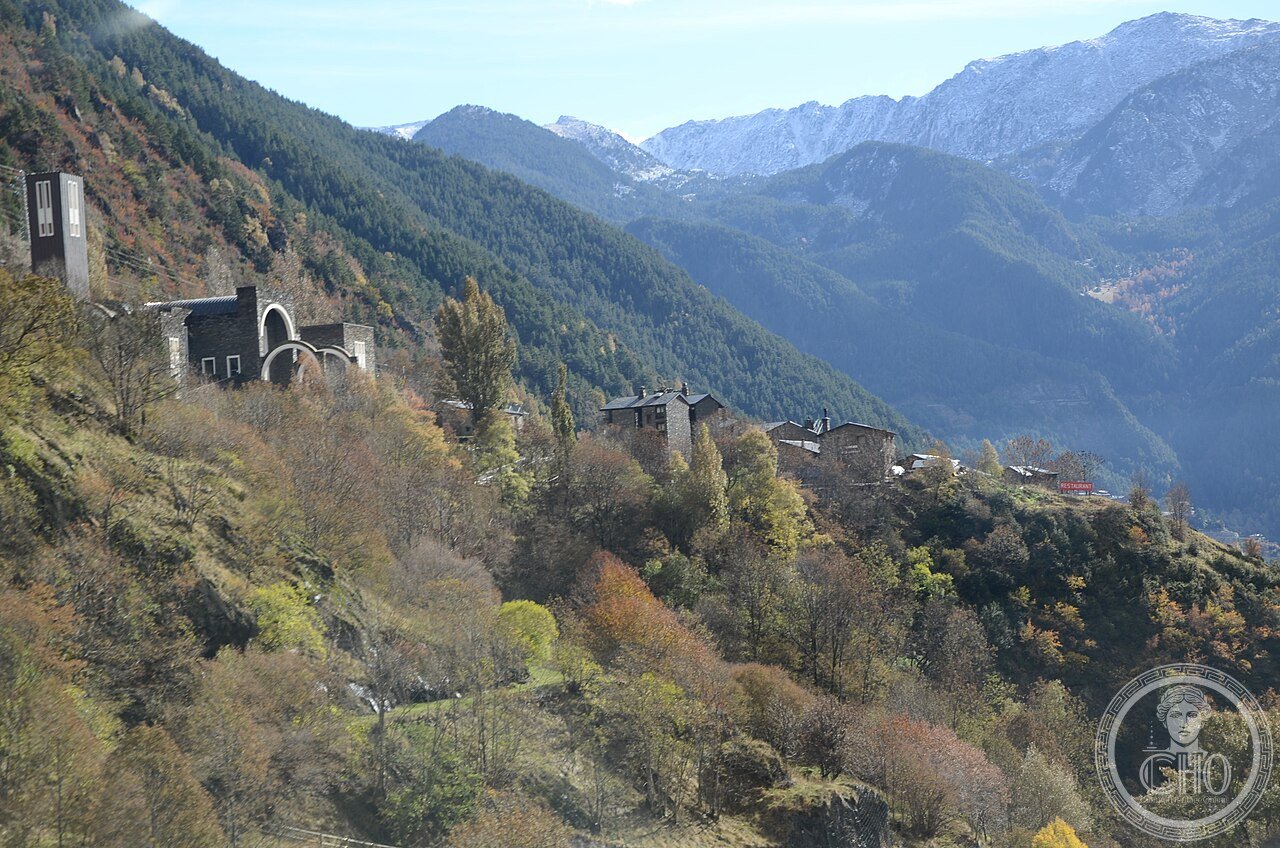
On 8 September 1921 the Romanesque statue of the Virgin of Meritxell, patroness of Andorra since 1873, was solemnly crowned by Pope Benedict XV. Exactly fifty-one years later, on 8 September 1972 — a day that is both the feast of the Virgin and the National Day of the Principality — a fire destroyed the original sanctuary and the statue itself. In its place rose a new basilica, designed by the architect Ricardo Bofill.
About Meritxell Sanctuary
According to tradition, villagers from Meritxell discovered a wild rosebush in bloom out of season on 6 January in the late 12th century; at its base they found a statue of the Virgin and Child. When the statue was moved to other churches, it reportedly returned each time to the same rosebush, a sign the community interpreted as a divine instruction to build a chapel on that exact spot — the origin of the Sanctuary of Our Lady of Meritxell. The original Romanesque statue, dated to the late 12th century, remained enshrined there for centuries; in 1873, the General Council of the Valleys of Andorra formally declared Our Lady of Meritxell patron saint of the country, and on 8 September 1921 the statue was solemnly and canonically crowned by Pope Benedict XV. Disaster struck on 8 September 1972 — the same calendar date as both the Virgin’s feast day and Andorra’s National Day — when a fire destroyed the chapel housing the statue, reducing both the original sanctuary and the centuries-old image itself to ruins. In response, the new Meritxell Basilica was designed in 1976 by the celebrated architect Ricardo Bofill’s Taller de Arquitectura, conceived as a modern reinterpretation of the Romanesque forms of the lost original, and completed in 1978; a replica of the destroyed statue was placed within the new building. The image of Our Lady of Meritxell remains embedded in Andorra’s national anthem, and in 2014 Pope Francis granted the sanctuary the title of Minor Basilica, making it the only church in the Principality to hold that distinction.
Key facts
- Late 12th century: legendary discovery of the Romanesque statue beneath a flowering rosebush
- 1873: Our Lady of Meritxell declared patron saint of Andorra
- 8 September 1921: statue canonically crowned by Pope Benedict XV
- 8 September 1972: fire destroys the original sanctuary and its historic statue, on the same date as the feast day and Andorra’s National Day
- 1976-1978: new basilica designed and built by Ricardo Bofill’s Taller de Arquitectura, reinterpreting the Romanesque original
- 2014: Pope Francis grants Minor Basilica status, the only one in Andorra
History
The coincidence of dates surrounding Meritxell’s 1972 fire — occurring on 8 September, the same calendar date as both Our Lady of Meritxell’s feast day and Andorra’s National Day, exactly 51 years after her formal 1921 coronation — gives the disaster a symbolic weight in Andorran national memory that a fire on any ordinary date would not have carried, permanently intertwining the loss of the country’s most sacred religious image with the very day set aside to celebrate national identity itself. Ricardo Bofill’s decision to design an explicitly modern reinterpretation of the lost Romanesque sanctuary, rather than an exact historical reconstruction, reflects a distinctly late-20th-century approach to rebuilding a destroyed national shrine — preserving symbolic continuity with the original architectural tradition while making no attempt to disguise the building’s contemporary origins.
The 2014 grant of Minor Basilica status by Pope Francis, making Meritxell the only church in Andorra to hold this rank, formalises at the highest level of Church recognition the sanctuary’s unique status as the country’s principal site of national religious devotion, a role the shrine has held in Andorran civic and religious life since well before its 1873 formal declaration as national patroness.
What you see
The new basilica, designed by Ricardo Bofill’s Taller de Arquitectura and completed in 1978, offers a contemporary reinterpretation of the Romanesque architectural forms present in the original sanctuary destroyed in 1972. Inside, a replica of the lost 12th-century statue of the Virgin and Child occupies the place of honour once held by the original. The sanctuary sits within the mountainous landscape of the Canillo parish, its modern silhouette a deliberate contrast with — and homage to — the Romanesque tradition it replaced.
Practical information
- Opening hours: generally open daily; check current hours before visiting; free admission
- Address: Santuari de Nostra Senyora de Meritxell, CS-230, el Forn, Meritxell, AD100 Canillo, Andorra
Getting there
Meritxell is reachable by car from Andorra la Vella (approximately 20 minutes) in the parish of Canillo. GPS: 42.5546° N, 1.5909° E.
Nearby
- Canillo — the parish in which the sanctuary stands
- Andorra la Vella — approximately 20 minutes away; the country’s capital
- Valira d’Orient valley — the surrounding mountain valley
Sources
- Wikipedia — “Our Lady of Meritxell” (en.wikipedia.org)
- VisitAndorra — “Sanctuary of Meritxell Basilica” (visitandorra.com)
- ArchitectureLab — “Meritxell Sanctuary Andorra / Ricardo Bofill” (architecturelab.net)
Find it on the map
See this place and what’s around it →📷 Become a Cultural Heritage Online photographer
Share your photos of places: they stay published under your name as the author. The more they're seen, the more you get noticed — and soon a contest will reward the most appreciated photos.
Log in or sign up free to add a photo