

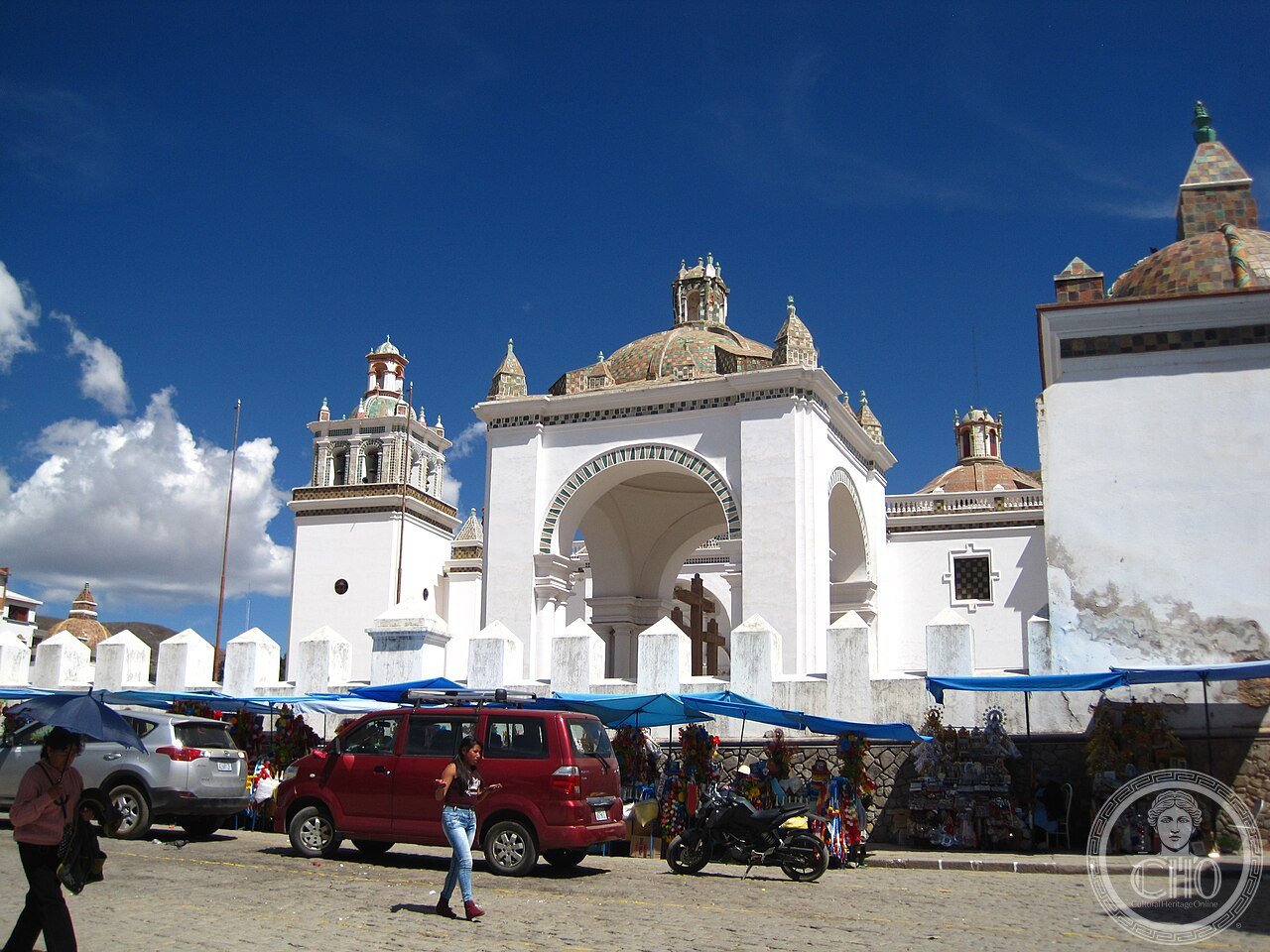
The Basilica of Our Lady of Copacabana, on the shore of Lake Titicaca in Bolivia, houses the venerated statue of the Virgin of Copacabana, popularly known as “La Virgen Morena” or “La Morenita del Lago”, carved in Potosí around 1582 by Francisco Tito Yupanqui, a self-taught Andean sculptor of Inca descent who insisted on giving the figure Indigenous features despite the local parish priest’s preference for a European-looking Virgin. Carved from maguey wood and standing roughly 53 centimetres tall, the statue was enthroned in the Copacabana church on 2 February 1583. The site’s religious significance long predates its Christian shrine. For the Tiwanaku and later the Aymara people, Copacabana served as a gateway to the Isla del Sol on Lake Titicaca, believed in Andean tradition to be the birthplace of the sun, and the shoreline held a temple associated with solar worship well before the arrival of Christianity. The present basilica building was constructed between 1669 and 1679 by the Spanish architect Francisco Jiménez de Sigüenza, its Renaissance structure decorated with Mudéjar-influenced tilework and glazed domes reflecting Spain’s own Moorish architectural heritage. In 1925, Pope Pius XI granted the image a canonical coronation and declared the Virgin of Copacabana patroness of Bolivia, and in 1940 Pope Pius XII elevated the shrine to the status of minor basilica. Devotion to the Virgin of Copacabana spread as far as Rio de Janeiro, where Portuguese-Brazilian sailors, having survived a storm they attributed to her intercession, built a small shrine to her on a beach then known as Sacopenapã. The beach subsequently took the name Copacabana from that shrine, giving the Bolivian sanctuary an unexpected legacy on one of the world’s most famous stretches of sand.
About the Basilica of Our Lady of Copacabana
The Basilica of Our Lady of Copacabana, on the shore of Lake Titicaca in Bolivia, houses the venerated statue of the Virgin of Copacabana, popularly known as “La Virgen Morena” or “La Morenita del Lago,” carved in Potosí around 1582 by Francisco Tito Yupanqui, a self-taught Andean sculptor of Inca descent who insisted on giving the figure Indigenous features despite the local parish priest’s preference for a European-looking Virgin. Carved from maguey wood and standing roughly 53 centimetres tall, the statue was enthroned in the Copacabana church on 2 February 1583. The site’s religious significance long predates its Christian shrine: for the Tiwanaku and later the Aymara people, Copacabana served as a gateway to the Isla del Sol on Lake Titicaca, believed in Andean tradition to be the birthplace of the sun, and the shoreline held a temple associated with solar worship well before the arrival of Christianity. The present basilica building was constructed between 1669 and 1679 by Spanish architect Francisco Jiménez de Sigüenza, its Renaissance structure decorated with Mudéjar-influenced tilework and glazed domes reflecting Spain’s own Moorish architectural heritage. In 1925, Pope Pius XI granted the image a canonical coronation and declared the Virgin of Copacabana patroness of Bolivia, and in 1940 Pope Pius XII elevated the shrine to the status of minor basilica. Devotion to the Virgin of Copacabana spread as far as Rio de Janeiro, where Portuguese-Brazilian sailors, having survived a storm they attributed to her intercession, built a small shrine to her on a beach then known as Sacopenapã — the beach subsequently took the name Copacabana from that shrine, giving the Bolivian sanctuary an unexpected legacy on one of the world’s most famous stretches of sand.
Key facts
- c. 1582-1583: the statue carved by Francisco Tito Yupanqui and enthroned on 2 February 1583.
- Pre-Christian significance: Copacabana as a gateway to the sacred Isla del Sol on Lake Titicaca.
- 1669-1679: present basilica built by Francisco Jiménez de Sigüenza.
- 1925: Pope Pius XI grants canonical coronation, names the Virgin patroness of Bolivia.
- 1940: Pope Pius XII elevates the shrine to minor basilica status.
- Legacy: gave its name to Copacabana Beach in Rio de Janeiro, Brazil.
History
The Basilica of Our Lady of Copacabana stands as one of the clearest examples of religious continuity and syncretism in the Andes, its Christian shrine rising on ground already sacred for centuries to the Tiwanaku and Aymara peoples as the threshold to Lake Titicaca’s most venerated sacred island. Francisco Tito Yupanqui’s insistence on carving an Indigenous-featured Virgin, against the wishes of the local parish clergy, gave the resulting image a distinctive identity that helped root Marian devotion in Andean cultural terms from its very origin, a devotion that expanded across the Spanish and Portuguese colonial world in the centuries that followed.
What you see
The basilica’s Renaissance structure, completed between 1669 and 1679, is topped by distinctive glazed tile domes reflecting Mudéjar architectural influence, with a whitewashed courtyard and facade framing the entrance to the sanctuary. Inside, the venerated statue of the Virgin of Copacabana, dressed in elaborate ceremonial robes, is displayed above the main altar, drawing pilgrims from across Bolivia and neighbouring countries.
Practical information
- Opening hours: generally open daily with seasonal variation; free admission; expect large crowds during the early-February pilgrimage feast.
- Address: Copacabana, La Paz Department, Bolivia.
Getting there
The Basilica of Our Lady of Copacabana stands in the town of Copacabana on the shore of Lake Titicaca, reachable by bus from La Paz. GPS: 16.1667° S, 69.0853° W.
Nearby
- Isla del Sol — the sacred island of Inca mythology, reachable by boat from Copacabana.
- Lake Titicaca — the high-altitude lake bordering the town.
- La Paz — Bolivia’s seat of government, a drive away.
Sources
- Wikipedia — “Basilica of Our Lady of Copacabana” (en.wikipedia.org).
- Wikipedia — “Francisco Tito Yupanqui” (en.wikipedia.org).
- The Culture Trip — “Why This World Famous Beach Stole Its Name From Its South American Neighbor” (theculturetrip.com).
Find it on the map
See this place and what’s around it →📷 Become a Cultural Heritage Online photographer
Share your photos of places: they stay published under your name as the author. The more they're seen, the more you get noticed — and soon a contest will reward the most appreciated photos.
Log in or sign up free to add a photo